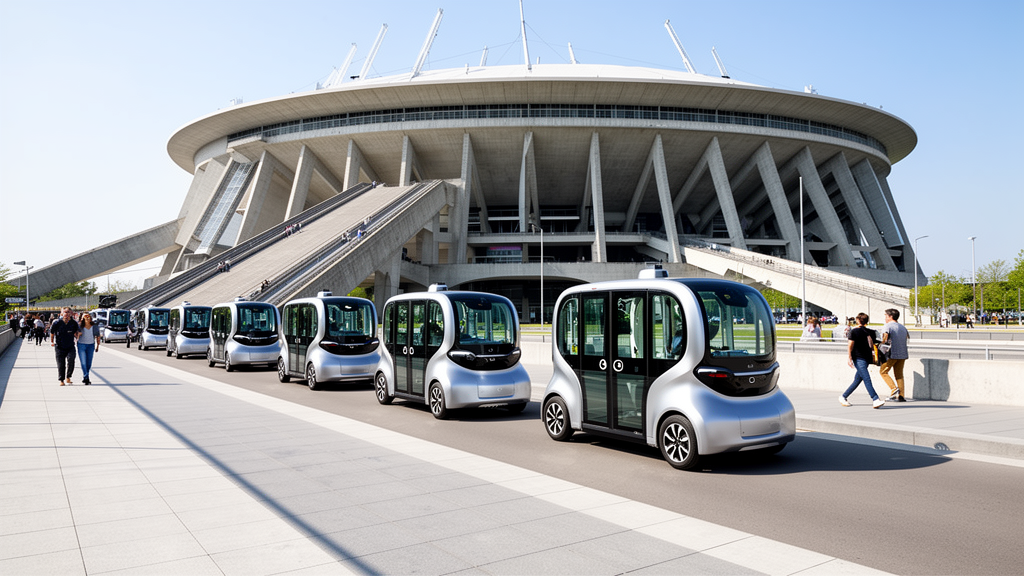
A discrete-time agent-based simulation study evaluating shared autonomous electric vehicle operations across Montreal Olympic Park indicates that a modest fleet of twenty vehicles can successfully satisfy visitor travel demand while maintaining a service performance rate of ninety percent or higher. Conducted by researchers Elena Golchin and Anjali Awasthi, the investigation analyzed one hundred and five distinct operational scenarios across varying customer arrival frequencies, vehicle battery capacities, and fleet configurations. The findings demonstrate that overall system performance and customer rejection rates are predominantly governed by fleet size and customer demand intensity, whereas vehicle battery range exerts a surprisingly negligible influence on service delivery in short-distance urban contexts. Furthermore, the modeling reveals an unexpected operational dynamic regarding parking infrastructure: reducing the number of designated parking spaces per station decreases the overall volume of rejected customers by prompting an automatic, decentralized vehicle redistribution mechanism, even though this physical constraint concurrently increases the total number of empty repositioning trips.
The study contextualizes this automated mobility service against the longstanding challenges of conventional urban transportation. While internal combustion engine vehicles historically transformed urban accessibility, they introduced pervasive issues including severe traffic congestion, greenhouse gas emissions, safety hazards stemming from human driver error, and excessive capital burdens, particularly since private automobiles remain parked and idle for more than ninety percent of their operating lifespans. Emerging automotive technologies, notably autonomous electric vehicles and shared fleet business models, offer potential pathways toward sustainable urban mobility. Electric powertrains eliminate tailpipe emissions, although their broader environmental efficacy depends upon regional electricity generation sources. Nevertheless, widespread electric adoption has faced persistent hurdles, such as restricted battery capacity, sparse charging infrastructure, prolonged recharging durations, and consumer range anxiety. Integrating automated driving systems into shared municipal fleets can mitigate these operational bottlenecks by removing individual charging responsibilities, lowering workforce overhead through driverless operations, facilitating robotic plug-in systems, and smoothing vehicular movements.
To investigate these system interactions within a geographically authentic environment, the researchers constructed a discrete-time stochastic agent-based model utilizing the NetLogo platform coupled with a geographic information systems extension. Unlike aggregate or deterministic analytical approaches that treat urban zones as abstract grid networks with boundless capacity, the simulation imported the actual street topology surrounding Montreal Olympic Park. Within this computational environment, street intersections are explicitly instantiated as network vertices that define allowable driving corridors and station coordinates. The temporal progression of the model is governed by discrete clock ticks, wherein forty-two ticks represent exactly one minute of operational time, calibrated to reflect a constant urban vehicle operating speed of thirty kilometers per hour. Moving agents continuously track their spatial coordinates across these vertices, confirming route compliance along shortest-path trajectories and validating physical movement patterns across the five square kilometer recreational zone without relying on artificial spatial abstractions.
The physical network comprises five strategically situated service stations designed to ensure comprehensive geographic coverage across Montreal Olympic Park. The first station is situated along Pierre-de Coubertin Avenue adjacent to the Viau metro terminal, while the second is positioned on Viau Street near the municipal Golf Complex. A third station is established on Rosemont Boulevard near the Frederic-Back Tree Pavilion, a fourth is located along Route 125 accessible via the Pie-IX metro station near the main entrance plaza, and a fifth station operates at the junction of Sherbrooke Street and the access road leading to the Montreal Insectarium. Customer arrivals at these five transit hubs follow an independent Bernoulli process with spatially uniform distribution. When a prospective passenger arrives, the system attempts to allocate an available vehicle stationed at that depot; if an operational vehicle is idling on site, the trip commences immediately toward a randomly designated destination station. If no vehicle is present, the traveler departs the network entirely to walk or take alternative transit, recording a rejected customer event.
Energy management within the autonomous fleet operates under explicit physical and operational rules reflecting realistic electric battery constraints. Rather than modeling fully electric long-range platforms, vehicle parameters were calibrated against hybrid specifications suited for localized urban hops. To prevent accelerated battery degradation and avoid the severe non-linear deceleration of charging rates observed above eighty percent capacity, usable battery storage is strictly bounded at eighty percent of total volume. Vehicles initiate daily service at this eighty percent maximum threshold, and recharging operations cease immediately once this cap is regained. Energy consumption updates instantaneously upon trip completion based on traveled distance and nominal range. The framework enforces a two-parameter threshold policy: when a vehicle completes a journey and its state of charge registers at or below a critical lower threshold theta, typically set at twenty percent of total capacity, it transitions into an unavailable charging state, remaining disconnected from passenger service until replenishing to the target eighty percent level.
Charging durations in the model scale proportionally with battery capacity, where a vehicle equipped with a thirty-kilometer operating range requires approximately one hundred and fifty minutes to achieve a full zero-to-one-hundred percent charge, with an additional thirty minutes added for each ten-kilometer increment in total range. However, drawing upon empirical findings from prior fleet literature showing that half of total charging duration is consumed restoring the final twenty percent of capacity, the NetLogo simulation incorporates only fifty percent of full recharge durations to reach the eighty percent operating ceiling. For standard thirty-kilometer vehicles, preliminary calibration revealed operational instability under lower thresholds, necessitating an adjusted critical state of charge cutoff of eight percent rather than six percent. Each individual parking berth across all stations is assumed to possess an active robotic charger, ensuring that any vehicle parked in an authorized stall can initiate battery replenishment if its reserve falls below the designated threshold.
A critical contribution of the research lies in its examination of an implicit semi-rebalancing mechanism driven purely by parking capacity limitations. In one-way ridesharing systems, asymmetric customer travel patterns routinely produce localized fleet deficits and surpluses, typically requiring centralized dispatch algorithms and dedicated personnel to tow or relocate idle vehicles. Because visitor trips within Montreal Olympic Park exhibit stochastic multi-directional patterns rather than rigid commuter corridors, the authors omitted centralized rebalancing. Instead, when a vehicle arrives at a destination station whose parking bays are fully occupied, the system redirects the autonomous vehicle along shortest paths to the nearest neighboring station exhibiting vacant capacity. This operational rule produces a counterintuitive outcome: restricting parking capacity compels vehicles to relocate dynamically, increasing uncrewed travel distance while naturally evening out spatial distribution, thereby reducing passenger rejection rates. Conversely, generous parking allocations permit vehicles to accumulate indefinitely at drop-off hubs, causing fleet clustering and sharp spikes in unserved demand.
To evaluate these systemic dynamics comprehensively, the investigators formulated a full factorial experimental matrix encompassing one hundred and five distinct simulation scenarios. Fleet size was systematically adjusted across seven configurations, varying from two to eight vehicles per station, yielding aggregate fleet sizes ranging between ten and forty vehicles. Battery ranges were evaluated across five discrete increments of thirty, forty, fifty, sixty, and seventy kilometers, while passenger demand was modeled across low, medium, and high arrival probabilities corresponding to zero point one, zero point two, and zero point five arrivals per minute. Each operational scenario was executed across one hundred independent Monte Carlo simulation replications over a ten-hour horizon representing peak weekend park operations, totaling twenty-five thousand two hundred discrete ticks per run. The computational model recorded primary output metrics, including total rejected customers, overall service performance percentage, empty relocation journeys, and battery depletion failures where charge dropped to zero.
Numerical results derived from the Monte Carlo experiments demonstrate that customer rejection rates decline in an approximately exponential trajectory as total fleet size expands, highlighting vehicle availability as the decisive factor in service quality. For instance, under high customer arrival rates of zero point five requests per minute, expanding the fleet from ten to twenty-five vehicles dramatically curbs service failures, leaving an average of eighteen point fifty-two rejected passengers over the ten-hour window. Under moderate and low demand settings of zero point two and zero point one arrivals per minute, a fleet of twenty vehicles restricts average rejections to six point seventy and two point ninety-two passengers, respectively. Throughout these trials, varying vehicle range from thirty to seventy kilometers produced virtually overlapping rejection curves, proving that battery size plays a negligible role in meeting short-distance park trips, except under isolated conditions characterized by severe vehicle shortages combined with peak passenger volumes.
The sensitivity analysis confirmed that fleet capacity serves as the dominant control lever governing system success, with minor vehicle additions between ten and twenty-five units generating the steepest performance gains. Conversely, vehicle range exhibited strong non-linear sensitivities regarding battery exhaustion risks, as configurations restricted to thirty or forty kilometers showed heightened vulnerability to operational disruption when demand surged. Robustness evaluations indicated that the autonomous network achieves consistent operational stability once total fleet size reaches thirty vehicles or more with battery ranges of at least fifty kilometers, particularly when arrival rates remain near zero point two per minute or lower. Furthermore, tracking vehicle charging frequencies revealed that across a full ten-hour operational shift, total recharging cycles across the entire fleet never exceeded thirty-five events, indicating that installing active charging infrastructure at every individual parking space represents redundant capital expenditure.
While the agent-based simulation provides concrete operational targets for municipal park deployment, the authors outline several structural limitations and avenues for future technical enhancement. The current NetLogo implementation omits external roadway congestion and variable traffic velocity, assuming uniform travel speeds along unobstructed shortest paths. Additionally, customer demand was parameterized as spatially uniform Bernoulli arrivals, leaving non-stationary surges and simultaneous origin requests unmodeled. Future iterations could incorporate real-time traffic flow dynamics, station-specific arrival rates, and dynamic fleet rebalancing algorithms that steer surplus vehicles toward stations with minimum occupancy rather than strictly nearest proximity. Expanding the computational framework to integrate comprehensive capital expenditure and operational maintenance costs will further empower urban planners to weigh infrastructure investments against service reliability when designing automated transit systems.
Subject of Research: Agent-based simulation of shared autonomous electric vehicle fleets
Article Title: Agent-based simulation of shared autonomous electric vehicle fleets: application to Montreal Olympic Park
Article References: Golchin, E., & Awasthi, A. (2026). Agent-based simulation of shared autonomous electric vehicle fleets: application to Montreal Olympic Park. Management System Engineering, 5(1), Article 21. https://doi.org/10.1007/s44176-026-00077-2
Image Credits: AI Generated
DOI: 10.1007/s44176-026-00077-2
Keywords: shared autonomous electric vehicles, agent-based modeling, Montreal Olympic Park, NetLogo, fleet sizing, urban mobility, charging infrastructure, state of charge, semi-rebalancing, Monte Carlo simulation, parking capacity, vehicle range, service level, stochastic demand, micro-transit, GIS road network
News Source: Denise Maddox. (November 16, 2026). Simulation Shows Small Autonomous Electric Fleet Meets Montreal Olympic Park Demand. Scienmag.