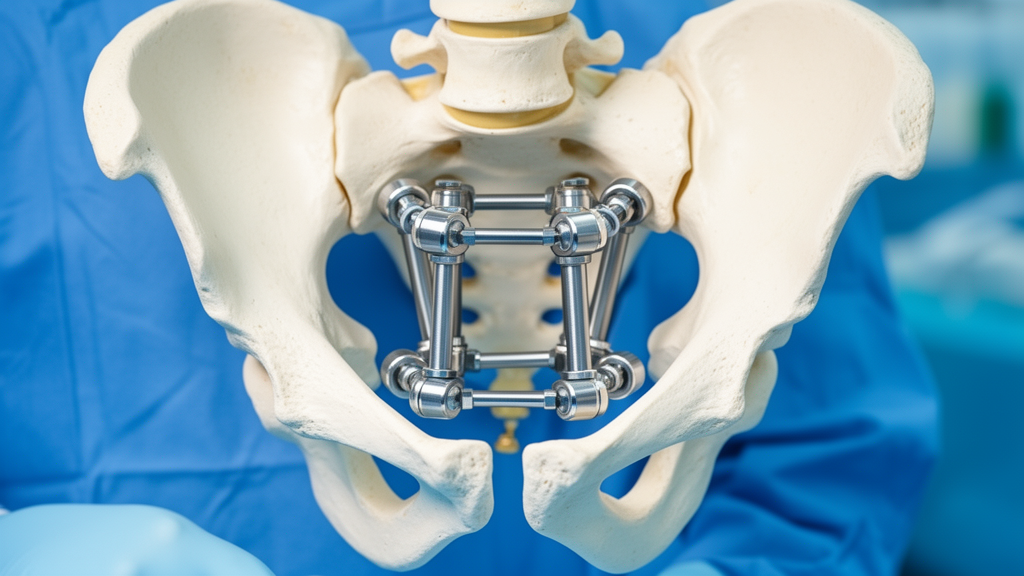
Cementless conversion to total hip arthroplasty using a standardised four-pillar reconstructive framework demonstrated favourable preliminary clinical and radiological outcomes in older patients whose subtrochanteric fracture fixations had failed, according to a retrospective case series. The study evaluated patients over sixty years of age who required complex hip reconstruction after initial surgical stabilization with an intramedullary nail had broken down or failed.
The research team, led by G. Solarino and colleagues, described the structured four-pillar approach to address the substantial anatomical and biomechanical challenges associated with salvage hip arthroplasty. The reconstructive framework systematically targets four predefined surgical domains: establishing stable distal axial and rotational fixation, ensuring joint stability, reconstructing the trochanteric-abductor complex, and either preserving or restoring medial cortical support along the proximal femur.
The retrospective review evaluated patients who underwent cementless conversion total hip arthroplasty under this protocol between January 2017 and December 2024. The final outcome-analysis cohort comprised fifteen patients with a mean age of 72.7 years and a standard deviation of 4.0 years. Following surgery, the cohort had a mean follow-up period of 23.7 months, with a median duration of 24 months, an interquartile range extending from 18 to 30 months, and an overall range between 12 and 36 months.
During the operative interventions, surgeons utilized a trochanteric grip plate across all fifteen patients to assist in stabilizing the abductor mechanism. Additionally, in nine of the fifteen patients where intraoperative documentation identified a relevant medial or anteromedial cortical deficiency, surgical teams placed a tibial cortical strut allograft to restore mechanical support. Operative records indicated that the procedures required a mean surgical time of 101 minutes, with a standard deviation of 30.5 minutes.
Following surgical intervention, patients achieved full weight-bearing at a mean time of 6.8 weeks, with a standard deviation of 1.2 weeks. Patient-reported functional recovery and pain alleviation showed marked progress across the follow-up window. The cohort’s mean Harris Hip Score improved substantially, rising from a preoperative baseline of 42 points with a standard deviation of 9 points to a postoperative score of 80 points with a standard deviation of 7 points.
Pain scores measured via a visual analogue scale demonstrated a corresponding reduction, dropping from a preoperative mean of 8.0 with a standard deviation of 0.8 down to a postoperative mean of 2.0 with a standard deviation of 0.8. On serial radiographic evaluations, investigators assessed femoral stem fixation, subtrochanteric healing, and cortical strut allograft behaviour. Across serial imaging, no femoral stem exhibited progressive radiolucent lines or clinically relevant subsidence, defined by investigators as migration exceeding 5 millimetres.
Postoperative monitoring identified three complications within the study cohort. One major complication occurred in the form of a pulmonary embolism that necessitated temporary admission to an intensive care unit, alongside two recorded minor complications. Despite these events, none of the fifteen patients included in the final outcome-analysis cohort required reoperation or revision surgery during the available follow-up period.
The investigators classified the study as Level IV evidence under the Oxford Centre for Evidence-Based Medicine 2011 criteria, emphasizing that its findings stem from a retrospective case series with limited sample size. They concluded that while the standardised four-pillar construct yielded favourable early results for salvage arthroplasty, larger prospective comparative studies with longer follow-up durations remain necessary to definitively confirm whether the framework provides measurable advantages over alternative surgical reconstructive strategies.
Subject of Research: Conversion total hip arthroplasty using a four-pillar reconstructive framework after failed subtrochanteric fracture fixation
Article Title: The ‘four-pillar’ construct for failed subtrochanteric osteosynthesis: a standardised reconstructive framework and preliminary clinical and radiological outcomes
Article References: Solarino, G., Loiodice, M., Scarpino, A., Ficele, M., Vitale, I., Carrozzo, M., & Vicenti, G. (2026). The ‘four-pillar’ construct for failed subtrochanteric osteosynthesis: a standardised reconstructive framework and preliminary clinical and radiological outcomes. Journal of Orthopaedics and Traumatology. https://doi.org/10.1186/s10195-026-00980-0
Image Credits: AI Generated
DOI: 10.1186/s10195-026-00980-0
Keywords: conversion total hip arthroplasty, four-pillar reconstructive framework, subtrochanteric fracture fixation, intramedullary nail failure, trochanteric grip plate, tibial cortical strut allograft, Harris Hip Score, visual analogue scale, stem subsidence, trochanteric-abductor complex, medial cortical support, distal axial fixation, rotational fixation, joint stability, orthopaedic revision surgery, level IV evidence
News Source: Ophelia Keating. (November 16, 2026). Four-Pillar Framework Shows Early Success in Conversion Hip Arthroplasty After Failed Fixation. Scienmag.