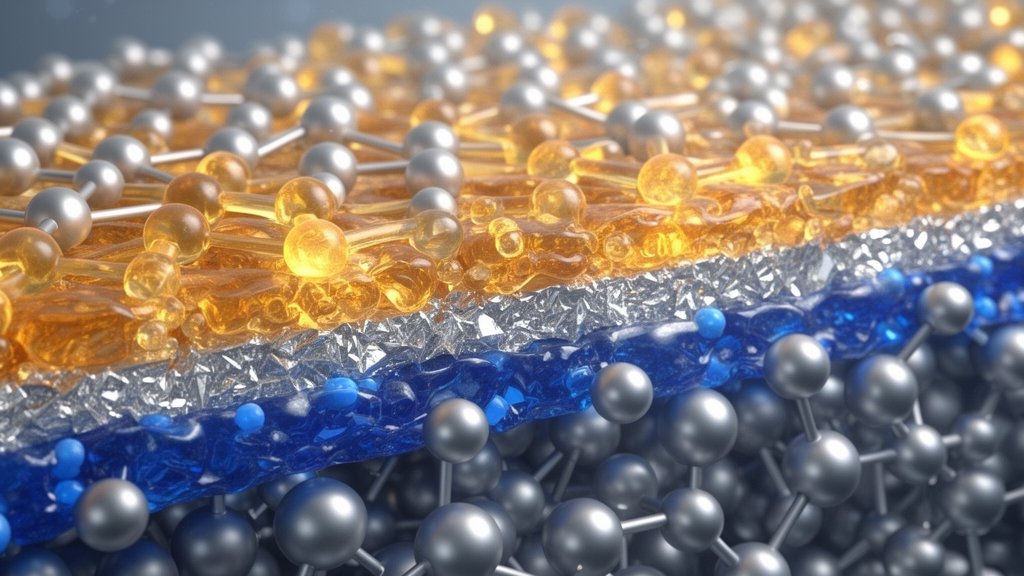
Computational researchers have fine-tuned a machine learning foundation model to accurately simulate the initial formation and degradation reactions of the solid-electrolyte interphase occurring at the contact boundary between lithium metal anodes and carbonate-based liquid electrolytes. Lithium metal anodes have drawn substantial research interest because of their high theoretical specific capacity of 3860 milliampere-hours per gram and low electrochemical potential of minus 3.04 volts with respect to the standard hydrogen electrode. Despite these advantages, practical deployment in commercial devices has been restricted by lithium dendrite growth and continuous electrolyte degradation, which raise concerns regarding internal short circuits, thermal runaway, and potential cell explosions. Designing a stable, electronically insulating, and ionically conducting interphase layer is considered essential to suppress parasitic chemical decomposition reactions while mitigating uneven morphology evolution during battery operation.
Simulating interface chemical dynamics at the quantum mechanical level has long posed a significant computational bottleneck for battery research. While ab initio density functional theory delivers high physical accuracy, the associated computational cost typically restricts molecular dynamics trajectories to small atomic systems of small sizes and simulation durations limited to between 1 and 10 picoseconds. Semi-empirical schemes like density functional tight binding reduce computational overhead but rely on extensive parameter calibrations that lack general transferability, while traditional empirical force fields fail to capture bond formation and rupture during complex interface reactions. To overcome these limitations, the research team employed the MACE-MP-0 foundation model, an equivariant machine learning interatomic potential pre-trained on the Materials Project trajectory dataset, adapting it through a targeted fine-tuning framework to achieve quantum-level predictive precision across extended interfaces.
The training workflow utilized an iterative fine-tuning scheme spanning four successive revisions designated R1 through R4 to systematically expand physical configuration space without catastrophic forgetting. The researchers first conducted molecular dynamics runs on bulk liquid electrolyte using MACE-MP-0 augmented with Grimme D3 dispersion corrections, fine-tuning the base potential against energy and force evaluations performed with the linear-scaling ONETEP density functional theory code to produce the R1 model. Subsequent training stages incorporated structures of electrolyte molecules adsorbed onto lithium metal surfaces to yield revision R2, followed by pristine lithium slab interfaces in contact with bulk electrolyte to train revision R3. The final R4 generation incorporated model protective inorganic coatings situated between the lithium slab and the liquid electrolyte, resulting in a comprehensive dataset designed for scalable interface modeling.
Reference quantum mechanical calculations were performed using the ONETEP program with periodic psinc basis functions at a kinetic energy cut-off of 1000 electronvolts and non-orthogonal generalized Wannier functions with a localization radius of 9.0 Bohr radii. The calculations utilized the Perdew-Burke-Ernzerhof generalized gradient approximation exchange-correlation functional without additional dispersion corrections, using norm-conserving pseudopotentials from the PseudoDojo library. The structural training set comprised 517 representative configurations sampled across temperatures ranging from 150 Kelvin to 350 Kelvin using constant pressure or constant volume thermostats to capture diverse bond configurations while preventing electrolyte evaporation. The MACE-MP-0 architecture was fine-tuned for 50 epochs using multi-head replay alongside 131331 structures from the Materials Project repository, enabling the model to learn multiple reference calculation outputs simultaneously without degrading prior knowledge.
Validation on an independent hold-out test set demonstrated substantial improvements in predictive accuracy following fine-tuning. For bulk electrolyte configurations, the baseline out-of-the-box MACE-MP-0 potential exhibited a force root mean square error of 0.251 electronvolts per angstrom, reflecting a wide scatter when benchmarked directly against reference quantum calculations. In contrast, the fine-tuned MACE-MP-0-R4 potential achieved a force root mean square error of 52 millielectronvolts per angstrom on hold-out electrolyte structures, bringing force errors within standard thresholds considered accurate for density functional theory. Hold-out evaluations across electrolyte, adsorbate, and interface domains demonstrated force errors between 38 and 67 millielectronvolts per angstrom for models trained on corresponding systems, whereas un-tuned baseline evaluations exhibited wider errors when extrapolating across chemically complex interfaces.
Using the fine-tuned R4 potential within the LAMMPS molecular dynamics package, the researchers performed nanosecond-scale simulations on pristine lithium metal slabs in contact with standard LP57 liquid electrolyte, consisting of 1 molar lithium hexafluorophosphate dissolved in a ethylene carbonate and ethyl methyl carbonate mixture at a three-to-seven volume ratio. Following fixed-volume geometry optimization and 50 picoseconds of constant pressure equilibration, production runs were conducted for 1 nanosecond at constant volume across temperatures of 300, 350, 400, and 450 Kelvin. At lower temperatures between 300 and 350 Kelvin, the bulk of the lithium metal slab preserved its crystalline body-centered cubic arrangement while structural disordering initiated at the boundary with the liquid electrolyte. At elevated temperatures of 400 and 450 Kelvin, extensive disorder developed across the metallic slab, accompanied by vigorous chemical reactions that rapidly degraded the surrounding electrolyte.
Chemical reaction tracking revealed that unpassivated metallic lithium directly reduced both the solvent and the salt species, producing breakdown products consistent with experimentally observed solid-electrolyte interphase compositions. Lithium reacted with hexafluorophosphate anions to yield fluoride-containing species, while simultaneous reduction of ethyl methyl carbonate generated lithium carbonate alongside methyl and ethyl free radicals. Ethylene carbonate molecules underwent two-electron reduction to yield solid lithium carbonate and gaseous ethylene. Large-scale electronic structure calculations conducted on molecular dynamics snapshot geometries using the ONETEP program verified that solvent reduction was driven by direct electron transfer from the anode. Computed Mulliken charges showed that neutral metallic lithium atoms inside the electrode transferred charge upon displacement into the electrolyte, adopting positive ionic oxidation states close to plus one while carbon and oxygen atoms accepted electron density.
To investigate artificial passivation strategies, the team simulated five-layer model inorganic coatings of lithium fluoride, lithium hydroxide, lithium oxide, and lithium carbonate oriented along both the 100 and 111 crystallographic planes. The presence of these inorganic layers markedly reduced electrolyte decomposition compared to the bare metallic slab, with 100 oriented coatings exhibiting superior mechanical and chemical stability relative to their 111 counterparts. Specifically, the lithium fluoride 100 coating maintained complete structural and chemical integrity across the full 1 nanosecond trajectory even at 450 Kelvin, entirely preventing solvent and salt reduction reactions. In contrast, the 111 lithium fluoride coating underwent partial crystalline breakdown, allowing lithium from the coating to interact directly with electrolyte molecules. Similarly, lithium hydroxide and lithium carbonate coatings transitioned from crystalline to amorphous structures, with the 111 orientations experiencing pronounced structural disintegration and accelerated interfacial reactions at higher temperatures.
Electronic density of states evaluations performed on snapshot configurations of a lithium oxide 100 coating confirmed the physical mechanism governing surface passivation. While the metallic lithium anode exhibited a finite electronic density of states at the Fermi level characteristic of a conductor, the constituent lithium and oxygen atoms within the bulk lithium oxide coating showed a near-zero density of states at the Fermi level, indicating strong electronic insulation. Likewise, the adjacent liquid electrolyte displayed a distinct band gap at the Fermi level. However, projected electronic structure analysis revealed that residual electron transfer can still originate from under-coordinated surface sites on less stable or disordered coatings, which facilitates local reduction of solvent molecules whenever structural degradation exposes reactive surface lithium.
The study also quantified lithium transport kinetics by extracting self-diffusion coefficients across the metal, protective coating, and electrolyte domains from ensemble-averaged mean-squared-displacement trajectories. Computed lithium self-diffusion coefficients within the inorganic coatings spanned from 10 to the minus 7 to 10 to the minus 5 square centimeters per second across the investigated temperature range. Comparisons with literature data indicated that the simulated diffusion values generally fell between activation regimes predicted for isolated vacancy hopping and collective knock-off diffusion mechanisms, exhibiting gentler Arrhenius slopes indicative of lower effective activation energies. Crucially, the simulations demonstrated an inherent trade-off in interphase engineering: protective coatings that exhibited the highest structural stability and chemical passivation, most notably lithium fluoride 100, simultaneously imposed the strongest resistance to lithium self-diffusion.
The authors highlighted several methodological boundaries inherent to the computational framework, noting that machine learning potentials fundamentally mirror the systematic errors of their underlying quantum mechanical training data. Because the training configurations were generated using the Perdew-Burke-Ernzerhof functional, known limitations such as self-interaction errors, underestimated surface adsorption energies, and inadequate descriptions of van der Waals interactions persist within the fitted model despite empirical dispersion corrections. Furthermore, the 1 nanosecond trajectories and simulation cell sizes containing 1500 to 2000 atoms represented pristine, defect-free interfaces, excluding extended meso-scale defects such as grain boundaries, point vacancies, and morphological voids that mediate ion conduction in realistic batteries. The researchers concluded that future investigations must integrate larger-scale multi-scale techniques to capture non-uniform interphase morphology while balancing electronic insulation against rapid ionic transport.
Subject of Research: Atomistic machine learning simulations of the solid-electrolyte interphase in lithium metal batteries
Article Title: Towards atomistic simulations of the SEI in Li metal batteries
Article References: Hernández-Melián, A., Bhandari, A., Björklund, E., Phelan, C. M. E., Swallow, J. E. N., Weatherup, R. S., Grey, C. P., Goodwin, Z. A. H., & Skylaris, C.-K. (2026). Towards atomistic simulations of the SEI in Li metal batteries. Journal of Materials Science: Materials Theory, 10(1), Article 27. https://doi.org/10.1186/s41313-026-00092-6
Image Credits: AI Generated
DOI: 10.1186/s41313-026-00092-6
Keywords: Lithium metal batteries, Solid-electrolyte interphase, Machine learning force fields, MACE-MP-0, Molecular dynamics, Density functional theory, ONETEP, Lithium fluoride, Lithium oxide, Lithium carbonate, Electrolyte degradation, Self-diffusion coefficient, LAMMPS, LP57 electrolyte, Interfacial stability, Battery degradation
News Source: Blake Davidson. (November 16, 2026). Machine Learning Model Simulates Solid Electrolyte Interphase Reactions in Lithium Batteries. Scienmag.