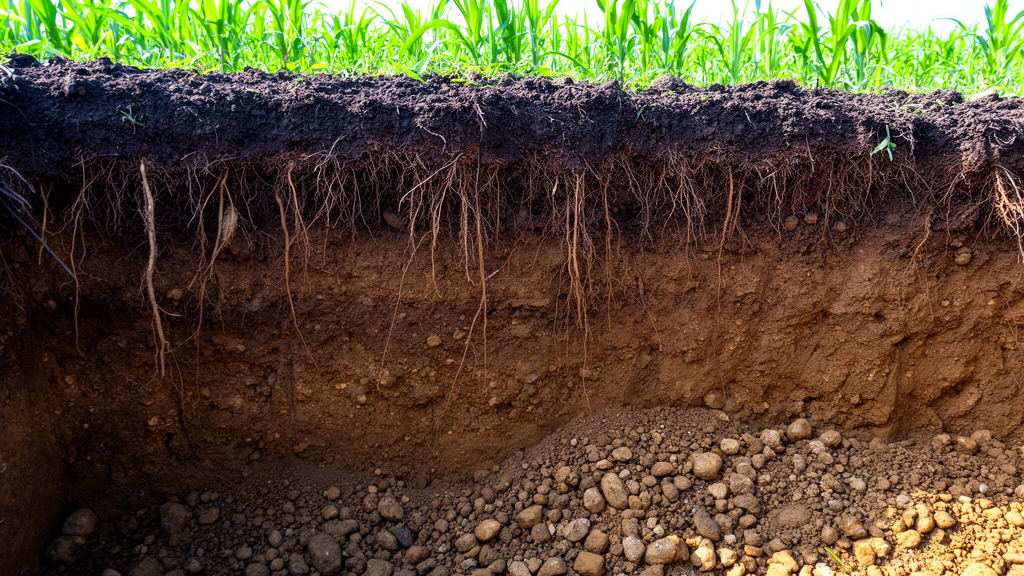
Deep soil layers below standard agricultural sampling depths store over 850 petagrams of organic carbon worldwide, representing approximately 50 to 60 percent of the total carbon stock present in the top meter of the earth’s soils, according to a comprehensive global synthesis published in Carbon Research. While conventional soil monitoring and carbon offset markets in nations like Australia routinely restrict measurement to the surface layer of zero to thirty centimeters, this operational standard captures primarily short-term management shifts while overlooking massive subterranean reservoirs. The comprehensive review, led by Nanthi Bolan and an international research team, systematically evaluated more than 2,900 peer-reviewed studies to clarify how carbon moves into deeper horizons, the physical and chemical bonds that allow it to persist across thousands of years, and the agronomic interventions capable of either protecting or inadvertently destabilizing this vast terrestrial pool.
The synthesis clarifies that the vertical distribution of soil organic matter shifts fundamentally between shallow and deep horizons due to differing geochemical drivers. Whereas surface carbon is governed predominantly by dynamic interactions between overlying vegetation communities and local climate, carbon situated in deeper strata is tied to inherent soil matrix characteristics, notably clay content, mineralogy, and profile development. Global soil accounts for approximately 1550 petagrams of carbon, constituting the largest terrestrial sink and exceeding the carbon held within living plant biomass by roughly threefold. Because deeper strata maintain lower temperatures, reduced oxygen availability, and diminished microbial population densities, the turnover rate of subsoil carbon slows dramatically. Radiocarbon investigations confirm that the mean residence time of deep organic matter spans 2,000 to 10,000 years, establishing subsoils as critical stabilization zones rather than inert substrates.
Translocation of carbon into these deep reserves proceeds through both endogenous biological pathways and exogenous additions via specific transport mechanisms. Endogenous inputs originate largely from the fine roots, structural turnover, and exudation of deep-rooted perennial grasses, shrubs, and trees, alongside the downward transport of dissolved organic carbon through leaching and preferential flow paths. Macropores created by desiccation cracks and biopores constructed by earthworms, termites, and burrowing mesofauna allow fresh organic matter to move rapidly past the surface matrix. Additionally, exogenous organic amendments such as manures, composts, and biosolids reach subsoils either through slow colloidal filtration or direct mechanical incorporation. In certain specialized subsoil interventions, placing granulated or chopped cereal straw at depths between twenty-five and forty centimeters elevated subsoil organic carbon levels by 11 to 57 percent across trial periods lasting three to four years, sequestering up to 18 megagrams of carbon per hectare.
The long-term preservation of deep organic carbon depends upon specific physical and geochemical mechanisms that shield molecules from enzymatic decomposition. Foremost among these is association with reactive mineral surfaces, notably phyllosilicate clays and amorphous iron and aluminum oxides and hydroxides, which create organo-mineral complexes that hold organic matter in place. Microscopic physical occlusion within tight soil microaggregates and isolation within narrow pores similarly isolate complex substrates from soil microbes. Chemical conditions within the profile exert secondary control: neutral to slightly alkaline pH levels and elevated cation exchange capacity foster electrostatic bonding and reduce organic compound solubility, while acidic conditions promote dissolved organic carbon mobility. Conversely, in peatlands and saturated wetlands, preservation relies on persistent waterlogging that maintains anoxic conditions and inhibits native microbial decomposition.
Despite its remarkable age and geological stability, deep soil carbon is not impervious to disturbance and displays acute sensitivity to environmental alterations. The review highlights that the introduction of fresh, labile carbon compounds—such as uncomplexed root exudates or soluble plant debris—into deep horizons can stimulate dormant microbial populations, inducing positive priming effects that accelerate the mineralization of centuries-old recalcitrant carbon. Physical perturbations such as deep tillage, subsoil mixing, and agricultural drainage can shatter protective microaggregates, expose previously occluded organic matter to atmospheric oxygen, and induce rapid carbon losses. Furthermore, shifting hydrological conditions that cause iron reduction or alterations in profile chemistry can dissolve organo-mineral complexes, liberating bound carbon back into active cycling and releasing carbon dioxide to the atmosphere.
Projected climatic changes pose substantial risks to subterranean carbon reservoirs by altering subterranean thermal and hydrological dynamics. Whole-profile warming projections indicate that subsoils could warm at rates matching surface soils, with potential increases reaching 4.5 degrees Celsius by the year 2100 under high-emission scenarios. Elevating temperatures accelerate microbial extracellular enzyme kinetics and lower microbial carbon use efficiency, potentially transforming subsoil sinks into net atmospheric carbon sources. Long-term whole-profile heating experiments in temperate forest soils demonstrated a 30 percent increase in total soil respiration alongside a 33 percent reduction in subsoil carbon below twenty centimeters, predominantly driven by the loss of particulate organic matter. However, the temperature sensitivity of subsoil respiration varies widely across ecosystems, showing high vulnerability in coarse granitic soils rich in particulate carbon but notable resistance in weathered tropical Andisols rich in reactive, poorly crystalline minerals.
Mechanical and agronomic strategies aimed at deliberately storing carbon in subsoils present intricate trade-offs between physical placement and unintended destabilization. Deep soil inversion and deep ploughing to depths between 55 and 90 centimeters have been shown in specific European field chronosequences to raise total profile carbon stocks by 67 to 69 percent over multi-decade intervals of 20 to 48 years, achieving sequestration rates near 9 megagrams of carbon per hectare annually. This preservation is attributed to placing topsoil in oxygen-depleted, microbe-sparse subsoil horizons rich in unsaturated mineral surfaces. Nevertheless, parallel long-term trials indicate that inverted subsoils can suffer net carbon depletion of 15 to 36 percent compared to original baselines, demonstrating that mechanical inversion carries severe risks of carbon release if local pedological conditions and mineral binding capacities are unfavorable.
Targeted chemical amendments, mineral supplements, and engineered sorbents represent another avenue under intense scientific evaluation for stabilizing subsoil organic matter. Laboratory investigations demonstrate that associating dissolved organic compounds with iron hydroxides drastically limits biodegradation, resulting in less than 0.5 percent decomposition of iron-bound glucose compared to free compounds in deep subsoil environments. Similarly, applying clay minerals to coarse-textured, sandy subsoils introduces reactive surface areas capable of binding vulnerable dissolved carbon fractions. The synthesis also documents emerging interventions utilizing biochar burial below thirty centimeters, where biochar’s highly condensed aromatic structure resists microbial degradation, showing less than 3 percent decomposition over its initial years. However, the authors caution that field-scale evidence remains sparse, and wide-scale application requires rigorous evaluation of energy inputs, sourcing sustainability, and economic feasibility.
Biological approaches, centered on breeding crop cultivars with deeper, more expansive root systems and perennializing cropping rotations, offer non-invasive methods to increase deep carbon storage. Perennial grasses and agroforestry systems sustain extensive root architecture, depositing recalcitrant biopolymers such as suberin and lignin into subsoil horizons where natural degradation rates are inherently suppressed. Genomic interventions, including the expression of the Deeper Rooting 1 gene in rice, have successfully doubled root penetration depth and subsoil biomass. Concurrently, symbiotic soil organisms, particularly arbuscular mycorrhizal fungi, foster aggregation through the exudation of glomalin-related proteins and the accumulation of recalcitrant fungal necromass. Converting annual cropping systems to perennial vegetation over two-decade periods has been observed to increase rooting depth by 11 percent down to one meter, generating sustained annual carbon gains throughout the deeper profile.
The authors conclude that integrating subsoil carbon into international greenhouse gas accounting frameworks and agricultural land management is imperative for genuine climate change mitigation. Realizing this potential demands a transition from shallow, short-term soil monitoring toward comprehensive, globally coordinated field sampling extending beyond one meter across diverse pedoclimatic gradients. Critical research priorities highlighted by the synthesis include developing composite amendments like mineral-integrated biochars, mapping regional subsoil mineral reactivity, conducting life-cycle and techno-economic assessments of subsoil modifications, and tracking the delicate balance between microbial necromass stabilization and priming-induced carbon release under shifting climatic regimes.
Subject of Research: Deep soil organic carbon distribution, stabilization mechanisms, and agricultural management strategies
Article Title: Sources, distribution, stability and management of deep soil carbon in agricultural systems
Article References: Bolan, N., Kumar, M., Gupta, J., Rao, C. S., Hou, D., Huang, C., Bolan, S., Chandana, M., Jagadesh, M., Mukherjee, S., Chadalavada, S., Kirkham, M. B., & Siddique, K. H. M. (2026). Sources, distribution, stability and management of deep soil carbon in agricultural systems. Carbon Research, 5(1), Article 30. https://doi.org/10.1007/s44246-026-00270-8
Image Credits: AI Generated
DOI: 10.1007/s44246-026-00270-8
Keywords: soil organic carbon, deep soil carbon, carbon sequestration, mineral-associated organic matter, soil health, subsoil management, priming effect, climate change mitigation, dissolved organic carbon, soil aggregates, deep tillage, deep rooting crops, biochar, soil organic matter, organo-mineral complexes, bioturbation
News Source: Bethany Barker. (November 16, 2026). Subsoil Horizons Store Most Soil Carbon but Face Vulnerability Under Management. Scienmag.