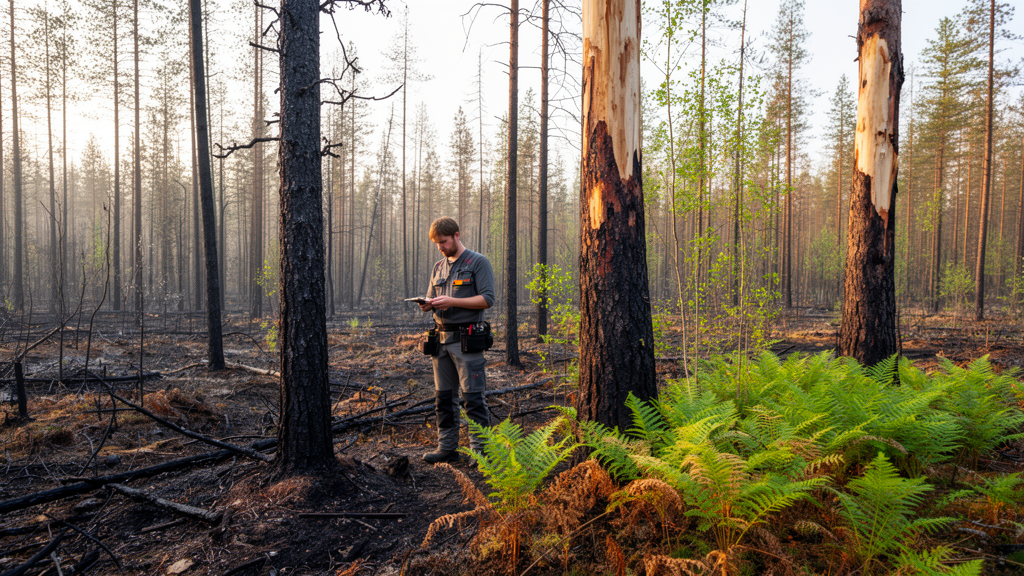
In boreal forest ecosystems where climate warming drives more severe and extensive wildfire seasons, public policy faces an urgent question regarding how burnt landscapes should be managed after flames subside. A survey experiment conducted in Gävleborg county in central Sweden—an area heavily impacted by severe 2018 wildfires—reveals that more than ninety percent of respondents reject the country’s prevailing practice of post-fire clear-cutting. Instead, over seventy percent favored selective felling of dead trees, while others preferred leaving burnt forests untouched for natural ecological succession. Furthermore, the investigation demonstrated that providing citizens and forest owners with targeted scientific information detailing the socio-ecological consequences of management choices significantly increases support for less intensive post-fire interventions. By examining responses across private landowners and the wider public, the research underscores an unexpected societal alignment: even among private forest owners bearing immediate financial risks, heavy salvage-logging is far less favored than ecologically minded retention forestry.
However, exceptional drought conditions in 2014 and 2018 sparked unprecedented fires across central Sweden, exposing vulnerabilities in traditional management assumptions and prompting national debate over post-fire recovery strategies. Sweden presents an instructive socio-ecological case because ownership of productive forest land is divided almost equally between commercial corporations or the state and private individual or family owners.
To examine how competing stakeholder priorities interact after natural disturbances, researchers evaluated three real-world management options currently applied across fire-affected Swedish stands. The second option is selective felling, a closer-to-nature silvicultural technique where harvesters extract only severely scorched patches where most trees were killed, intentionally retaining living and partially damaged trees to preserve structural diversity. The third option is passive restoration, wherein all burnt and surviving trees remain standing to facilitate unassisted natural succession, an approach applied when damaged parcels become formal nature reserves. The investigators hypothesized that private forest owners would prioritize commercial salvage-logging to minimize short-term capital losses while non-owners would favor reduced intervention, and that scientific evidence regarding ecological outcomes would nudge both groups toward less intensive harvesting.
The empirical design grounded its informational interventions in established ecological evidence regarding forest carbon budgets, which fluctuate dramatically depending on fire severity and subsequent timber logging. In low-severity burns, fire sweeps through surface litter and dwarf shrubs without killing dominant tree crowns of resistant species like Scots pine (Pinus sylvestris). Because the canopy survives and photosynthetic carbon uptake continues, these stands frequently remain close to carbon neutral or quickly transition back into net carbon sinks within years following disturbance. However, when operators salvage-log living, partially scorched trees after low-severity burns, the stand is converted into a net carbon source for several years because microbial decomposition in the soil outpaces vegetative assimilation. Conversely, after high-severity fires where tree canopies are destroyed and tree mortality approaches one hundred percent, stands inevitably become substantial carbon sources regardless of timber harvesting, taking at least a decade of vegetative regrowth before regaining net carbon sink capacity.
Beyond carbon dynamics, the study detailed the pronounced ramifications of post-fire salvage operations on forest biodiversity and subterranean soil integrity. Synthesizing prior ecological meta-analyses, researchers highlighted that salvage-logging significantly suppresses the population abundance of eight out of twenty-four major species groups, with deadwood-dependent organisms suffering the most severe declines. Simultaneously, mechanical salvage operations inflict acute compounding damages on vulnerable post-fire soils. High-severity combustion consumes the protective organic soil mantle, depleting microbial biomass and reducing accessible nutrient reserves.
To ground their experimental scenarios in practical economic realities, researchers conducted semi-structured interviews with operational forestry experts, including representatives from regional forest agencies, landowner associations, and commercial timber insurers. These practitioner consultations confirmed that the vast majority of stands burnt during the 2018 Ljusdal fires suffered low-severity surface burns rather than catastrophic stand replacement. Timber salvaged from scorched stands suffered modest commercial price reductions, primarily caused by charcoal contamination that poses operational difficulties for sawmills, though government aid programs compensated owners at roughly 300 to 350 Swedish kronor per cubic meter, covering approximately half the pre-fire timber valuation. Replanting and reseeding mechanized operations were estimated between 12,000 and 15,000 Swedish kronor per hectare, with costs escalating where difficult terrain demanded manual planting or resilient seedlings. Furthermore, national administrative policies provided landowners with compensation equal to 125 percent of assessed land value when fire-affected private tracts were converted into permanent state nature reserves.
Equipped with these economic parameters and ecological metrics, the research team deployed an extensive survey experiment targeting sixteen thousand adult residents in Gävleborg county, split into two equal random samples of eight thousand private forest owners and eight thousand members of the non-landowning public. Administered through postal invitations and web forms by a professional surveying agency, the protocol collected 2,171 completed questionnaires, yielding an overall response rate of 13.6 percent. To guarantee that experimental findings reflected genuine informational reception rather than casual guesswork, researchers administered two factual comprehension questions evaluating whether participants understood which management scenario optimized climate mitigation and which generated the steepest financial losses. Exactly 1,841 respondents answered both control questions accurately, comprising 621 treated individuals who received the socio-ecological informational brief and 1,220 unexposed control individuals. Within this verified analytical cohort, the sample stratified into 1,158 private forest owners (781 controls and 377 treated) and 683 non-landowning citizens (439 controls and 244 treated).
To rigorously quantify the influence of the informational treatment on management selections, researchers evaluated the data using an ordinal logistic regression framework. Because diagnostic Brant tests revealed that the ownership variable violated the standard proportional odds assumption (p < 0.001), analysts implemented a partial proportional odds model allowing ownership coefficients to vary across categorical thresholds while holding other predictors uniform. The best-fitting model (Model 3, with an Akaike Information Criterion of 2539.0) demonstrated that receiving the socio-ecological informational treatment exerted a statistically significant positive effect across all response categories, producing an odds ratio of 1.29. This indicates that informed participants were twenty-nine percent more likely to select a less intensive management alternative than their uninformed peers. Land ownership proved to be a powerful, non-proportional factor: at the initial threshold, owners exhibited seventy-nine percent lower odds than non-owners of moving away from clear-cutting (odds ratio 0.21), though this divergence contracted substantially at the second threshold (odds ratio 0.56).
Crucially, the statistical interaction between treatment exposure and private ownership proved non-significant (odds ratio 0.75, p > 0.1), demonstrating that scientific information nudged private landowners and public citizens toward preservation-oriented choices with comparable relative efficacy. Beyond discrete management choices, the survey captured motivational hierarchies using ranked preferences and Likert-scale evaluations. While recreation emerged as the top-ranked forest benefit across both groups, permutational multivariate analysis of variance revealed that ownership explained 12.6 percent of total ranking variation (F = 285.74, p = 0.001). Non-owners placed higher priority on natural values and carbon storage, whereas owners prioritized cultural heritage and timber revenues. Nevertheless, large majorities in both cohorts—73 percent of non-owners and 83 percent of forest owners—endorsed state-funded financial compensation for landowners retaining unharvested burnt timber for environmental reasons.
These findings carry substantial policy implications for forest management governance in Sweden and broader boreal territories navigating increasingly volatile fire regimes. Although standard post-fire operational norms have long favored rapid commercial clear-cutting followed by artificial restocking, actual societal preferences among both rural landowners and general citizens lean heavily toward selective felling and retention of surviving trees. While researchers cautioned that their strongest treatment effects appeared among participants who demonstrated clear baseline comprehension of the informational materials, the evidence confirms that transparent public communication regarding carbon sinks and biodiversity trade-offs can effectively broaden societal consensus. Furthermore, broad support for compensatory subsidy mechanisms indicates that national policies compensating forest owners for leaving scorched timber standing would achieve strong social legitimacy. As climate change continues to heighten the frequency of boreal disturbances, integrating socio-ecological education with equitable financial incentives offers a practical pathway toward post-fire forest management that reconciles private property livelihoods with critical ecological resilience.
Subject of Research: Public and forest owner preferences for post-wildfire forest management and the effects of socio-ecological information in Sweden
Article Title: Socio-ecological knowledge increases support for selective logging after forest fire in Sweden
Article References: Droste, N., Danley, B., Doerr, S. H., Fridén, A., Kelly, J., Santín, C., Rütting, L., & Kljun, N. (2026). Socio-ecological knowledge increases support for selective logging after forest fire in Sweden. Fire Ecology, 22(1), Article 142. https://doi.org/10.1186/s42408-026-00559-4
Image Credits: AI Generated
DOI: 10.1186/s42408-026-00559-4
Keywords: post-fire forest management, salvage-logging, selective felling, clear-cutting, Gävleborg county, Ljusdal wildfire, boreal forest resilience, carbon sequestration, forest biodiversity, private forest owners, allemansrätten, survey experiment, partial proportional odds model, Pinus sylvestris, nature reserves, forest disturbance, deadwood ecology
News Source: Drew Townsend. (November 16, 2026). Ecological Information Increases Swedish Support for Selective Post-Fire Logging. Scienmag.