Credit: Brianna Santamaria
Charissa de Bekker, Ph.D., came to UCF earlier this year to continue her research on a fungal parasite that infects ants, hijacks their brains and controls their behavior to spread its fungal spores – a phenomenon that's led to those infected being called "zombie ants."
Throughout her career, she's found evidence that the parasite may manipulate the ants' behavior, in part, by hijacking their biological clocks. In her latest research published Nov. 3 in the peer-review journal Plos One, findings show that the parasite itself has a working biological clock, too, that may be the driving force behind the timing of when and how the parasite infects and manipulates the ants.
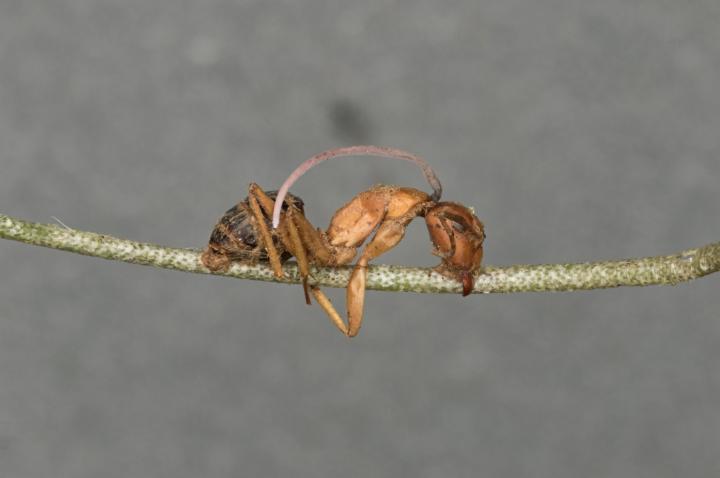
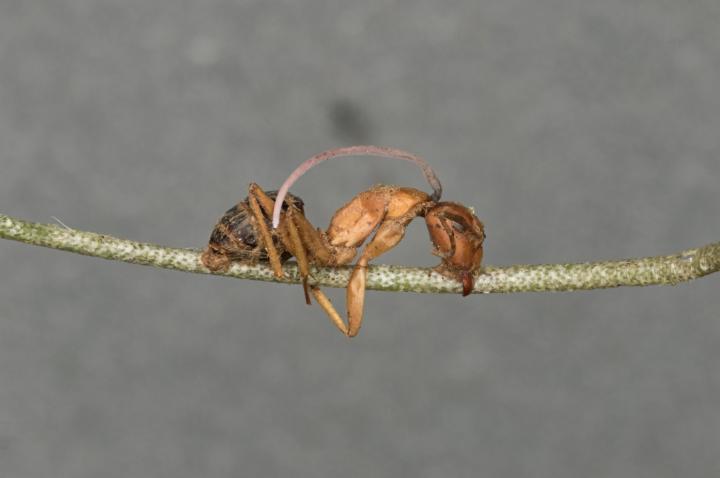
It's been observed that infected zombie ants wander out of their nests, climb onto a piece of vegetation such as Spanish moss or pine needle, bite down and ultimately die. Afterward, a spore-carrying stalk grows out of their heads. This is the work of the parasite manipulating the ants' behavior to lead them away from their nest and normal routines so that the fungus can spread its spores more effectively. Now knowing that the parasite has its own biological clock, scientists such as de Bekker can hone in on answering how and why this phenomenon occurs.
"We don't quite understand yet how parasites manipulate their hosts with such precision," said de Bekker, an assistant professor in biology. "Even the most brilliant neurologists can't change behavior that effectively. The goal of my lab, therefore, is to learn more about this."
Infected ants are found in Central Florida, including the Little Big Econ State Forest near Geneva and the Arboretum at UCF. While the majority of infected ants have been found in rainforests, this phenomenon has been observed across the globe, de Bekker said.
The first hint that the fungal parasite may hijack the ants' biological clock came from field studies that observed infected ants all actively searched for an elevated piece of vegetation to bite down on at the same time of day. Later laboratory studies showed similar results that indicated the time of day may be an important factor for the manipulating fungus.
De Bekker and her team, which consists of UCF undergraduate and graduate students, now plan to further this new avenue of research to hopefully one day better understand how biological clocks are disturbed by parasites. Scientists in Scotland are already researching how biological clocks are involved in malaria, and a team of medical researchers last month won the Nobel Prize for research on the molecular structure of the biological clock of fruit flies. De Bekker sees the role of biological clocks in infectious diseases as the next big thing for scientists to study. Scientists can better understand how diseases internally impact humans by knowing more about parasites and their impact on the biological clock.
De Bekker and her team's research takes place in a lab at UCF, as well as in the field at Little Big Econ State Forest and the UCF Arboretum.
In the lab, ants are infected with the parasite so the team can observe their behavior in a controlled environment. Ian Will, a Ph.D. candidate and co-author of the published paper, closely watches the ants to better determine when and how ants act differently after they're infected.
"I'm interested in uncovering the genes that are involved in parasitic behavioral manipulation and how," he said.
Will met de Bekker in Munich, Germany, in 2014 while pursuing his master's degree. He was also intrigued by the parasite, and followed de Bekker to Orlando after she arrived at UCF to continue the line of research together.
"In Munich, we didn't have the ants – we had to ship them," De Bekker said "Being here [in Florida], the ants and the fungus are all around us, which gives us all of these opportunities to work both in the lab and in the field."
###
Media Contact
Rachel Williams
[email protected]
407-823-1044
@UCF
Home
Original Source
http://today.ucf.edu/biological-clock-found-fungal-parasite-sheds-light-zombie-ants-phenomenon/