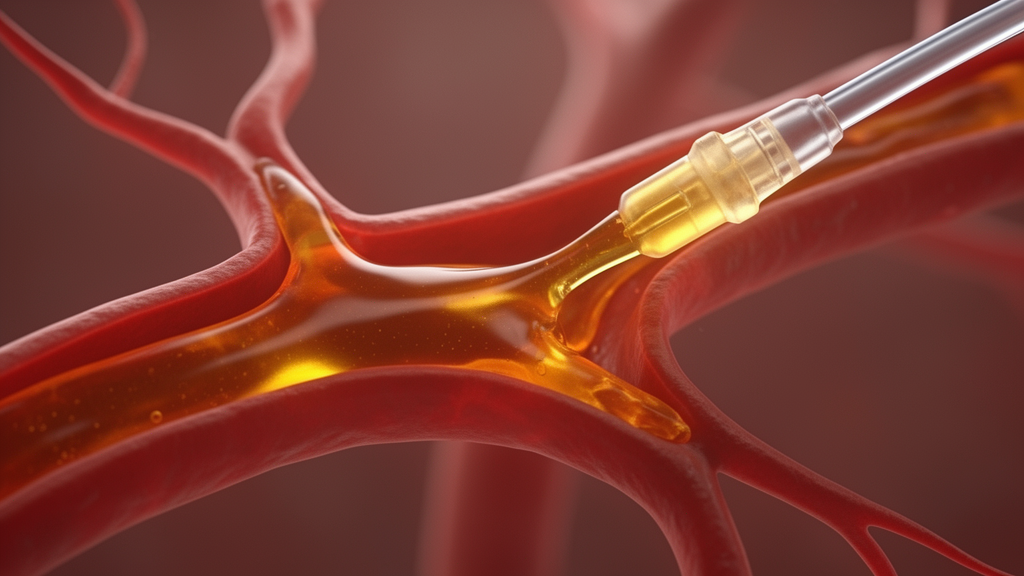
A prospective, multicenter, first-in-human clinical investigation conducted across eleven medical centers in Spain has demonstrated that the novel Amber peripheral liquid embolic system achieved complete vascular occlusion in all treated participants without incurring any device-related serious adverse events. Transcatheter embolization serves as an indispensable endovascular technique for managing acute hemorrhage, vascular malformations, tumors, and endoleaks, yet conventional liquid embolic agents frequently present significant technical hurdles. Traditional formulations often require arduous preparation protocols, carry risks of catheter entrapment or fragmentation, and incorporate metallic radiopacifiers such as tantalum powder that cause severe beam-hardening artifacts on subsequent computed tomography imaging. The preliminary results from this trial indicate that the tested organic polymer system, formulated with covalently bound iodine, safely addressed varied peripheral vascular targets while eliminating the need for pre-procedural shaking.
Peripheral transcatheter embolization relies on the controlled endovascular delivery of occlusive materials to arrest arterial bleeding, devascularize hypervascular lesions, exclude abnormal vascular structures, or redistribute flow prior to surgical resections. Within the armamentarium of interventional radiology, embolic materials are categorized according to target vessel caliber, encompassing mechanical coils, particulate suspensions, biological agents, and liquid embolic agents. Nevertheless, established liquid formulations, including cyanoacrylates and conventional ethylene vinyl alcohol copolymers, present distinct clinical trade-offs. Conversely, ethylene vinyl alcohol copolymers require dissolution in dimethyl sulfoxide, necessitating the use of specialized solvent-compatible delivery microcatheters, lengthy mechanical agitation to homogenize suspended tantalum powder, and acceptance of pronounced metallic streak artifacts that obscure post-procedural radiological evaluation.
To overcome these persistent limitations while preserving the deep penetration capabilities of dimethyl sulfoxide-based systems, biomedical engineers designed the Amber peripheral liquid embolic system as a non-adhesive, tantalum-free, iodinated organic polymer. The Amber system is supplied as an integrated single formulation containing one 1.5-milliliter vial of Amber 20, one 1.5-milliliter vial of pure dimethyl sulfoxide, two administration syringes dedicated to the embolic liquid, and one syringe dedicated to the solvent. Rather than relying on insoluble particulate metals to achieve radiopacity, the Amber 20 copolymer features iodine groups that are covalently integrated into the polyacrylate backbone structure. This molecular architecture ensures uniform, intrinsic radiopacity under fluoroscopic guidance without requiring prolonged pre-injection shaking or mechanical vortexing. Preclinical studies suggested that covalent iodination may reduce computed tomography artifacts compared with tantalum-based agents, while allowing the liquid formulation to be used directly without prior preparation.
The biophysical behavior of Amber 20 governs its controlled endovascular delivery through compatible microcatheters into targeted vascular lesions. During intervention, the delivery microcatheter is first primed with dimethyl sulfoxide to fill the dead space and prevent premature intraluminal solidification. Amber 20 is subsequently administered via slow, continuous injection at a standardized delivery rate of 0.33 milliliters per minute. Upon exiting the microcatheter tip and contacting the aqueous blood environment, media exchange rapidly initiates as dimethyl sulfoxide diffuses into the surrounding bloodstream while water diffuses into the polymer solution. This solvent displacement triggers progressive phase precipitation, transforming the liquid into an elastic, cohesive polymeric mass that advances distally into the vascular nidus without fragmenting. Solidification completes over approximately four minutes. Because the precipitated polyacrylate mass remains non-adhesive, interventionalists can maintain the microcatheter in its initial position, adjust positioning, or continue prolonged controlled injections until targeted occlusion is achieved, substantially reducing the risk of microcatheter entrapment.
The stage I clinical trial was structured as a prospective, single-arm, multicenter, open-label investigation registered under ClinicalTrials.gov identifier NCT06456125. Eligible candidates ranged from 18 to under 95 years of age and required peripheral endovascular embolization for active arterial hemorrhage, vascular aneurysms or pseudoaneurysms, type II endoleaks, pathologic organ bleeding, hypervascular neoplasms, or pre-resection portal vein embolization. Patients with documented hypersensitivity to contrast media, dimethyl sulfoxide, or Amber 20, as well as those with previous failed embolization attempts in the target territory, were excluded.
The patient cohort enrolled in stage I comprised nine females and six males, representing sixty percent female participation, with an overall median age of 56 years and an interquartile range spanning 34 to 74 years. Documented medical histories revealed substantial comorbidity burdens across the cohort: seven individuals presented with chronic renal disease, six had established cardiovascular disease, and six had active histories of neoplastic malignancy. Clinical indications for endovascular intervention encompassed a broad spectrum of acute and elective peripheral conditions. Hypervascular tumors constituted the largest clinical subgroup, accounting for six cases, including renal angiomyolipoma. Four patients required intervention for acute arterial hemorrhage, arterial aneurysm, or pseudoaneurysm. Pathologic organ bleeding accounted for three procedures, while one participant presented with a persistent type II endoleak following endovascular abdominal aortic repair, and one patient required portal vein embolization to stimulate hypertrophy of an insufficient future liver remnant prior to major hepatic resection.
Procedural data illustrated consistent technical performance across varied peripheral anatomical territories using standard endovascular access and instrumentation. Transfemoral arterial access served as the primary entry route in thirteen patients, representing 86.7 percent of the cohort. Interventions addressed between one and four target arteries per procedure, with a single target vessel treated in ten cases. Operators utilized standard dimethyl sulfoxide-compatible microcatheters with outer diameters ranging from 1.9 to 2.7 French and lengths between 130 and 175 centimeters, incorporating commercially available brands such as Progreat, Carnelian, Xcepter XC, and TruSelect. Diagnostic angiographic catheters of 4 to 5 French caliber were deployed in thirteen cases, complemented by guiding catheters in two procedures. Most interventions required two vials of Amber 20, yielding a median administered liquid embolic volume of 1.5 milliliters with an overall range of 0.2 to 12.0 milliliters and a mean volume of 2.42 plus or minus 2.87 milliliters. No ancillary embolic devices were required.
Immediate technical success was strictly defined according to prespecified, indication-specific angiographic endpoints assessed at the conclusion of the index procedure. In the four patients treated for active hemorrhage, aneurysm, or pseudoaneurysm, final angiography confirmed complete vascular occlusion and total cessation of contrast extravasation. In the patient presenting with a type II endoleak originating from the inferior mesenteric artery, post-injection control runs demonstrated total obliteration of the endoleak cavity without residual sac filling. Similarly, complete branch occlusion was confirmed in portal vein embolization, and complete angiographic devascularization was verified across all hypervascular neoplastic lesions and pathologic organ bleeding territories. No device deficiencies, delivery failures, or mechanical catheter blockages occurred during any procedure.
The primary safety outcome focused on the incidence of device-related serious adverse events occurring within twenty-four hours of the index embolization procedure. The study protocol prespecified an early safety stopping threshold of twenty percent or less, stipulating that occurrence of four or more device-related serious adverse events among the fifteen participants would halt trial progression to stage II. During the twenty-four-hour primary monitoring window, zero device-related serious adverse events and zero device-related adverse events were observed, comfortably satisfying the protocol safety criterion. Across the entire peri-procedural period, five patients experienced mild postembolization syndrome characterized by transient low-grade fever. Because postembolization syndrome typically results from the inflammatory and ischemic effects of embolization on treated tissues, these occurrences were considered related to the procedure rather than the device, despite resulting in prolonged hospitalization. A total of seven mild-to-moderate adverse events were recorded overall, of which two emerged within the initial twenty-four hours; all resolved completely without permanent clinical sequelae.
The early safety and efficacy metrics established in stage I provide empirical support for advancing the OPAL investigation into its planned seventy-patient trial cohort. The sample size calculation for the complete investigation was statistically calibrated using a performance threshold of 92.1 percent, derived from a meta-analysis of fifty published studies encompassing 2,204 peripheral embolization patients demonstrating a pooled technical success rate of 98.86 percent. Investigators acknowledged that the stage I trial entails inherent limitations, including its modest sample size of fifteen patients, substantial heterogeneity of anatomical indications, lack of direct quantitative CT artifact evaluations, and a primary safety assessment window limited to twenty-four hours. This brief window cannot capture late-onset ischemic injuries, delayed non-target embolization, or chronic tissue responses. Consequently, a stage II trial with a six-month follow-up is currently underway to further characterize the safety and efficacy profile of Amber as a liquid embolic agent system for complete peripheral vascular occlusion.
Subject of Research: Early clinical safety and technical feasibility of the novel Amber peripheral liquid embolic system
Article Title: Feasibility, safety, and efficacy of the amber peripheral liquid embolic system: results from stage I of the first-in-human OPAL study
Article References: Serrano, E., Urbano, J., Irurzun, J., Pérez, M., Insausti, I., García, R., Gelabert, A., Pisoni, S., Correa, R., Guirola, A., Cibrán, M., Espejo, J., Magallanes, M., Pich, S., Fernández, A., Valle, S., Gómez, Á., Molina, M., López-Rueda, A., … research team of the OPAL study (2026). Feasibility, safety, and efficacy of the amber peripheral liquid embolic system: results from stage I of the first-in-human OPAL study. CVIR Endovascular, 9(1), Article 140. https://doi.org/10.1186/s42155-026-00797-2
Image Credits: AI Generated
DOI: 10.1186/s42155-026-00797-2
Keywords: Amber 20, OPAL study, liquid embolic agent, peripheral vascular embolization, interventional radiology, dimethyl sulfoxide, first-in-human trial, technical success, postembolization syndrome, iodinated polyacrylate, endovascular intervention, arterial hemorrhage, hypervascular tumors, type II endoleak, portal vein embolization, catheter delivery, radiopacity
News Source: Ophelia Keating. (November 16, 2026). First-in-Human Trial Validates Novel Amber Liquid Embolic Agent for Peripheral Occlusion. Scienmag.