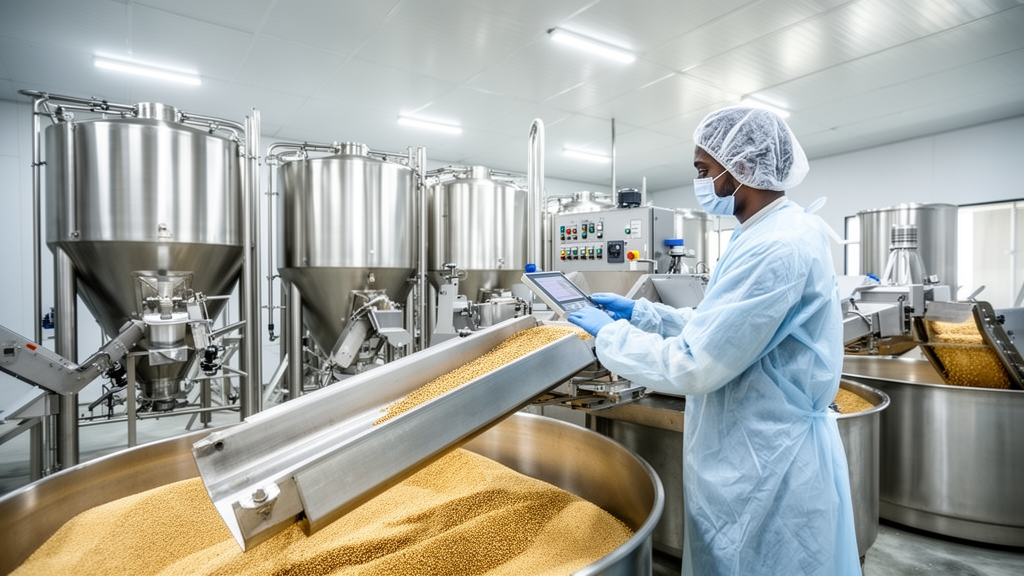
A cross-sectional survey of 287 registered livestock feed processors in South-West Nigeria has identified significant technical knowledge gaps in scientific feed formulation and nutrient analysis. Published in Frontiers in Animal Science, the study reveals that while local processors possess strong practical operational skills, they exhibit critical deficiencies in the biochemical and nutritional aspects of feed production. These findings have direct implications for the delivery of agricultural extension services, suggesting that current training programs may not adequately address the specific technical needs of the feed processing sector.
The research team, led by John Iweanya Onyemenam from Landmark University in Nigeria, assessed the technical competencies and training needs of feed processors in Lagos, Ogun, and Oyo States. The study aimed to provide empirical evidence to guide extensionists, policymakers, and training institutions in improving feed quality and livestock productivity. By quantifying the actual technical skills of local actors, the researchers sought to bridge a gap in empirical data regarding the specific knowledge deficits within the regional feed industry.
Participants were selected through a multistage sampling procedure from a population frame of 381 registered feed processors. The sample included 112 respondents from Lagos State, 62 from Ogun State, and 113 from Oyo State. Data were collected using a validated structured questionnaire that measured technical knowledge through 31 feed-processing statements and evaluated training needs using the Borich Needs Assessment Model. The instrument demonstrated high internal consistency and temporal stability, with Cronbach’s alpha coefficients ranging from 0.82 to 0.83.
The results indicated that respondents demonstrated adequate knowledge in 19 of the 31 technical areas assessed. These areas included feed safety, particle-size management, and basic nutritional practices. For instance, processors showed strong understanding of mechanical safety, such as the importance of installing iron guards on mixer-buckets to prevent accidents, with a mean score of 4.42. They also correctly identified appropriate particle size parameters for chick starters and recognized the risk of aflatoxin contamination from rancid groundnut cake.
However, significant knowledge gaps were identified in feed formulation, nutrient balancing, ingredient classification, anti-nutritional factors, and the appropriate use of feed additives. A notable misconception was found regarding the use of the Pearson square method, where many processors incorrectly believed it could balance both crude protein and energy content simultaneously. This misunderstanding can lead to the production of feeds that are energy-deficient or protein-unbalanced, potentially affecting livestock growth and feed conversion efficiency.
Another critical gap involved the identification of anti-nutritional factors in non-conventional ingredients. Many respondents did not realize that unfermented cassava root meal is unsuitable for direct use in feed processing due to the presence of cyanogenic glycosides. If raw cassava is fed without proper fermentation or drying, these compounds can convert to hydrocyanic acid in the animal’s digestive system, inhibiting cellular respiration and leading to metabolic acidosis. This lack of awareness poses a direct risk to animal health and the safety of the food chain.
Training needs were highest for preparing feed formulas, with a Borich Needs Value of 3.68, followed by feed analysis at 3.48. Other high-priority areas included determining ingredient inclusion levels and identifying anti-nutritional factors. The Borich model calculates training needs by measuring the gap between the perceived importance of a task and how frequently it is performed. High values indicate that processors recognize the importance of these tasks but lack the practical skills to perform them effectively, highlighting a disconnect between theoretical knowledge and operational capability.
The study also assessed the expressed needs of feed processors regarding agricultural advice. Calculating proximate analysis was the most highly expressed training priority, with a mean score of 2.48 on a three-point scale. Formulating feed using basic methods ranked second, with more than half of the respondents indicating this skill was highly needed. These findings suggest that processors require targeted support in analytical competencies to ensure that rations meet the nutritional requirements necessary for optimal livestock performance.
The demographic profile of the respondents revealed that the majority were male, married, and had tertiary education. Most processors had between 11 and 20 years of experience in the industry, indicating that they have acquired practical knowledge through prolonged on-site learning. However, the study notes that experience is not a substitute for formal training, as technical knowledge in feed science is continuously updated. The lack of formal training among 55.05% of respondents underscores the need for structured capacity development programs.
The implications for agricultural extension services are significant. The study suggests a misalignment between existing extension content and the evolving knowledge requirements of feed processors. Traditional extension programs have often targeted primary producers, neglecting upstream actors like feed processors whose competencies are central to ensuring livestock productivity and food safety. The findings call for tailored, competency-based training modules that address specific technical gaps, such as nutrient balancing, ingredient evaluation, and the detection of anti-nutritional factors.
Researchers recommend that government agencies and agricultural development partners fund specialized, modular training led by animal nutrition experts within the extension system. Public-private partnerships with feed research institutions and industry stakeholders are also suggested to ensure continuous capacity building and standardization of feed processing practices. By integrating feed specialists into extension systems, the study argues that it is possible to enhance feed quality, improve livestock productivity, and promote sustainable agribusiness development in Nigeria.
The study highlights the importance of precision extension programming to address the systemic weaknesses in the feed processing sector. While processors are skilled in the hands-on operations of feed mills, their limitations in scientific and biochemical aspects of feed production can lead to nutritional imbalances and safety risks. Addressing these gaps through targeted training and regulatory frameworks is essential for safeguarding livestock health and promoting food security in the region.
This research provides a baseline for designing extension interventions that are responsive to the specific needs of the feed processing industry. By focusing on the most critical skill gaps, such as feed formulation and nutrient analysis, extension services can produce better results and contribute to the overall resilience of the agricultural value chain. The study underscores the urgent need to reorient extension service delivery to accommodate the specific training and capacity-building needs of feed processors in South-West Nigeria.
The survey data indicate that the feed processing sector in the selected states is predominantly male and experienced. Approximately 70.73% of the 287 respondents were male, while 29.27% were female. The mean age of the participants was 45 years, with the majority falling within the 30 to 60-year age bracket. Educational attainment was relatively high, with 49.48% of respondents holding tertiary education qualifications, 31.36% having secondary education, and 14.98% having primary education. Only a small fraction, 2.79%, reported having no formal education. This educational profile suggests that most processors possess the literacy required to engage with technical training materials and adopt new innovations through extension services.
Economic characteristics of the respondents reveal that the industry is largely driven by small-scale operations. Approximately 70.73% of the processors operated at a small scale, with a production capacity of less than one ton per hour. A further 27.18% operated at a medium scale, producing between one and four tons per hour, while only 2.09% operated at a large scale with capacities above four tons per hour. In terms of weekly output, 74.91% of respondents reported processing less than 10 tons of feed per week, with a mean weekly production of 5.6 tons. The primary motivation for engaging in feed processing was unemployment, cited by 66.20% of respondents, compared to 28.22% who cited investment opportunities. This suggests that many processors entered the sector as a livelihood strategy rather than through formal professional pathways, which may explain the reliance on trial-and-error methods and the lack of standardized technical training.
The study’s sampling methodology involved a three-stage multistage procedure designed to ensure representativeness across the selected states. Lagos, Ogun, and Oyo States were purposively selected due to their high concentration of feed mills and livestock farms. Within these states, 22 Local Government Areas were chosen based on the presence of small, medium, and large-scale feed mills. The final sample of 287 respondents was drawn from a population frame of 381 registered feed processors, representing a sampling fraction of approximately 75.3%. This high sampling fraction was intended to maximize statistical power and minimize sampling error in this specialized sector. The sample was proportionally allocated to each Local Government Area based on the number of registered processors, ensuring that the distribution of respondents reflected the actual distribution of the industry across the study area. All selected respondents participated in the survey, meaning no non-response adjustments were necessary.
The reliability of the research instrument was established through a pilot study conducted in Kwara State, which was selected for its similar agro-ecological and macroeconomic conditions to the primary study area. Fifteen feed processors, comprising an equal distribution of small, medium, and large-scale operators, participated in the pilot. The instrument was administered on two occasions with a four-week interval to assess temporal stability. The results showed high internal consistency, with Cronbach’s alpha coefficients ranging from 0.82 to 0.83 for the different sections of the questionnaire. The test-retest reliability, measured using Pearson correlation coefficients, ranged from 0.83 to 0.84, confirming that the instrument yielded stable measurements over time. These psychometric properties support the validity of the findings regarding knowledge levels and training needs, as the data collected are considered reliable indicators of the respondents’ actual competencies and perceived needs.
Subject of Research: Technical knowledge gaps and training needs of livestock feed processors in South-West Nigeria
Article Title: Assessment of knowledge gaps and training needs of livestock feed processors in South-West Nigeria: implications for agricultural extension services
Article References: Onyemenam, J. I., Akangbe, J. A., Kolawole, A. E., & Onyemenam, L. U. (2026). Assessment of knowledge gaps and training needs of livestock feed processors in South-West Nigeria: implications for agricultural extension services. Frontiers in Animal Science, 7, Article 1848810. https://doi.org/10.3389/fanim.2026.1848810
Image Credits: AI Generated
DOI: 10.3389/fanim.2026.1848810
Keywords: feed processing, agricultural extension, South-West Nigeria, livestock nutrition, training needs, knowledge gaps, food security, feed formulation, Assessment, knowledge, gaps, training
News Source: Drew Townsend. (November 16, 2026). Nigerian Feed Processors Show Major Gaps in Scientific Formulation Skills. Scienmag.