Researchers at the University of Southern California have established a proof-of-concept workflow for conducting forward genetic screens in Macrocystis pyrifera, commonly known as giant kelp. The study, published in Frontiers in Genetics, demonstrates a practical method for inducing mutations in the microscopic gametophyte stage of the kelp life cycle using the chemical mutagen ethyl methanesulfonate, or EMS. By combining this mutagenesis with agar-based solid media culture, the team created a system that immobilizes individual gametophytes, allowing for visual screening of morphological changes and the isolation of specific strains for downstream genomic analysis. This approach addresses a significant gap in kelp research, where genomic resources are expanding but functional genetic tools for validating gene function remain limited.
The primary motivation for this work stems from the ecological and economic importance of giant kelp. These brown macroalgae form underwater forests that support biodiversity, contribute to nutrient cycling, and sequester carbon. Economically, giant kelp is a crucial source of alginate and is being explored as an agricultural fertilizer and biostimulant. While high-quality genomes for kelp and other brown macroalgae have enabled comparative genomics and population genetics studies, experimental approaches are necessary to understand how specific genes influence traits such as development, morphology, and stress response. Forward genetic approaches are particularly useful in this context because they do not require prior knowledge of the causative genes influencing a phenotype.
Macrocystis pyrifera possesses a haplodiplontic life cycle, alternating between microscopic gametophyte and macroscopic sporophyte stages. The gametophyte stage is advantageous for mutagenesis screens for two key reasons. First, gametophytes are haploid, which reduces the likelihood that mutant phenotypes will be masked by alternate alleles. Second, these microscopic individuals divide clonally under laboratory conditions, enabling isolated individuals to be propagated, maintained, and re-screened as distinct strains. The study utilized female M. pyrifera gametophyte strains, with one strain used to evaluate culture on agar-based media and a separate strain used for the EMS treatment and sequencing analysis.
The workflow began with the collection of gametophytes using a 40-micrometer cell strainer and rinsing them with filter-sterilized artificial seawater to remove bacteria. The gametophytes were then treated with 0.25% EMS for 16 hours at 13 degrees Celsius under dark conditions on a rotator. EMS is known to induce G to A and C to T transitions after DNA replication. Following the treatment, the gametophytes were fragmented using a motorized pestle to reduce the individual cell count and filtered again to enrich for individuals with low cell numbers. The resulting cells were resuspended at a density of approximately 5,000 cells per milliliter.
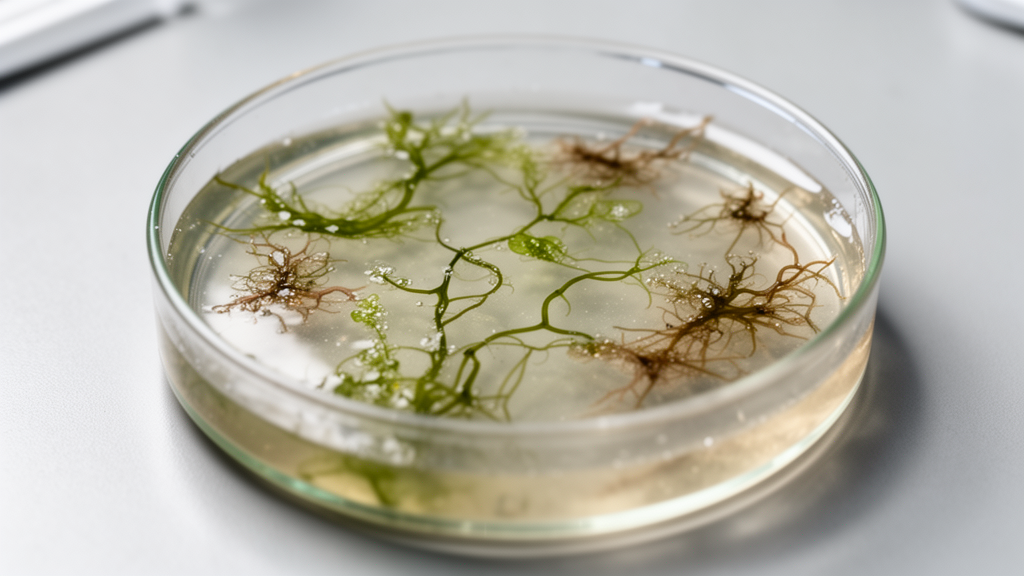
To facilitate screening, the EMS-treated gametophytes were plated onto solid media containing 1% agar and 500 micrograms per milliliter of cefotaxime, an antibiotic used to suppress bacterial growth. The cells were spread evenly across the agar and air-dried to ensure immobilization. The plates were cultured at 13 degrees Celsius under red light with a 12-hour light and 12-hour dark photoperiod for three months. This solid media approach was critical because, in liquid culture, gametophytes can move and clump together, making visual screening and strain isolation difficult. On agar, individuals are spatially separated, easing the identification of gametophytes with unusual morphology.
After three months of culture, the EMS-treated gametophytes were visible across the agar surface. While many individuals displayed typical growth patterns, such as brown pigmentation and outward filamentous growth, others exhibited distinct morphologies. One candidate individual showed darker pigmentation and dense, compact growth. Seven individuals with unusual morphologies were isolated from the agar plates and transferred into liquid media for propagation. Not all isolated individuals survived the transfer or maintained their original morphology, but the compact candidate strain was successfully propagated in liquid culture. This strain was then fragmented and re-plated on agar to establish three subcultures, which continued to show dark pigmentation, dense compact growth, and relatively short branches.
To quantitatively assess the morphological differences, the researchers measured solidity and circularity of the gametophytes using image analysis software. Solidity serves as an indirect estimate of how compact the individual gametophytes are, while circularity estimates how round the overall shape is. The untreated parental strain had a mean solidity of 0.524 and a mean circularity of 0.135. In contrast, the three candidate subcultures had mean solidity values ranging from 0.789 to 0.863, and mean circularity values ranging from 0.462 to 0.563. These measurements provided quantitative support for the observation that the subcultures possessed a more compact morphology than the untreated parental strain.
The compact candidate strain was selected for whole-genome sequencing to identify mutations consistent with EMS mutagenesis. The team compared sequencing data between the untreated parental strain and the compact candidate strain, revealing 10,249 single nucleotide substitutions that differed between the two samples. Of these, 2,917 mutations were characteristic of EMS mutagenesis, specifically G to A and C to T transitions. The analysis identified 1,464 G to A transitions and 1,453 C to T transitions. These mutations were interpreted as EMS-characteristic candidates rather than definitive EMS-induced mutations, as additional validation would be needed to determine whether each individual mutation was directly caused by the chemical treatment.
The researchers further narrowed the EMS-characteristic mutations to a subset located proximal to annotated genes. This filtered set included 52 G to A or C to T mutations associated with annotated gene regions, corresponding to 49 distinct genes. Most of these mutations were predicted to occur in noncoding or regulatory regions, such as intronic, upstream, downstream, or intergenic regions. The team did not identify mutations predicted to cause missense, nonsense, or frameshift effects, nor did they find mutations affecting splicing. The functional categories associated with these genes included vesicle trafficking, membrane coat function, cytoskeletal movement, lipid metabolism, kinase signaling, and redox metabolism. The most coherent functional category was vesicle trafficking, represented by mutations associated with a COPI coatomer beta subunit gene and a clathrin/coatomer adaptor-like gene.
Several limitations are inherent to this workflow. Culturing gametophytes on solid media may introduce a form of selection, meaning the screened individuals are those capable of surviving and growing under agar-based conditions. This process may miss mutants that are sensitive to plating conditions or cannot grow well on solid media. Additionally, the use of cefotaxime to suppress bacterial growth raises questions about how long-term antibiotic exposure affects gametophyte growth or phenotypic expression. The study sequenced only one isolated EMS-treated strain, so it does not provide a quantitative estimate of EMS mutagenesis efficiency across independent strains. Some observed mutations may reflect background variation or somatic mutations accumulated during the eight years of propagation of the parental strain, rather than being directly induced by EMS.
Despite these limitations, the study provides a foundation for future forward genetic screens in Macrocystis pyrifera. The workflow combines mutagenesis, strain isolation, and genomic analysis in a single process, expanding the functional genetics toolkit for giant kelp. The candidate genes identified in this study provide targets for future validation rather than direct evidence of causality. Future work could apply this workflow under selective conditions relevant to kelp development and aquaculture, such as nutrient limitation or temperature stress, to identify genes associated with specific crop-relevant traits. By making screening and strain isolation more manageable at the microscopic gametophyte stage, this approach offers a practical path toward understanding the genetic basis of important kelp traits.
The workflow described in this study is designed as a discovery step that precedes more targeted genetic experiments. Because forward genetic approaches do not require prior knowledge of the specific genes controlling a phenotype, they offer a distinct advantage over targeted methods like CRISPR-based gene editing, which are most effective when candidate genes are already known. By adapting EMS mutagenesis and agar-based culture to the biology of the haploid, clonally propagating gametophyte stage, the researchers created a system that can identify candidate genes without needing to know their function in advance. This is particularly relevant for giant kelp, where practical forward genetic workflows have previously been limited, despite the availability of high-quality genomic resources for comparative studies.
The use of the gametophyte stage is central to the study’s design because it allows for the maintenance of induced mutations as stable strains. Since M. pyrifera gametophytes divide clonally under laboratory conditions, isolated individuals can be propagated and maintained for experimental validation and replication.
While the study identified a set of candidate genes associated with EMS-characteristic mutations, the authors emphasize that these findings should not be interpreted as evidence of causality. The mutations identified were predicted to occur in noncoding or regulatory regions, meaning their functional effects on the observed compact morphology remain uncertain. The functional categories, such as vesicle trafficking and membrane coat function, are notable because these processes are potentially related to regulating polarized growth and cellular organization in kelp gametophytes. However, the relationship between these specific mutations and the phenotype is associative rather than causal, requiring further validation through targeted genetic tools or crosses to produce sporophytes for testing crop-relevant traits.
Future applications of this workflow could involve screening EMS-treated gametophytes under selective conditions relevant to kelp development and aquaculture, such as nutrient limitation, variable light conditions, or temperature stress. Individuals that survive or continue growing under these specific conditions could be isolated and sequenced to identify mutations associated with stress tolerance or other agronomic traits. This approach would provide a practical path for identifying genetic variants that may be useful for improving kelp aquaculture, although the current study serves primarily as a proof-of-concept for the technical feasibility of the workflow rather than a comprehensive analysis of specific environmental responses.
Subject of Research: Forward genetics workflow for EMS mutagenesis and genomic analysis in Macrocystis pyrifera gametophytes
Article Title: A forward genetics workflow for EMS mutagenesis, agar-based screening, and genomic analysis of Macrocystis pyrifera gametophytes
Article References: Vong, B., Hua, Z., Langa, I., Monney, J., & Nuzhdin, S. (2026). A forward genetics workflow for EMS mutagenesis, agar-based screening, and genomic analysis of Macrocystis pyrifera gametophytes. Frontiers in Genetics, 17, Article 1958697. https://doi.org/10.3389/fgene.2026.1958697
Image Credits: AI Generated
DOI: 10.3389/fgene.2026.1958697
Keywords: Macrocystis pyrifera, EMS mutagenesis, forward genetics, gametophyte, giant kelp, whole-genome sequencing, agar culture, functional genomics, brown macroalgae, strain isolation, forward, genetics
News Source: Juliet Wilcox. (November 16, 2026). Kelp Gametophytes Screened for Mutations Using EMS and Agar. Scienmag.