Researchers have identified aging-related candidate genes and biological pathways in the water flea Daphnia sinensis, demonstrating that silencing specific target genes disrupts antioxidant defenses and accelerates anatomical markers of senescence. The investigation combined systematic transcriptomic profiling across five developmental life stages with in vivo functional RNA interference validation to uncover the genetic regulation of physiological decline in cladocerans.
Organismal aging is a natural biological process characterized by progressive declines in the morphological structure and physiological functions of living organisms over time, shaped by multifaceted interactions between environmental influences and genetics. While a limited set of aging-related candidate genes had previously been characterized in related species such as Daphnia pulex and Daphnia magna, systematic transcriptome-wide screening across multiple developmental growth stages paired with in vivo functional RNA interference validation had remained unaddressed in the genus Daphnia.
To elucidate the molecular mechanisms governing aging in Daphnia, the research team tracked morphological and physiological alterations across five distinct developmental stages of Daphnia sinensis, sampling specimens at 1 day, 7 days, 14 days, 21 days, and 28 days of age. By comparing gene expression profiles across these developmental time points, the investigators systematically mapped candidate genetic sequences and functional regulatory pathways associated with the progression of mature lifespan.
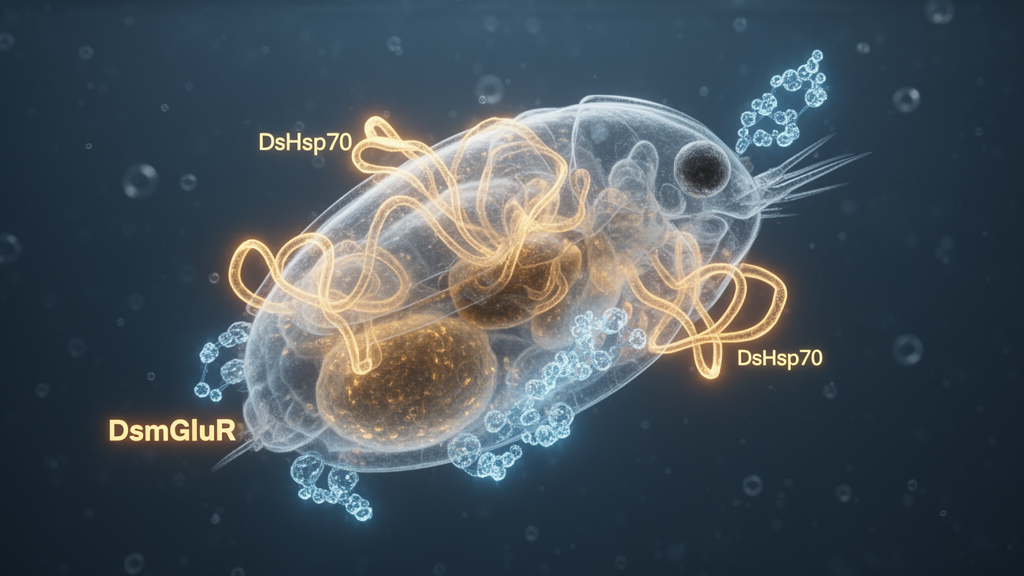
The transcriptomic screening revealed ten potential biological pathways related to aging in Daphnia sinensis, including the longevity regulating pathway and the estrogen signaling pathway. From these pathways, the authors identified fourteen candidate aging-associated genes, selecting DsHsp70 and DsmGluRs for targeted functional exploration. In Daphnia sinensis, DsHsp70 is thought to act as a molecular chaperone involved in preserving protein homeostasis, whereas DsmGluRs participates in regulating cellular metabolism and physiological responses to oxidative stress.
To evaluate the biological functions of these genes directly in vivo, the scientists administered an oral RNA interference protocol. Daphnia sinensis specimens were fed Escherichia coli bacteria expressing double-stranded RNA specifically targeting either DsHsp70 or DsmGluRs. A control group was fed Escherichia coli carrying the empty plasmid vector L4440-EGFP. Molecular assays confirmed significant suppression of transcript levels, demonstrating down-regulation of target gene expression by 22.6 percent in the DsHsp70 group and 36.8 percent in the DsmGluRs group compared to the empty-vector controls.
Knockdown of these target genes triggered notable declines in enzymatic activity and organismal fitness. Glutathione S-transferase activity was reduced by 1.8 percent in the DsHsp70 group and by 22.5 percent in the DsmGluRs group relative to the control animals. Furthermore, both overall body length and the total number of offspring produced by Daphnia sinensis decreased in both treatment cohorts, with the DsHsp70-deficient group exhibiting a statistically significant decline in reproductive fecundity.
Anatomical examinations also revealed pronounced reproductive defects following gene silencing. Brood pouch depression was observed in 48 percent of individuals in the DsHsp70 treatment cohort and 44 percent of specimens in the DsmGluRs group, compared with only 16 percent of individuals in the control group. The investigators concluded that DsHsp70 and DsmGluRs perform essential roles in modulating the aging process in Daphnia sinensis, providing an empirical framework for subsequent investigations into cladoceran aging genetics.
Subject of Research: Aging-related gene screening and functional RNAi validation in Daphnia sinensis
Article Title: Screening and functional analysis of aging-related genes in Daphnia sinensis
Article References: Han, L., Li, G., Zhu, H., Deng, D., Wang, Z., Li, J., Tang, W., Wang, W., & Zhang, K. (2026). Screening and functional analysis of aging-related genes in Daphnia sinensis. Frontiers in Zoology. https://doi.org/10.1186/s12983-026-00640-3
Image Credits: AI Generated
DOI: 10.1186/s12983-026-00640-3
Keywords: Daphnia sinensis, DsHsp70, DsmGluRs, aging-related genes, RNA interference, transcriptomic profiling, longevity regulating pathway, estrogen signaling pathway, glutathione S-transferase, protein homeostasis, oxidative stress, brood pouch depression, molecular chaperones, cladocerans, developmental stages, cellular metabolism, offspring fecundity
News Source: Beatrice Stafford. (November 16, 2026). Aging Genes DsHsp70 and DsmGluRs Regulate the Aging Process in Daphnia sinensis. Scienmag.