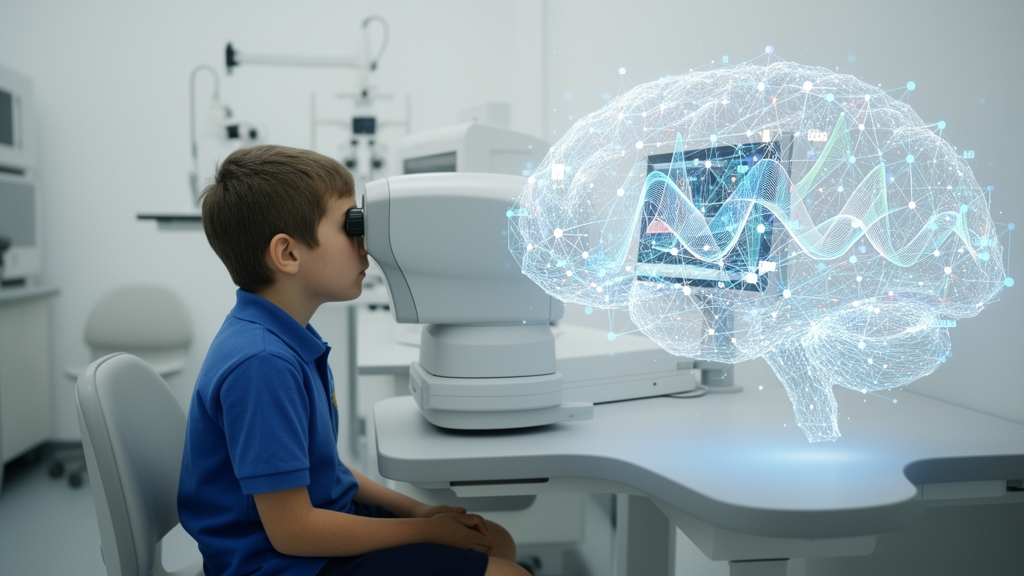
A compact time-aware transformer deep learning model can forecast one-year-ahead pediatric refractive error and detect rapid myopia progression directly from irregularly sampled school screening records without requiring data imputation, according to an internal validation study published in the Journal of Translational Medicine. Rising global myopia rates present a major public health challenge due to the risk of irreversible vision loss associated with high myopia, creating an urgent clinical need to identify children on rapidly worsening visual trajectories early. While standard school-based vision screening programs routinely characterise a child’s current refractive state, they do not forecast the future course of that trajectory. To address this limitation, investigators developed an architecture designed to handle uneven clinical screening intervals and evaluated whether incorporating school-level geospatial context provides meaningful prognostic information.
The deep learning model adapts a Time-Aware Transformer framework to evaluate irregularly sampled refractive screening sequences without relying on data imputation techniques. The system combines an Adaptive-Frequency Time Embedding mechanism, which tunes a sinusoidal frequency spectrum to variable clinical sampling intervals using two learnable parameters, with a temperature-scaled Gated Residual Network. This gated network selectively integrates school-level environmental indices alongside individual longitudinal screening measurements.
The researchers developed and evaluated the model using a Gold Standard cohort of 2,874 students from Yecheng County, China, all of whom had complete four-year screening trajectories collected between 2020 and 2023. The study evaluated two primary predictive outcomes: one-year-ahead spherical equivalent refraction as a continuous measure and the binary classification of rapid myopic progression, defined specifically as an annual decrease in spherical equivalent refraction of at least 0.75 diopters per year. The rigorous internal validation design incorporated a held-out test set, five-fold cross-validation, a ten-seed stability evaluation, a school-level grouped split, and leave-one-school-out validation protocols to assess model generalizability.
In test evaluations, the proposed time-aware transformer achieved a mean squared error of 0.168 D² and an R² of 0.929 when predicting one-year-ahead spherical equivalent refraction. For the secondary task of identifying rapid progressors, the model achieved an area under the receiver operating characteristic curve of 0.891. Model risk estimates demonstrated strong calibration, yielding a calibration slope of 0.968 and an intercept of -0.014 diopters. Decision-analytic assessment indicated that the transformer yielded higher net benefit than either referring all children or referring no children across a wide spectrum of referral probability thresholds ranging from 0.10 to 0.55.
Validation experiments demonstrated consistent performance across multiple resampling schemes, with the model recording a mean squared error of 0.171 ± 0.017 across five-fold cross-validation and 0.168 ± 0.004 across ten random seeds. When compared against nine baseline architectures using paired test-set bootstrap tests with post hoc multiplicity control, the model achieved accuracy comparable to the strongest baselines rather than a marked superiority. Specifically, the difference in root mean squared error between the proposed model and ContiFormer was only 0.010 diopters, an increment well below the measurement precision of non-cycloplegic autorefraction. However, the proposed transformer required 42 percent fewer parameters, using 52,000 versus 89,000 parameters, and trained 2.7 times faster than ContiFormer.
The study identified notable variations in predictive difficulty across distinct patient subgroups and geographic validation splits. Predicting refractive trajectories proved most difficult for children who converted to myopia during the follow-up period, where the mean squared error reached 0.243, while forecasting was easiest among persistent non-myopes, who exhibited a mean squared error of 0.105. Furthermore, when entire schools were held out during evaluation, the overall mean squared error increased to 0.191, and the performance benefit attributable to environmental features dropped from 0.027 to 0.005 D². This substantial reduction indicated that the apparent geospatial signal predominantly captures school identity rather than direct, measured environmental exposures.
The authors concluded that the compact time-aware transformer successfully forecasts one-year-ahead refractive error from routinely collected school screening records with accuracy comparable to substantially larger continuous-time models. The primary justification for adopting this deep learning architecture rests on its operational efficiency, parameter stability, and clinically interpretable attention mechanisms rather than on raw predictive superiority over existing complex models. Furthermore, the findings indicate that school-level environmental indices must be understood as geospatial baseline priors rather than direct individual-level causal exposures when modeling refractive progression in pediatric screening programs.
Subject of Research: Deep learning forecasting of pediatric myopia progression from irregular longitudinal school screening records
Article Title: Development and internal validation of a time-aware transformer model for predicting pediatric myopia progression from irregular longitudinal school screening data
Article References: Zhang, M., Wumaier, T., Maimaiti, A., Zhao, Y., Moutari, S., Usama, M., Zhang, Z., Bu, S., Pazo, E. E., & Ren, X. (2026). Development and internal validation of a time-aware transformer model for predicting pediatric myopia progression from irregular longitudinal school screening data. Journal of Translational Medicine. https://doi.org/10.1186/s12967-026-09221-8
Image Credits: AI Generated
DOI: 10.1186/s12967-026-09221-8
Keywords: pediatric myopia, myopia progression, transformer models, deep learning, spherical equivalent refraction, school screening, longitudinal data, irregular sampling, time-aware transformer, ophthalmology, internal validation, refractive error, environmental indices, ContiFormer, gated residual network, adaptive-frequency time embedding, Yecheng County, clinical calibration
News Source: Harold Sullivan. (November 16, 2026). Time-Aware Transformer Forecasts Pediatric Myopia Progression From Irregular School Screening Data. Scienmag.