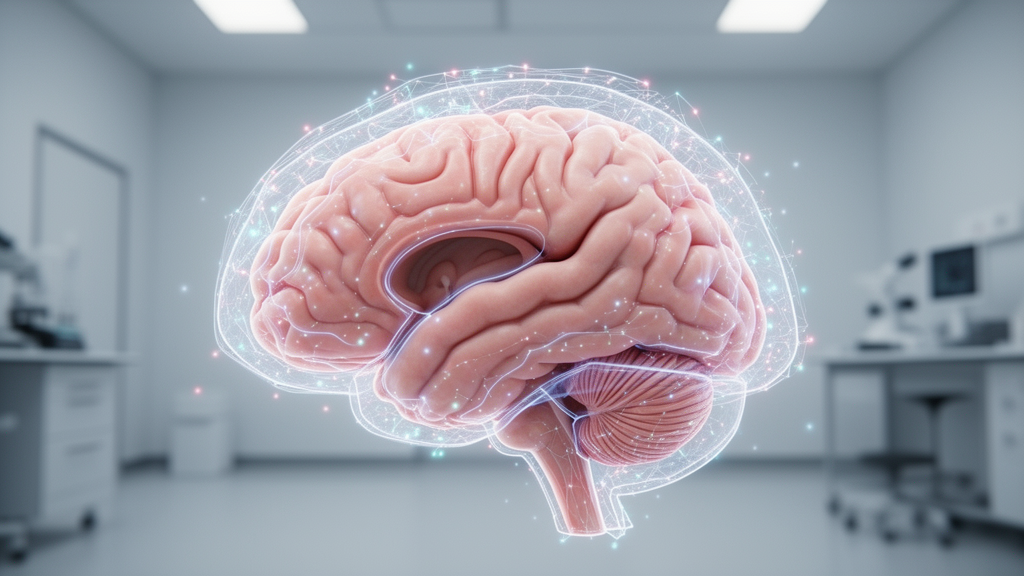
Synthetic pathological magnetic resonance images generated by a conditional diffusion model significantly improve automated brain segmentation in developing fetuses and neonates, according to an open-access research study published in BMC Medical Imaging. The investigation, conducted by researchers Misha Pieter Thijs Kaandorp, Damola Agbelese, Hosna Asma-ull, Kelly Payette, Patrice Grehten, Antonio Giulio Gennari, Levente István Lánczi, Hyun Gi Kim, and Andras Jakab, demonstrated that synthetic pathological training data substantially enhanced the performance of state-of-the-art nnU-Net segmentation architectures. The most pronounced improvements were observed in ventricle segmentation for severe ventriculomegaly cases, where the Dice score rose significantly from 0.7317 with real baseline data to 0.9290 with synthetic augmentation, achieving statistical significance at p < 0.05.
The research team developed their computational approach to address critical challenges in perinatal medical imaging. Automated analysis of fetal and neonatal brain magnetic resonance imaging is severely constrained by the scarcity of annotated pathological datasets, as well as stringent privacy regulations that restrict medical data sharing across healthcare institutions, particularly for rare developmental conditions. Because clinical scans of abnormal prenatal brains are difficult to acquire in large volumes, the authors investigated whether synthetic pathological fetal and neonatal brain MRI generated directly from semantic label images could overcome data shortages and enhance automated segmentation performance in abnormally developing brains.
To produce the synthetic imaging datasets, the researchers introduced Fetal&Neonatal-DDPM, a novel three-dimensional conditional diffusion model framework designed specifically to generate high-quality synthetic pathological fetal and neonatal brain scans from semantic label images. To further expand and enrich the available training data, the team modified healthy label images through morphological alterations. These anatomical modifications allowed the researchers to simulate specific pathological conditions in the developing brain, including ventriculomegaly, cerebellar hypoplasia, pontocerebellar hypoplasia, and microcephaly.
The visual fidelity and clinical utility of the synthetic scans generated by Fetal&Neonatal-DDPM were evaluated through formal expert radiological assessment. The conditional diffusion model successfully generated visually realistic fetal and neonatal brain MRIs from both original semantic labels and pathologically modified label images. Four board-certified radiologists assessed the resulting images using a structured four-level image-quality and diagnostic-usability score. In this evaluation, the synthetic images received significantly higher average radiological quality and diagnostic-usability scores than the sampled real images.
The utility of the synthetic data was subsequently evaluated in automated segmentation experiments by training nnU-Net models with various combinations of real and synthetic data. The researchers assessed segmentation accuracy using Dice scores across two rigorous benchmark datasets: the FeTA2021 MICCAI challenge test set and an independent clinical cohort presenting severe spina bifida-associated ventriculomegaly. The addition of synthetic pathological images enhanced the nnU-Net model’s segmentation accuracy, delivering the greatest performance gains in delineating ventricular structures.
The authors concluded that generative artificial intelligence represents a transformative tool for data augmentation in medical imaging, providing marked improvements in segmentation performance for pathological cases. The study marks a significant step toward improving analysis and segmentation accuracy in prenatal imaging while offering new opportunities for data anonymization through the generation of synthetic pathologic image data. To support future research, the authors released their complete Fetal&Neonatal-DDPM code, label modification framework, and pathological fetal synthesis examples at https://github.com/Mishakaandorp/Fetal_neonatal_DDPM.
Subject of Research: Synthetic pathological data generation for fetal and neonatal brain MRI segmentation
Article Title: Pathological MRI segmentation by synthetic pathological data generation in fetuses and neonates
Article References: Kaandorp, M. P. T., Agbelese, D., Asma-ull, H., Payette, K., Grehten, P., Gennari, A. G., Lánczi, L. I., Kim, H. G., & Jakab, A. (2026). Pathological MRI segmentation by synthetic pathological data generation in fetuses and neonates. BMC Medical Imaging. https://doi.org/10.1186/s12880-026-03027-2
Image Credits: AI Generated
DOI: 10.1186/s12880-026-03027-2
Keywords: fetal brain MRI, neonatal brain MRI, Fetal&Neonatal-DDPM, conditional diffusion models, synthetic pathological data, semantic label images, nnU-Net, ventriculomegaly, cerebellar hypoplasia, pontocerebellar hypoplasia, microcephaly, spina bifida, FeTA2021 challenge, MICCAI, radiological quality scoring, prenatal imaging, medical image segmentation
News Source: Cassandra Pierce. (November 16, 2026). Diffusion Model Generates Synthetic Pathological Data to Improve Fetal Brain Segmentation. Scienmag.