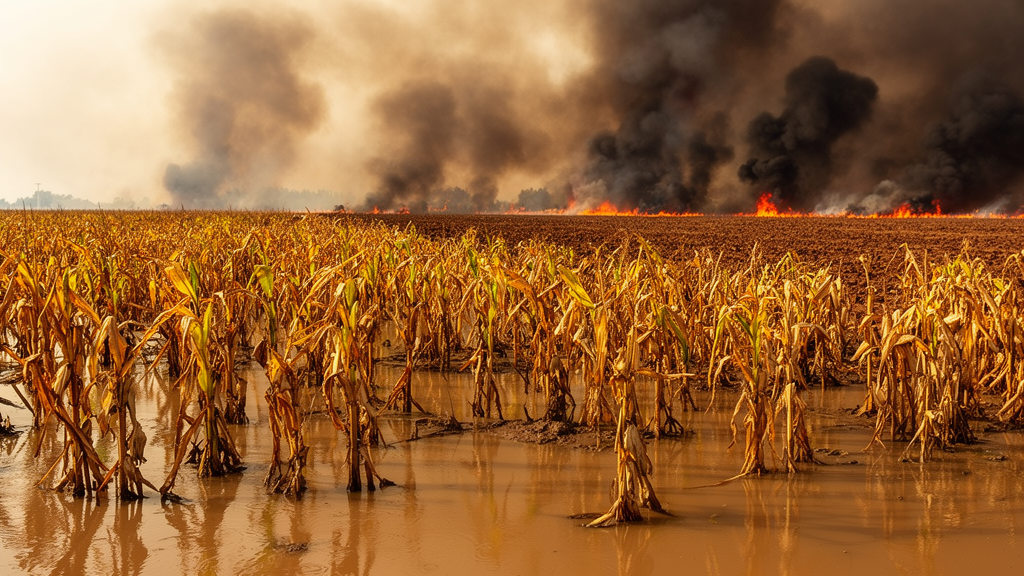
A multi-source data framework evaluating compound natural hazards found that a 1% increase in flood-wildfire co-occurrence risk was associated with global production reductions of 3% in maize, 3% in rice, 2% in soybean, and 2% in wheat. The assessment framework was developed to directly link concurrent disaster risks with staple-crop outputs, global trade patterns, and Sustainable Development Goal benchmarks.
Between 2002 and 2018, the investigation identified more than 242,000 global co-occurrence risk events distributed across nine classified levels. Spatial analysis revealed that these compound hazard risks were heavily concentrated geographically, with the highest occurrences documented in Central Africa and Mainland Southeast Asia.
Over the 17-year monitoring window, approximately 53% of all recorded co-occurrence risk events took place directly within staple-crop production areas. This substantial overlap highlights how frequently major agricultural production zones are exposed to joint flood and wildfire pressures.
The observed agricultural production decreases were further associated with projected declines in global commodities trade. Estimated reductions in worldwide exports averaged 24,314 kilotons for maize, 167,969 kilotons for rice, 35,653 kilotons for soybean, and 13,936 kilotons for wheat, with export contractions falling heavily on major suppliers including the United States and Thailand.
On an international scale, compound disaster exposures were associated with an average 3% decline in overall Sustainable Development Goal scores. These developmental disruptions were disproportionately concentrated in emerging economies, with 76% of the affected nations situated in the Global South.
The observed shifts in sustainability metrics included deteriorating international relationships, with SDGs 16 and 17 recording a combined change of -0.62. The framework also registered adverse impacts on marine ecosystems and gender equality, marked by a combined change of -0.54 across SDGs 14 and 5, demonstrating how compound disaster risks extend across broader ecological and social domains.
The development of this analytical framework addresses a major challenge in disaster research, where the concurrent occurrence of floods and wildfires complicates efforts to evaluate their full consequences on agricultural systems and international trade. By integrating multi-source datasets spanning the 2002 to 2018 period, the study systematically structured more than 242,000 co-occurrence events across nine distinct risk levels. This tiered categorization allowed researchers to trace how compound hazards cluster geographically, particularly within high-density hazard zones documented across Central Africa and Mainland Southeast Asia, and to quantify their direct intersection with key crop territories.
A critical finding of the modeling approach is the pathway through which local agricultural disruptions translate into broader supply constraints. Because approximately 53% of all recorded hazard events fell within staple-crop acreage, the measured production decreases in maize, rice, soybean, and wheat cascaded directly into global export projections. Major agricultural exporters experienced significant projected contractions, led by reductions in rice shipments totaling 167,969 kilotons and soybean exports dropping by 35,653 kilotons, alongside losses of 24,314 kilotons for maize and 13,936 kilotons for wheat. The projections emphasize that key producing countries, notably Thailand and the United States, play a disproportionate role in absorbing trade shocks caused by concurrent climate hazards.
Beyond agricultural production and trade volumes, the framework demonstrates how compound natural disasters affect interconnected international development goals. The average 3% decline in overall Sustainable Development Goal scores was heavily concentrated among vulnerable nations, with 76% of affected countries located in the Global South. These developmental setbacks manifested not only in weakened international cooperation and peace institutions, represented by a combined change of -0.62 across SDGs 16 and 17, but also in concurrent setbacks to marine ecosystems and gender equality, where SDGs 14 and 5 showed a combined change of -0.54. The authors conclude that capturing these cross-sector dynamics offers vital insights into the potential of natural disasters to disrupt global sustainability goals through a unified assessment framework.
Subject of Research: Impacts of flood and wildfire co-occurrence risks on global crop production, trade, and Sustainable Development Goals
Article Title: Flood-wildfire co-occurrence risks disrupt global staple food trade and erode SDG progress
Article References: Huan, S., Xiao, C., Feng, Z., Chen, W., Dong, H., & Peñuelas, J. (2026). Flood-wildfire co-occurrence risks disrupt global staple food trade and erode SDG progress. npj Science of Food. https://doi.org/10.1038/s41538-026-01111-z
Image Credits: AI Generated
DOI: 10.1038/s41538-026-01111-z
Keywords: flood risks, wildfire risks, co-occurrence risks, staple crop production, maize production, rice production, soybean production, wheat production, agricultural trade, crop export reductions, Sustainable Development Goals, Central Africa, Mainland Southeast Asia, Global South, United States exports, Thailand exports, marine ecosystems, gender equality
News Source: Alan Morgan. (November 16, 2026). Flood and Wildfire Risks Associated with Global Staple Crop Production Declines. Scienmag.