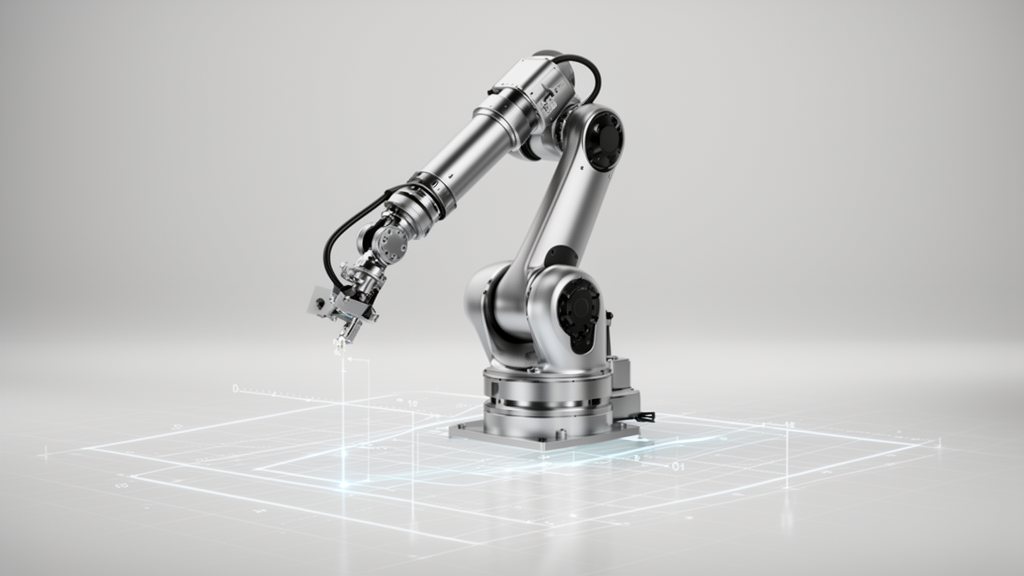
A research team has demonstrated an uncertainty-aware, two-stage computational compensation framework that enhances Cartesian positioning precision in a simulated four-degree-of-freedom serial robot by coupling point prediction with calibrated prediction intervals and safety-gated residual adjustment. Addressing a persistent limitation in automated manufacturing—where non-stationary parameter drift, friction memory, and sudden operational shifts degrade end-effector accuracy—the investigated methodology uses internal joint telemetry exclusively, dispensing with external optical or laser-tracking instruments during deployment. Across a controlled synthetic test sequence containing multi-axis drifts, high-frequency oscillations, and step discontinuities, the pipeline achieved axis-dependent positioning error reductions while maintaining empirical coverage near nominal target thresholds. The architecture integrates a long short-term memory sequence model with an auxiliary interval-generating network, feeding intermediate uncertainty metrics into compact secondary calibration models that adjust the final positional commands. The findings provide a reproducible, transparent algorithmic baseline demonstrating that quantifying predictive confidence allows robotic controllers to apply aggressive corrections during steady-state operations while enforcing conservative safeguards during sudden dynamical regime changes.
Achieving millimeter-level and sub-millimeter positional repeatability represents an ongoing engineering hurdle across precision handling, automated inspection, and light-process industrial applications. Although conventional geometric calibration based on standard kinematic models can resolve static offset discrepancies, persistent Cartesian deviations inevitably accumulate during extended duty cycles. These discrepancies arise from complex physical interactions, including mechanical gear reduction effects, joint compliance, structural backlash, thermal expansion, and non-linear friction. Because these phenomena depend heavily on instantaneous joint positions, velocities, and operational histories, traditional static lookup tables and purely geometric kinematic equations frequently fail when operating conditions shift. Data-driven compensation algorithms have consequently emerged to learn temporal mappings from joint states directly to Cartesian tool-tip errors. However, prevailing machine learning compensators operate strictly as deterministic point estimators, returning single-value corrections devoid of associated confidence bounds. Lacking rigorous uncertainty estimates, automated controllers cannot discern whether a neural model is operating within its training comfort zone or encountering severe, unmodeled disturbances, creating risks of over-correction near sudden operational transitions.
To rigorously investigate confidence-bounded error correction under controlled yet demanding dynamics, the investigators formulated a systematic benchmark based on a serial manipulator with four revolute joints described through classical Craig Denavit-Hartenberg conventions. Nominal end-effector positions were computed via forward kinematics, establishing the baseline coordinates from executed joint angles. In parallel, a synthetically generated ten-thousand-sample trajectory was constructed to serve as an idealized ground-truth positional reference. Deliberately amplified non-stationary perturbations were superimposed onto the synthetic trajectory to stress-test the pipeline under severe boundary conditions. While nominal positions remained essentially static across the run—registering approximately thirty millimeters along the horizontal axes and zero millimeters along the vertical axis—the synthetic measured trajectory introduced slow drifts and amplitude-modulated oscillations of approximately thirty millimeters along the primary horizontal coordinates, a prominent mid-sequence baseline step shift near sample five thousand on the lateral axis, and continuous zero-centered periodic oscillations of approximately twenty-five millimeters across the vertical coordinate.
The first stage of the computational architecture, designated as the joint predictor, accepts normalized sequences of joint positions and joint velocities compiled across a sliding historical window spanning twenty discrete time increments. By structuring the input vector as an eight-dimensional state across twenty sequential steps, the underlying model captures history-dependent positioning phenomena such as hysteresis, drift, and friction memory without peering into future trajectory intervals. A unidirectional long short-term memory network containing two stacked recurrent layers with sixty-four hidden units each processes the normalized sequence, projecting the final hidden representation through a linear output head to generate a three-dimensional Cartesian error point prediction expressed in millimeters. Optimized using the Adam algorithm against a standard mean squared error objective, this primary predictor models underlying trajectory dynamics while intentionally ignoring rotational end-effector components, thereby isolating non-stationary translational positioning errors from complex spatial orientation cross-coupling effects.
Simultaneously within Stage I, an auxiliary sequence model operates in parallel to estimate empirical prediction interval boundaries without relying on restrictive parametric probability distribution assumptions. The input to this auxiliary recurrent unit augments the normalized joint state history with the point prediction generated by the primary model, broadcasting the three predicted Cartesian coordinates across all twenty temporal steps. A single sixty-four-unit recurrent layer maps this augmented representation to separate interval midpoints and softplus-transformed positive width values, outputting lower and upper error bounds designed to encompass the ground-truth Cartesian disturbance at a nominal ninety-five percent confidence level. Training proceeds under a custom dual-objective loss function that mathematically balances empirical prediction-interval coverage probability against captured mean prediction-interval width. By penalizing instances where observed errors fall outside the computed bounds while discouraging excessive band expansion, the auxiliary model learns dynamic interval envelopes that expand automatically during steep transitional phases and contract during predictable steady-state cycles.
Stage II of the framework introduces a localized residual calibration mechanism that converts raw point estimates and corresponding uncertainty bounds into refined, actionable displacement offsets. For each independent Cartesian coordinate, a compact three-dimensional calibration feature vector is assembled at each sample step, consisting of the initial point estimate, the absolute prediction-interval width representing instantaneous predictive uncertainty, and the point midpoint skew quantifying structural asymmetry between the point prediction and the interval boundaries. To identify the most effective mapping between these features and the remaining unmodeled residual errors, three lightweight candidate calibrators are fitted on a dedicated validation dataset: an L2-regularized linear ridge regression model, a two-regime piecewise linear model partitioned by an interval width threshold, and an adaptive neuro-fuzzy inference system utilizing zero- or first-order Sugeno reasoning over normalized inputs. The architecture automatically selects the candidate yielding the lowest validation root-mean-square error for each respective coordinate.
To guarantee operational stability, the Stage II calibration stage incorporates three sequential algorithmic safeguards prior to issuing final positional adjustments. First, the three input features undergo standardization and winsorization clipping at three standard deviations, preventing extreme statistical outliers from distorting downstream regression estimates. Second, the calibrated residual adjustment generated by the secondary model is strictly clamped within an envelope proportional to the standard deviation of residuals observed during the calibration phase. Third, an automated fallback gate continuously evaluates model performance on validation data: if secondary residual calibration degrades root-mean-square error by more than two percent relative to the uncalibrated point predictor on any axis, the framework disables residual adjustment entirely and reverts to the primary point estimate. These safeguards ensure that the system suppresses aggressive, high-amplitude corrective actions whenever elevated uncertainty indicates that the primary recurrent network has lost tracking confidence.
Evaluation on the held-out test trajectory demonstrated that residual calibration achieves tangible accuracy gains across smooth and periodic regimes while successfully constraining corrections during sharp physical discontinuities. Along the primary horizontal axis, residual calibration reduced baseline tracking errors across slow drift cycles, delivering a four-point-seven percent decrease in root-mean-square error while generating an empirical interval coverage probability of ninety-four percent at a mean interval width of ten-point-nine millimeters. Along the vertical axis, dominated by persistent periodic oscillations, the framework tracked continuous cycles with negligible phase lag, reducing residual amplitude mismatches and lowering root-mean-square error by eight-point-one percent with a conservative coverage probability of ninety-nine percent and a mean width of eight-point-three millimeters. Conversely, on the lateral axis containing the severe step change, the interval upper bound truncated post-shift spikes, yielding eighty-three percent coverage and triggering the fallback gate to prevent adverse over-compensation.
Diagnostic evaluation using Probability Integral Transform histograms corroborated the numerical coverage metrics across all three Cartesian coordinates. In an ideally calibrated probabilistic predictor, the transform histogram displays a flat, uniform distribution across the unit interval, indicating that observed realizations match theoretical predictive densities. For the vertical axis, the diagnostic histogram closely matched the uniform baseline, confirming that the auxiliary network produced reliable, well-calibrated bounds during sustained oscillatory motion. The primary horizontal axis exhibited a slight central hump, signaling mild over-dispersion and conservative interval margins consistent with its ninety-four percent empirical coverage. In contrast, the lateral axis produced a pronounced right-skewed histogram, confirming systematic upper-tail under-coverage precisely where the large mid-sequence step shift occurred. This diagnostic alignment confirms that the computed interval widths serve as dependable proxies for local tracking difficulty, expanding near sudden deviations to warn downstream controllers of compromised predictive accuracy.
To verify that the proposed compensation strategy generalizes across distinct motion regimes rather than overfitting specific trajectory profiles, the investigators conducted a comprehensive leave-one-trajectory-out cross-validation across all data groups. For each experimental fold, an entire motion sequence was held out for testing while normalizations, recurrent predictors, and candidate calibrators were fitted exclusively on remaining trajectories. Across all validation folds, the calibrated pipeline consistently outperformed the point-only baseline on average, achieving a mean root-mean-square error reduction of three-point-nine-seven percent with an empirical coverage of ninety-three-point-one percent on the primary axis, a six-point-seven-one percent mean error reduction with ninety-six-point-nine percent coverage on the lateral axis, and a one-point-five-zero percent mean error reduction with ninety-eight-point-three percent coverage on the vertical coordinate. The consistent performance observed across unseen trajectories confirmed that interval-guided residual calibration provides systematic error reduction while preventing destabilizing over-corrections under generalized kinematic motion.
Notwithstanding these encouraging outcomes, the authors emphasize critical experimental limitations inherent in the current study design. The analysis was conducted entirely offline within a kinematic simulation environment using an idealized ground-truth positional reference, explicitly omitting physical sensor noise, computational communication latencies, and mechanical backlash encountered in physical hardware. Furthermore, the framework evaluates only three-dimensional translational errors, leaving rotational orientations and full six-degree-of-freedom spatial poses unaddressed. Because the recurrent network relies exclusively on retrospective joint positions and velocities, it operates purely reactively without anticipating planned trajectory waypoints. Additionally, the formulation assumes that upstream robot motion controllers resolve inverse kinematic multiplicity independently, restricting the learned error model to specific executed joint configurations. Future investigations will seek to validate the pipeline on physical industrial manipulators, extend the formulation to full spatial poses, incorporate explicit external payload dynamics, and integrate calibrated prediction intervals directly into closed-loop supervisory motion control systems.
Subject of Research: Uncertainty-aware Cartesian error compensation in industrial robotics
Article Title: Uncertainty-aware Cartesian error compensation in industrial robots via point interval prediction and residual calibration
Article References: Haq, I. U., Alfonso, L. D., Longo, L., Fedele, G., & Lamonaca, F. (2026). Uncertainty-aware Cartesian error compensation in industrial robots via point interval prediction and residual calibration. Discover Robotics, 2(1), Article 2. https://doi.org/10.1007/s44430-026-00017-5
Image Credits: AI Generated
DOI: 10.1007/s44430-026-00017-5
Keywords: robot error compensation, Cartesian positioning, industrial robotics, prediction intervals, residual calibration, long short-term memory, joint telemetry, prediction interval coverage probability, mean prediction interval width, adaptive neuro-fuzzy inference system, kinematic calibration, Denavit-Hartenberg parameters, probability integral transform, leave-one-trajectory-out, safety gating, uncertainty quantification, synthetic dataset
News Source: Denise Maddox. (November 16, 2026). Calibrated Interval Pipeline Improves Industrial Robot Cartesian Positioning in Simulation. Scienmag.