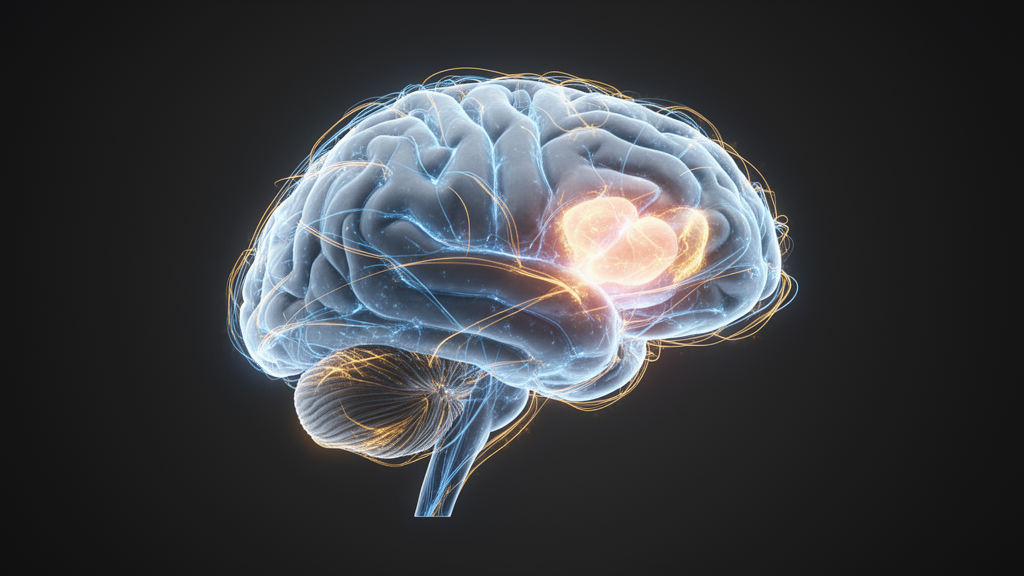
Researchers at the University Medical Center Hamburg have identified specific brain regions that enable humans to learn about temporal threat uncertainty by observing others. Published in Translational Psychiatry, the study demonstrates that the amygdala, hippocampus, and anterior insula are actively engaged when individuals learn to distinguish between predictable and unpredictable threats through social observation. This work extends previous neuroscience research, which had primarily focused on observational threats that were temporally predictable, by introducing a novel paradigm that incorporates unpredictable threat conditions.
The study was designed to investigate how the brain encodes predictive and unpredictive threat cues observed in others. In firsthand learning, temporally predictable and unpredictable threats are mechanistically discernible, resulting in distinct defensive responses. The researchers aimed to determine if similar neural mechanisms apply when learning is vicarious. By developing an observational paradigm, the team allowed participants to learn from predictable and unpredictable observational threats, as well as a no-threat condition, to understand the social aspects of fear and anxiety disorders.
The investigation comprised two experiments. Experiment 1 was a behavioral laboratory study involving 20 healthy participants, while Experiment 2 utilized functional magnetic resonance imaging (fMRI) with 23 participants to examine the underlying neural correlates. In both experiments, participants watched video clips of a demonstrator undergoing a painful blood-pressure measurement. The demonstrator’s pain expression served as an unconditioned aversive stimulus, allowing participants to learn threat contingencies without direct exposure to the pain.
The experimental design featured three distinct conditions: predictable, unpredictable, and neutral. In the predictable condition, the demonstrator’s pain was temporally linked to a visual cue, specifically a colored portion of a moving slider bar. In the unpredictable condition, pain occurred at random times, meaning the visual cue had no predictive value. The neutral condition involved no pain expression. Participants were not informed about these contingencies, requiring them to resolve the threat-related information solely through observation.
Behavioral results from both experiments confirmed that participants successfully learned the threat contingencies. In the expression phase, where participants faced the cues without actual pain, threat expectations were significantly higher for predictive cues and unpredictable condition onsets compared to the neutral condition. The data showed a significant interaction between condition and cue prominence, indicating that participants could discriminate between the temporal predictability of the cues and the overall condition context.
Neuroimaging data from Experiment 2 revealed that the observation of pain across predictable and unpredictable conditions elicited activation in the left insula and amygdala. When compared to the neutral condition, the observation of predictable pain specifically engaged the right hippocampus. This finding suggests that the hippocampus plays a role in integrating observed pain into learned predictions, particularly when the threat is temporally structured.
Further analysis of the fMRI data showed that the brain’s response to threat cues changed dynamically during the learning process. Amygdala activation in response to predictive threat cues displayed a linear decrease across trials, reflecting the resolution of prediction error as learning progressed. In contrast, activity to unpredictive cues remained sustained or increased. This pattern indicates that the brain rapidly resolves predictable threats while maintaining a state of surveillance for unpredictable ones.
The anterior insula was found to be central to resolving temporal threat uncertainty. During the expression phase, the right insula showed a specific activation pattern that mirrored the participants’ behavioral ratings of cue prominence. This neural response suggests that the anterior insula is involved in computing affective responses in uncertain conditions of threat, extending its known role in firsthand threat anticipation to the domain of observational learning.
The hippocampus also demonstrated a dual role in this process. It was involved in encoding threat cues and uncertain threat condition onsets during the observation phase. In the expression phase, the hippocampus showed sustained activation across the whole trial in the unpredictable condition compared to the predictable one. This sustained engagement is consistent with the hippocampus’s established role in contextual fear learning, where the absence of predictive cues leads to a generalized state of arousal.
The study highlights that the balance between predictive cues and unpredictable conditions in observational learning closely mirrors that of firsthand learning. The researchers noted that the amygdala and insula, key regions in pain observation, were enhanced during the predictable observation of painful experiences. This enhanced activity may reflect the additional neural resources required to resolve temporal predictability, as predictive threat cues increased activity to observed pain relative to temporally unpredictable experiences.
Limitations of the study include the relatively small sample size in the fMRI experiment and the use of explicit expectation queries rather than startle-probes, which are commonly used in firsthand learning tasks. Additionally, the skin conductance response data was limited by quality issues, preventing a full psychophysiological analysis. The researchers acknowledged that the visual comparison of behavioral results between the two experiments indicated generally lower threat expectation ratings in the fMRI study, potentially due to extinction learning from the absence of actual stimulation.
These findings provide a neural basis for vicarious learning of cued and sustained threats, offering new perspectives on how humans understand fear and anxiety as socially connected individuals. By showing that learning processes related to temporal certainty of threats closely mirror those from firsthand learning, the study contributes to a broader understanding of how vicarious processes contribute to threat learning. This knowledge may aid in broadening the understanding of fear, anxiety, and anxiety-related disorders in clinical and social contexts.
The research underscores the importance of social observation in shaping our defensive responses. By identifying the specific roles of the amygdala, hippocampus, and anterior insula, the study offers insights into the dynamic neural mechanisms that allow humans to navigate a world where threats are often learned through the experiences of others rather than direct encounter.
Methodological rigor guided participant recruitment and sample determination across both experiments conducted at the University Medical Center Hamburg. For Experiment 1, researchers enrolled 20 healthy volunteers, comprising 14 females and 6 males aged between 18 and 40 years. Eligibility screening verified normal vision and excluded anyone with current or previous psychiatric disorders, neurological conditions, psychoactive medication use, or participation in threat-conditioning experiments during the prior three months. To establish the cohort for Experiment 2, the authors conducted an a priori power calculation using GPower software based on the robust interaction effect size observed in the behavioral study. This calculation demonstrated statistical power exceeding 99 percent for 20 participants. The investigators consequently recruited 25 individuals to account for potential dropouts while enforcing additional safety criteria regarding ferromagnetic or electrical implants. Technical issues during stimulus delivery excluded one participant, and severe head motion precluding co-registration removed a second, leaving 23 participants, including 9 females, 1 non-binary individual, and 13 males, in the final neuroimaging analysis.
The researchers prepared standardized stimulus material by recording 33 video clips for each pain condition, featuring a demonstrator who received painful cutaneous heat from a thermode strapped under an arm cuff. Three independent reviewers evaluated the clips by assessing visible pain duration, perceived intensity, and five objective facial expressions: lip pressing, head protrusion, eye closure, forehead wrinkling, and masseter contraction. Clips displaying at least four of these facial markers underwent propensity-score matching based on mean rated intensity and duration. By narrowing the matching caliper, the authors isolated a balanced set of 12 clips per condition for Experiment 1 and 10 clips per condition for Experiment 2. Statistical checks confirmed that the selected predictable and unpredictable video clips did not differ significantly in demonstrator pain intensity or visible pain duration, ensuring that differences in learning were not driven by discrepancies in the demonstrator’s overt distress.
Experimental presentation and rating structures differed subtly between the laboratory and neuroimaging environments. During each 24-second trial, a black slider traversed one of three stacked horizontal bars displaying colored cue segments. In Experiment 1, participants rated pain intensity after every video clip during observation and reported self-directed as well as other-directed threat expectations across 12 trials during expression. Ratings were recorded at condition onset, during the cue, and at condition offset on continuous visual scales bounded between minus 100 for certainly no pain and plus 100 for certainly pain, with zero denoting uncertainty. To facilitate uninterrupted functional scanning in Experiment 2, the protocol collected baseline expectations prior to learning, eliminated ratings regarding the demonstrator, and queried self-directed threat expectations during only three of the twelve trials in each phase. Furthermore, Experiment 2 volunteers wore an arm cuff identical to the demonstrator’s and were advised that it might deliver unpleasant sensations, though no actual painful stimulation occurred during testing.
Neuroimaging acquisition utilized a 3 Tesla Siemens Prisma scanner to collect echo-planar images, focusing second-level analyses on predefined regions of interest within the insula, hippocampus, and amygdala subregions. Modeling demonstrated that observing unpredictable threats elicited sustained activation across entire trials within the right basolateral amygdala compared to predictable trials. During expression, encountering unpredictive cues prompted heightened left hippocampal responses, alongside sustained hippocampal engagement throughout unpredictable trials. The authors also sought physiological confirmation by measuring skin conductance responses through two palmar electrodes sampled at 1000 Hertz. However, pervasive recording artifacts and flatline responses severely compromised data quality, leaving complete recordings for only 13 participants across both experimental phases. Consequently, while functional neuroimaging successfully delineated the subregional contributions of the centromedial amygdala, basolateral amygdala, and hippocampus to vicarious threat resolution, psychophysiological verification remained constrained by acquisition loss.
Subject of Research: Neural mechanisms of observational threat learning
Article Title: Resolving temporal threat uncertainty by observational learning involves the amygdala, hippocampus and anterior insula
Article References: Knobloch, S., Jansen, T., Hille, L. C., Müller, M., Rumpf, L., Bauer, C. F. L., & Haaker, J. (2026). Resolving temporal threat uncertainty by observational learning involves the amygdala, hippocampus and anterior insula. Translational Psychiatry, 16(1), Article 488. https://doi.org/10.1038/s41398-026-04492-7
Image Credits: AI Generated
DOI: 10.1038/s41398-026-04492-7
Keywords: observational learning, temporal threat uncertainty, amygdala activation, hippocampal function, anterior insula, fMRI neuroimaging, pain perception, threat conditioning, social fear learning, prediction error, cued threat, contextual threat, behavioral neuroscience, anxiety disorders, vicarious learning, University Medical Center Hamburg, Translational Psychiatry, neural plasticity, defensive responses, social cognition
News Source: Glenn Wilkins. (November 15, 2026). Brain regions help humans learn threat uncertainty from others. Scienmag.