Credit: Drexel University
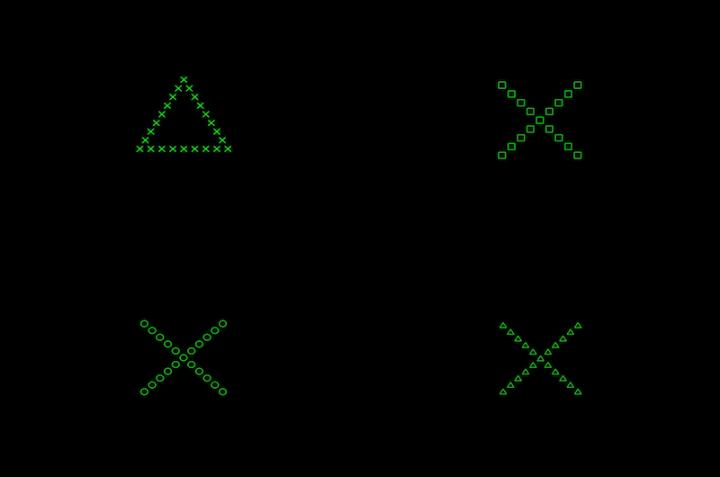
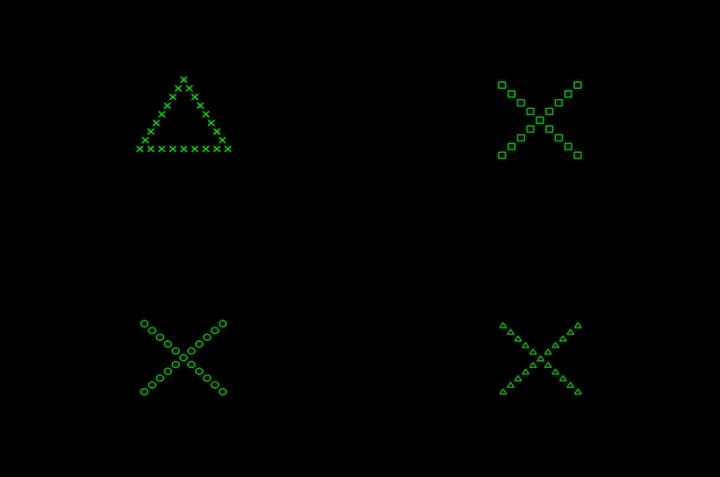
Take a look at the images above. A healthy brain can quickly switch its focus from the large shapes to the individual parts that make up the bigger pictures.
But imagine taking a test in which a different shape flashes in front of your eyes every two seconds. You're asked to name the larger (global) shape if the image is green, and the smaller (local) shape if the image is white. How well would you do?
This skill is called cognitive flexibility, and it is involved in virtually every complex behavior we undertake — from mental arithmetic to driving a car, according to John Medaglia, PhD, an assistant professor of psychology in the College of Arts and Sciences at Drexel University.
"How fast people can make that transition – from the global to the local – is the switch cost, and that's our index of flexibility," he said. "For some people, that's a very jarring, effortful task. Even if you've learned the rules very well, it's hard to make the right decision when things are happening fast."
Principal Investigator Medaglia and his colleagues at the University of Pennsylvania recently tested 30 subjects with this very task while measuring their brain activity with functional magnetic resonance imaging (fMRI) scanning. The authors then combined measures of human behavior, the structure and function of the brain, and mathematics known as "graph signal processing" to reveal a potential basis for cognitive flexibility.
Their research, published this week in Nature Human Behaviour, uncovers a new, structure-function correlation of human behavior. The study shows that the extent to which brain signals "stick" to white matter networks – or the brain's highway system – is associated with cognitive flexibility. This suggests that some brains are at a natural advantage to meet switching demands.
"The type of mathematics used to uncover this marker of cognitive flexibility in healthy adults takes into account the complex pattern of interconnectivity between different parts of the brain, and how information can travel across it," said Danielle S. Bassett, PhD, an associate professor at the University of Pennsylvania School of Engineering and Applied Science.
Though a hallmark of human cognition, flexible switching varies widely from person to person, and is associated with a measurable mental cost: Moving from one task to another extends the time it takes for you to respond to stimuli. For patients with neurological syndromes, this strain is even greater and can hamper someone's ability to complete everyday tasks. Stroke victims, for instance, might have trouble making calculations or expanding their awareness while driving.
Shifts in mental focus – like viewing the forrest through the trees, so to speak — are accompanied by transient changes in brain activity occurring on top of a stable, anatomical architecture of underlying white matter tracts. White matter is the brain's highway system that connects various regions and carries nerve impulses between neurons. Until now, no single measure existed for understanding how these complex processes work together in the brain to contribute to cognitive flexibility.
"Our behavior is determined both by the way the brain is structured, and, to some extent, the way it is dynamic, or changes over time," Medaglia said. "We wanted to find a way to study both of those things at the same time."
To address the challenge, the researchers tried a new approach: They imagined the extent to which the "traffic," or changing dynamics of the mind, align with the brain's underlying "roadways," or structural, unchanging pathways.
While subjects participated in the cognitive switch test, the research team collected diffusion spectrum imaging data, which providces a measure of an individual's white matter networks. They also collected blood oxygen level dependent signals from fMRI. From this data, the scientists constructed a white matter graph of the brain, as well as a lap of "aligned" and "liberal" fMRI signals. The "aligned" signals represented those that "stuck" most closely to white matter, or "highway" anatomy, while the "liberal" signals represented those that deviated.
Their results showed that the alignment between the most "liberal" functional signals and the architecture of the underlying white matter network was associated with greater cognitive flexibility. These findings suggest that some brains are actually at a natural advantage to meet switching demands. They also validate a new method for measuring cognitive flexibility and open a new door for better understanding neurological disorders.
The study, Medaglia explained, provided a "big picture" of cognitive flexibility, which is essential for future research.
"When thinking about how flexible someone's brain is, or treating someone who is suffering, we now have a new way to answer, 'Where do I need them to go? What kind of brain do we want to have?' Without a measure for that, you don't know what to do next," he said. "This study opened a new door."
###
Apoorva Kelkar of Drexel, along with Weiyu Huang, Elisabeth A. Karuza, Sharon L. Thompson-Schill and Alejandro Ribeiro, all of the University of Pennsylvania, also contributed to this research.
Media Contact
Lauren Ingeno
[email protected]
215-895-2614
@DrexelNews
http://www.Drexel.edu/
Original Source
http://drexel.edu/now/archive/2017/December/Cognitive-Flexibility-Wired-in-Brain/ http://dx.doi.org/10.1038/s41562-017-0260-9