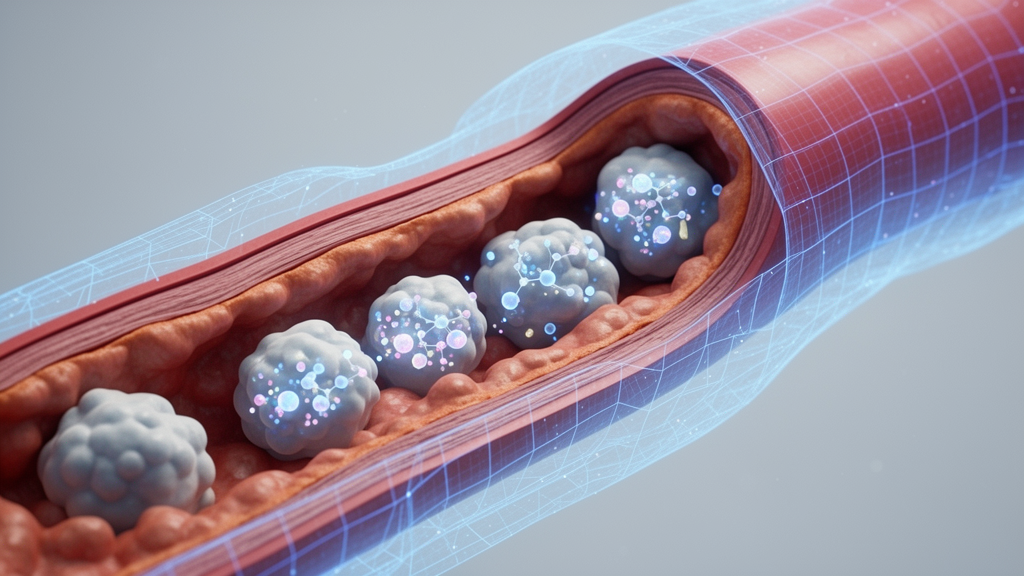
Despite growing recognition of mitophagy’s contribution to vascular disease pathogenesis, the specific molecular signatures associated with atherosclerotic plaques have remained incompletely characterized. In an exploratory investigation, researchers applied transcriptomic profiling and computational workflows to systematically identify and validate mitophagy-associated genes linked to plaque tissue.
To investigate potential disease markers, the investigators conducted a paired differential expression analysis using the transcriptomic dataset GSE43292. This discovery cohort comprised 32 plaque samples paired with 32 macroscopically intact carotid tissue samples, which served as comparator specimens representing Stary types I to II. The authors combined differential expression screening with weighted gene co-expression network analysis to define a distinct plaque-associated gene module, isolating relevant transcriptional shifts within diseased arterial walls.
The identified plaque-associated module was subsequently intersected with a reference set of 4,922 mitophagy-associated genes cataloged in GeneCards. From the initial paired analysis of GSE43292, which identified a total of 1,249 differentially expressed genes, 107 genes were determined to be specifically mitophagy-related. This subset formed the basis for downstream feature selection aimed at isolating the most informative candidate markers of plaque pathology.
To prioritize key genes, the researchers implemented an auxiliary, patient-grouped, cross-validated machine-learning feature-selection workflow incorporating LASSO regression, Random Forest, and XGBoost algorithms. This multi-algorithm consensus nominated three primary candidate markers: HAND2, NRP1, and RNF213. When fitted onto these three shared genes, a logistic-regression model achieved an out-of-fold area under the receiver operating characteristic curve of 0.892, with a 95 percent confidence interval ranging from 0.810 to 0.973, reflecting strong exploratory discrimination.
External validation was subsequently performed using the independent dataset GSE100927, which included 69 plaque specimens and 35 control peripheral artery samples. All three machine-learning-nominated candidates were directionally reproduced in this external cohort, yielding direction-locked area under the curve values of 0.814 for HAND2, 0.942 for NRP1, and 0.848 for RNF213.
The study also evaluated three additional genes selected a priori for their potential relevance. Among these candidates, MLXIP and EPB41L4A-AS1 successfully replicated in the external GSE100927 cohort, both demonstrating an area under the curve of 0.834.
Beyond single-gene profiling, the authors assessed immune cell infiltration patterns using the CIBERSORT computational algorithm. The analysis revealed marked shifts in the local inflammatory microenvironment of plaques, characterized by higher fractions of macrophages and memory B cells alongside lower fractions of regulatory T cells. These cellular alterations point toward a coordinated mitophagy-immune axis operating within the microenvironment of developing atherosclerotic lesions.
To supplement transcriptomic findings, the researchers explored protein abundance in an in vivo experiment using an ApoE-deficient murine model with three animals per group. Western blot analysis showed that aortic MLXIP protein abundance was 37.7-fold higher in atherosclerotic mice than in control animals, although this difference did not attain statistical significance, yielding a P-value of 0.11 alongside unchanged MLXIP messenger RNA levels.
The authors emphasized that because initial machine-learning feature selection and logistic regression evaluation utilized the same discovery cohort, the initial performance metrics remain strictly exploratory. Furthermore, the small animal sample size means the in vivo protein observations remain directional only. The research team concluded that these transcriptomic markers and the proposed mitophagy-immune axis provide hypothesis-generating insights that require formal confirmation in larger cohorts.
Subject of Research: Transcriptomic identification of mitophagy-related atherosclerotic plaque markers
Article Title: Transcriptomic identification of mitophagy-related plaque markers HAND2, NRP1 and RNF213, with external replication and in vivo validation of MLXIP
Article References: Wang, D., He, X., Lian, S., Fu, Y., Liang, C., Wang, J., & Liu, X. (2026). Transcriptomic identification of mitophagy-related plaque markers HAND2, NRP1 and RNF213, with external replication and in vivo validation of MLXIP. Frontiers in Cardiovascular Medicine, 13, Article 1932411. https://doi.org/10.3389/fcvm.2026.1932411
Image Credits: AI Generated
DOI: 10.3389/fcvm.2026.1932411
Keywords: Atherosclerosis, Mitophagy, HAND2, NRP1, RNF213, MLXIP, EPB41L4A-AS1, Transcriptomics, Machine Learning, LASSO, Random Forest, XGBoost, CIBERSORT, Carotid Plaque, Immune Infiltration, ApoE Mouse Model, Cardiovascular Medicine
News Source: Teresa Odom. (November 15, 2026). Machine Learning Identifies Mitophagy Markers in Atherosclerotic Plaques. Scienmag.