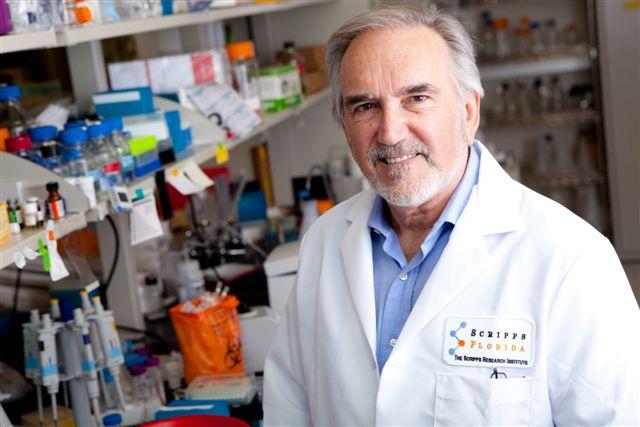

JUPITER, FL – Nov. 19, 2015 – In a new study that could have implications for future drug discovery efforts for a number of neurodegenerative diseases, scientists from the Florida campus of The Scripps Research Institute (TSRI) have found that the interaction between a pair of brain proteins has a substantial and previously unrecognized effect on memory formation.
The study, which was published November 19, 2015 by the journal Cell, focuses on two receptors previously believed to be unrelated–one for the neurotransmitter dopamine, which is involved in learning and memory, reward-motivated behavior, motor control and other functions, and the other for the hormone ghrelin, which has been connected to appetite as well as the distribution and use of energy.
"Our immediate question was, what is the ghrelin receptor doing in the brain since the natural ligand–ghrelin–for it is missing? What is its functional role?" said Roy Smith, chair of TSRI's Department of Metabolism and Aging. "We found in animal models that when these two receptors interact, the ghrelin receptor changes the structure of the dopamine receptor and alters its signaling pathway. This is important because many drugs used currently in the clinic, for example for schizophrenia, have poor compliance because of adverse side effects. This discovery opens the door to using neuronal agents that indirectly modify dopamine signaling by pharmacologically targeting the ghrelin receptor–and potentially dramatically reducing side effects."
"This concept has potentially profound therapeutic implications," said Andras Kern, the first author of the study and a staff scientist in the Smith lab, "pointing to a possible strategy for selective fine-tuning of dopamine signaling in neurons related to memory. By using small molecules binding to the ghrelin receptor we can enhance or inhibit dopamine signaling."
Challenging the current theory, which involves canonical dopamine signaling in neurons, the new study shows that the biologically active ghrelin-dopamine receptor complex produces synaptic plasticity, the ability of the brain's synapses (parts of nerve cells that communicate with other nerve cells) to grow and expand, the biological process underpinning long-term memory formation.
In addition, when the researchers blocked the ghrelin receptor, dopamine-dependent memory formation was inhibited in animal models, demonstrating the mechanism is essential to that process.
Combined with conclusions from earlier studies that showed a significant role for the ghrelin receptor in neurons that regulate food intake, insulin release and immune system deterioration due to aging, the new study further expands the ghrelin receptor's importance. In animal models, ghrelin inhibits neuronal loss associated with Parkinson's disease, and stroke, Smith noted, and the new study underlines its possible role in treating memory loss, age related or otherwise.
"All in all, it's a pretty amazing receptor," he said.
###
In addition to Smith and Kern, other authors of the study, "Hippocampal Dopamine/DRD1 Signaling Dependent on the Ghrelin Receptor," are Maria Mavrikaki, Celine Ullrich, Rosie Albarran-Zeckler and Alicia Faruzzi Brantley of TSRI.
This work was supported by the National Institutes of Health (grant R01AG019230).
About The Scripps Research Institute
The Scripps Research Institute (TSRI) is one of the world's largest independent, not-for-profit organizations focusing on research in the biomedical sciences. TSRI is internationally recognized for its contributions to science and health, including its role in laying the foundation for new treatments for cancer, rheumatoid arthritis, hemophilia, and other diseases. An institution that evolved from the Scripps Metabolic Clinic founded by philanthropist Ellen Browning Scripps in 1924, the institute now employs about 2,700 people on its campuses in La Jolla, CA, and Jupiter, FL, where its renowned scientists — including two Nobel laureates — work toward their next discoveries. The institute's graduate program, which awards PhD degrees in biology and chemistry, ranks among the top ten of its kind in the nation. For more information, see http://www.scripps.edu.