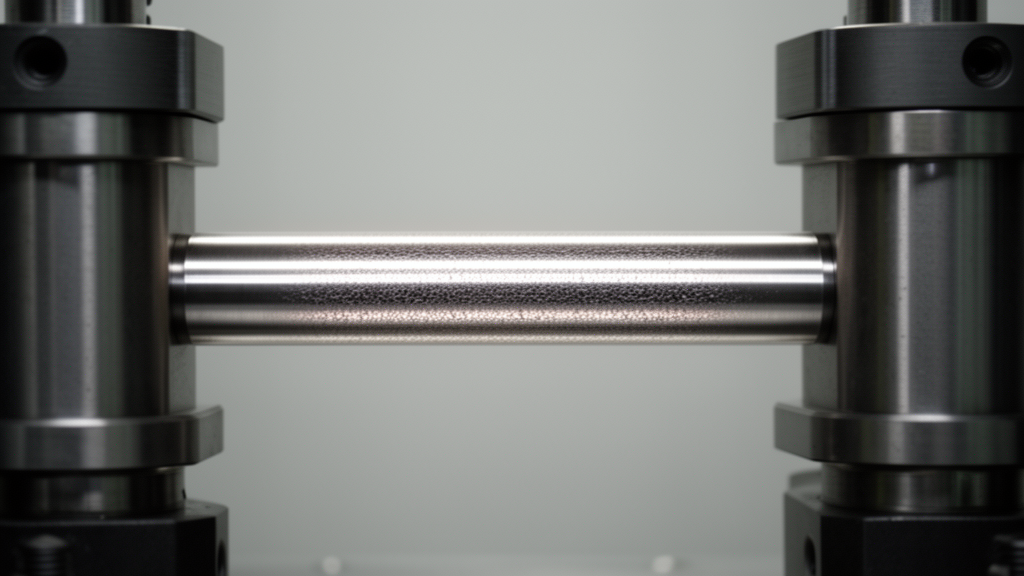
Researchers have fabricated a forging preform of AA7075 aluminum alloy with near-zero porosity using squeeze casting. Microstructural analysis of the aluminum-zinc-magnesium-copper alloy preform, with an Al-5.28Zn-1.87Mg-1.45Cu composition, revealed rosette-type α-Al dendrites accompanied by an interdendritic network of eutectic M- and θ-phases.
To evaluate the material’s forgeability and determine suitable hot-forging conditions, hot-compression tests were conducted across a temperature range of 250 °C to 475 °C and strain rates spanning 0.001 s⁻¹ to 0.1 s⁻¹. Experimental flow curves displayed pronounced thermal softening, demonstrating that deformation temperature exerted a greater influence on the plastic flow response than strain rate.
Constitutive modeling evaluated three formulations to capture the alloy’s deformation behavior. Among these candidates, a strain-compensated modified Zerilli-Armstrong model demonstrated the highest predictive capability, tracking plastic flow with an average absolute error of 4.3% across the entire experimental range.
A processing map developed at 0.92 true strain established two distinct domains of maximum forgeability efficiency. These processing regimes achieved maximum power dissipation efficiencies of approximately 36% and 41%.
Microstructural examination indicated that thermally activated and dislocation-assisted eutectic dissolution triggered dynamic precipitation of η and η′ phases, which substantially altered plastic flow at elevated temperatures. Deformation mechanisms shifted across temperature regimes, with dynamic recovery dominating at 325 °C and dynamic recrystallization governing flow between 400 °C and 475 °C.
Under deformation at 475 °C and a strain rate of 0.001 s⁻¹, geometric dynamic recrystallization prevailed, though power dissipation efficiency declined because dynamic precipitation produced flow hardening during later stages of deformation. Increasing the strain rate to 0.1 s⁻¹ promoted continuous dynamic recrystallization and particle-stimulated nucleation-assisted dynamic recrystallization, overcoming the precipitation hardening effect and yielding enhanced forgeability compared with preforms produced by alternative fabrication methods reported in the literature.
Subject of Research: Forgeability and microstructural evolution of squeeze-cast AA7075 aluminum alloy
Article Title: Forgeability assessment of squeeze-cast AA7075 alloy: plastic flow, processing map, and microstructural evolution
Article References: Kundu, P., Mandal, S., & Panda, S. K. (2026). Forgeability assessment of squeeze-cast AA7075 alloy: plastic flow, processing map, and microstructural evolution. Journal of Materials Science. https://doi.org/10.1007/s10853-026-13965-5
Image Credits: AI Generated
DOI: 10.1007/s10853-026-13965-5
Keywords: AA7075 alloy, squeeze casting, forgeability assessment, plastic flow, processing map, microstructural evolution, hot-compression tests, thermal softening, Zerilli-Armstrong model, power dissipation efficiency, dynamic precipitation, dynamic recovery, dynamic recrystallization, geometric dynamic recrystallization, particle-stimulated nucleation, eutectic dissolution
News Source: Neil Sanderson. (November 15, 2026). Squeeze-Cast AA7075 Alloy Shows Enhanced Forgeability in Hot Compression Tests. Scienmag.