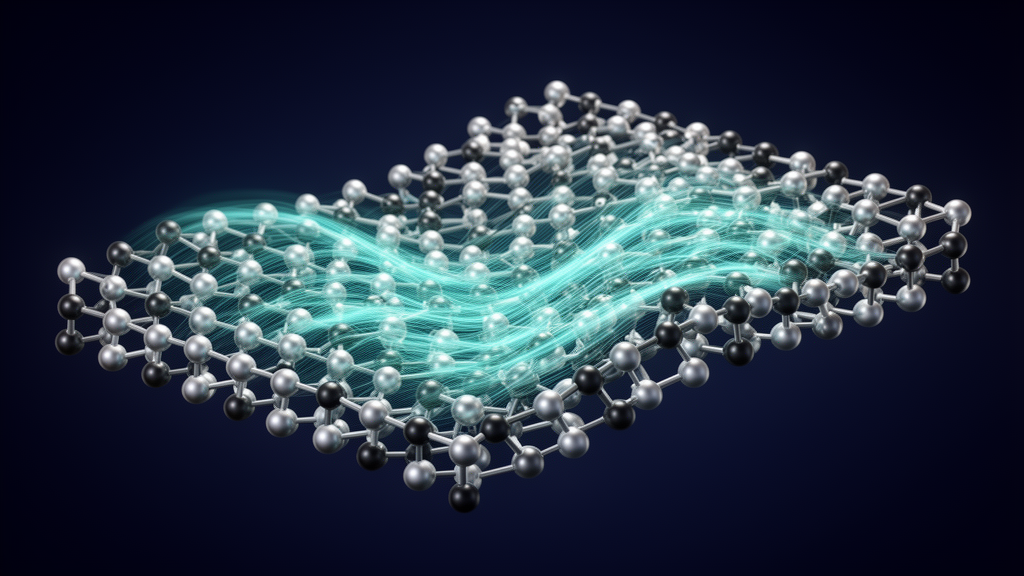
Computational physicists have identified a two-dimensional Janus chromium manganese carbide fluoride monolayer, designated as CrMnCF2, that theoretically unites robust ferromagnetism, spontaneous valley polarization, and distinct magneto-optical activity within a single atomic framework. By integrating two different transition metals across its basal plane, the proposed material breaks structural inversion symmetry while sustaining an intrinsic out-of-plane electric field. The research demonstrates that the interplay between broken inversion symmetry, spontaneous ferromagnetic ordering, and spin-orbit coupling generates a robust valley splitting of approximately 33 millielectronvolts at the valence band edges. These theoretical findings establish the fluorinated bimetallic Janus monolayer as an adaptable candidate for low-dimensional spintronic circuits, valleytronic processing architectures, and non-volatile field-free magneto-optical devices.
The engineered lattice of the Janus CrMnCF2 monolayer is derived conceptually from the symmetric MXene phase Mn2CF2 by substituting one layer of manganese atoms with chromium. Geometric optimization conducted using density functional theory with generalized gradient approximations and Hubbard U corrections yields a hexagonal equilibrium lattice constant of 2.98 angstroms. Structurally, the sheet forms an ordered five-layer atomic sequence stacked in a fluorine-chromium-carbon-manganese-fluorine arrangement perpendicular to the two-dimensional basal plane. Within this geometry, the central carbon layer is flanked symmetrically by chromium and manganese atoms, with the outer surfaces fully terminated by fluorine atoms. This unilateral transition metal substitution breaks mirror reflection symmetry across the midplane, inducing an intrinsic electrostatic potential offset. Planar-averaged potential calculations verify a vacuum level discrepancy of roughly 0.25 electronvolts between opposing faces, confirming the emergence of a permanent built-in out-of-plane electric field.
To evaluate whether the theoretical monolayer can be experimentally synthesized, the researchers performed extensive assessments of its thermodynamic, dynamical, thermal, and mechanical stability. Dynamical stability was verified through phonon dispersion calculations across the full Brillouin zone, which revealed no imaginary frequency branches that would signal spontaneous lattice collapse. In addition, ab initio molecular dynamics simulations carried out at 300 Kelvin using an NVT ensemble over three picoseconds demonstrated that the total energy fluctuates smoothly near equilibrium without bond breaking or structural deterioration.
Investigation of the magnetic ground state revealed that the Janus CrMnCF2 monolayer strongly favors ferromagnetic alignment over ferrimagnetic and antiferromagnetic configurations. Total energy comparisons among four distinct magnetic arrangements in a supercell showed that the ferromagnetic state possesses the lowest energy minimum. Magnetic moment analysis indicated that magnetism is concentrated almost entirely within the transition metal sublattices, with chromium atoms carrying local moments of approximately 3.2 Bohr magnetons and manganese atoms possessing approximately 4.0 Bohr magnetons. In contrast, the contributions from carbon and fluorine atoms remain negligible. Spin-resolved projected density of states calculations showed that these sizable moments stem from exchange-driven splitting among localized transition-metal 3d orbitals in high-spin electronic configurations. Furthermore, noncollinear magnetic calculations incorporating spin-orbit coupling revealed a magnetic anisotropy energy of 31.80 microelectronvolts per unit cell. The positive sign of this anisotropy energy confirms that the magnetic easy axis is oriented strictly along the out-of-plane direction, a prerequisite for lifting valley degeneracy.
To explain the origin of this robust ferromagnetic ordering, the researchers mapped total DFT energies onto a Heisenberg spin Hamiltonian incorporating three distinct exchange pathways. All three extracted exchange parameters are positive, indicating dominant ferromagnetic coupling mediated through an efficient chromium-carbon-manganese superexchange interaction facilitated by extended carbon p orbitals. Driven by the dominant interlayer superexchange channel, Monte Carlo simulations based on the Heisenberg model predicted a theoretical Curie temperature of approximately 1,076 Kelvin. While this high transition temperature highlights strong intrinsic magnetic coupling, the researchers noted that higher-order exchange interactions, finite-size effects, and thermal fluctuations could influence the actual experimental Curie temperature.
Electronic band structure calculations without spin-orbit coupling established that the Janus CrMnCF2 monolayer behaves as an indirect bandgap semiconductor with an energy gap of approximately 0.20 electronvolts. The valence band maximum is located at the K and K prime valley points of the hexagonal Brillouin zone, whereas the conduction band minimum resides at the zone center Gamma point. Intense exchange interactions between chromium and manganese 3d electrons generate massive spin splitting throughout the Brillouin zone, completely separating spin-up and spin-down energy bands. Specifically, the exchange splitting reaches 1.94 electronvolts at the conduction band minimum and expands to 2.83 electronvolts at the valence band maximum. Consequently, electronic states in proximity to the Fermi level are predominantly governed by the spin-up channel, producing an intrinsic spin-selective transport environment. This wide energy separation suppresses spin-flip scattering and hybridization between opposing spin states, suggesting that the monolayer could function effectively as a spin filter or spin injector in future spintronic nanodevices.
Although the combination of broken spatial inversion symmetry and ferromagnetic time-reversal symmetry breaking produces pronounced spin polarization, it does not split the energy degenerate valleys without relativistic interactions. When spin-orbit coupling is introduced with out-of-plane magnetization, the indirect semiconducting bandgap slightly narrows to 0.17 electronvolts while the valence band degeneracy between the K and K prime valleys is broken. The valence band maximum at the K valley shifts to an energy higher than that at the K prime valley, generating an intrinsic valley splitting of approximately 33 millielectronvolts. If the magnetization vector were tilted into the basal plane, altered magnetic symmetry would diminish or eliminate the valley splitting. Therefore, the energetically favorable out-of-plane magnetic easy axis provides an ideal environment for stabilizing spontaneous valley polarization without requiring external magnetic fields.
Band structure calculations incorporating spin-orbit coupling revealed that the semiconducting electronic state remains intact across compressive strains up to negative 2 percent and tensile strains up to positive 5 percent. However, when compressive strain reaches negative 3 percent, electronic bands cross the Fermi level, inducing a transition toward metallic or half-metallic conduction. Remarkably, the magnitude of the valley splitting exhibits high structural resilience across the entire deformation range, varying only within a narrow window between 30 and 35 millielectronvolts. Such mechanical tolerance makes the material especially promising for durable valleytronic circuits operating under varying strain conditions.
The coexistence of broken inversion symmetry, broken time-reversal symmetry, and spin-orbit coupling generates a non-zero momentum-space Berry curvature concentrated around the valley extrema. Density functional evaluations using the Kubo formula demonstrated that the Berry curvature exhibits opposite signs at the two valleys, reaching peak values of approximately positive 0.54 at the K valley and negative 0.69 at the K prime valley. Under an applied in-plane electric field, these opposite Berry curvatures impart opposing anomalous transverse velocities to charge carriers, driving valley-dependent transverse deflection. Furthermore, integration of the Berry curvature over occupied electronic states revealed that shifting the chemical potential via hole doping to negative 1.80 electronvolts produces a large intrinsic anomalous Hall conductivity of roughly negative 130 siemens per centimeter. This topological transport response exceeds values reported for three-dimensional noncollinear antiferromagnets such as Mn3Sn and Mn3Ge, and matches values found in ferromagnetic monolayers like Fe3GaTe2 and strain-engineered SrRuO3 perovskite films.
Finally, the optical response of the Janus CrMnCF2 monolayer was examined by evaluating the magneto-optical Kerr effect using the Kubo-Greenwood formulation under a 6.0-angstrom effective thickness model on a silicon dioxide substrate. Calculations showed that the off-diagonal optical conductivity displays sharp resonant features within the 3.0 to 4.0 electronvolt photon energy range, corresponding to intense spin-dependent interband transitions. As a result, the calculated Kerr rotation angle reaches an impressive maximum of approximately 130 millidegrees, or 2.27 milliradians, in the ultraviolet spectrum between 3.60 and 3.80 electronvolts without any external magnetic bias. Nevertheless, the authors emphasized that these multifaceted findings represent theoretical predictions based on density functional theory and idealized substrate approximations. Experimental synthesis of the fluorinated Janus monolayer and precise empirical spectroscopy will be essential to validate these predicted magnetic, valleytronic, and magneto-optical properties.
Subject of Research: Electronic, magnetic, valleytronic, and magneto-optical properties of two-dimensional Janus CrMnCF2 monolayer
Article Title: Multifunctional spin-valley-topological transport and magneto-optical responses in Janus bimetallic CrMnCF2 monolayer
Article References: Cheng, K., Zhang, G., Li, M., Guo, S., & Su, Y. (2026). Multifunctional spin-valley-topological transport and magneto-optical responses in Janus bimetallic CrMnCF2 monolayer. Frontiers in Chemistry, 14, Article 2002616. https://doi.org/10.3389/fchem.2026.2002616
Image Credits: AI Generated
DOI: 10.3389/fchem.2026.2002616
Keywords: CrMnCF2 monolayer, Janus materials, two-dimensional magnets, first-principles calculations, density functional theory, Monte Carlo simulations, valley splitting, magneto-optical Kerr effect, anomalous Hall conductivity, Berry curvature, spin-orbit coupling, Curie temperature, magnetic anisotropy energy, bimetallic MXenes, superexchange interaction, spintronics, valleytronics
News Source: Bethany Barker. (November 15, 2026). Theoretical Study Predicts Robust Valley Splitting and Magnetism in Janus CrMnCF2. Scienmag.