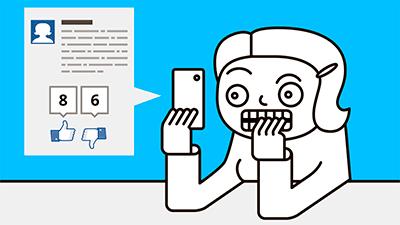
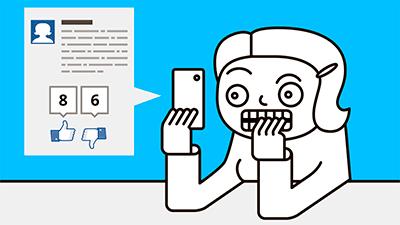
Facebook can have positive and negative effects on teens levels of a stress hormone, say researchers at the University of Montreal and the Institut universitaire de santé mentale de Montréal. Led by Professor Sonia Lupien, the team found that having more than 300 Facebook friends increased teens' levels of cortisol. On the other hand, teens who act in ways that support their Facebook friends – for example, by liking what they posted or sending them words of encouragement – decreased their levels of cortisol. Their findings were published in Psychoneuroendocrinology.
Lupien and her colleagues recruited 88 participants aged 12-17 years who were asked about their frequency of use of Facebook, their number of friends on the social media site, their self-promoting behaviour, and finally, the supporting behaviour they displayed toward their friends. Along with these four measures, the team collected cortisol samples of the participating adolescents. The samples were taken four times a day for three days.
Stress levels measured in adolescents from cortisol samples are obviously not entirely due to the popular social media site. "While other important external factors are also responsible, we estimated that the isolated effect of Facebook on cortisol was around eight percent," Lupien said. "We were able to show that beyond 300 Facebook friends, adolescents showed higher cortisol levels; we can therefore imagine that those who have 1,000 or 2,000 friends on Facebook may be subjected to even greater stress."
Other studies have shown that high morning cortisol levels at 13 years increase the risk of suffering from depression at 16 years by 37%. While none of the adolescents suffered from depression at the time of the study, Lupien could not conclude that they were free from an increased risk of developing it. "We did not observe depression in our participants. However, adolescents who present high stress hormone levels do not become depressed immediately; it can occur later on," Lupien said. "Some studies have shown that it may take 11 years before the onset of severe depression in children who consistently had high cortisol levels."
The study is one of the first in the emerging field of cyberpsychology to focus on the effects of Facebook on well-being. "The preliminary nature of our findings will require refined measurement of Facebook behaviors in relation to physiological functioning and we will need to undertake future studies to determine whether these effects exist in younger children and adults," Lupien said. "Developmental analysis could also reveal whether virtual stress is indeed 'getting over the screen and under the skin' to modulate neurobiological processes related to adaptation."
###
About this study:
Sonia Lupien and her colleagues published "Facebook behaviors associated with diurnal cortisol in adolescents: Is befriending stressful?" in Psychoneuroendocrinology on October 9, 2015. DOI: 10.1016/j.psyneuen.2015.10.005.
Sonia Lupien, PhD, is a professor at the University of Montreal's Department of Psychiatry and Scientific Director of the university's affiliated Institut universitaire en santé mentale de Montréal Research Center.
This study was supported by funding from the Canadian Institutes for Health Research and the Fonds de recherche du Québec – Santé.
The University of Montreal is officially known as Université de Montréal. The Institut universitaire en santé mentale de Montréal is a part of the Centre intégré universitaire de santé et de services sociaux (CIUSSS) de l'Est-de-l'Île-de-Montréal.