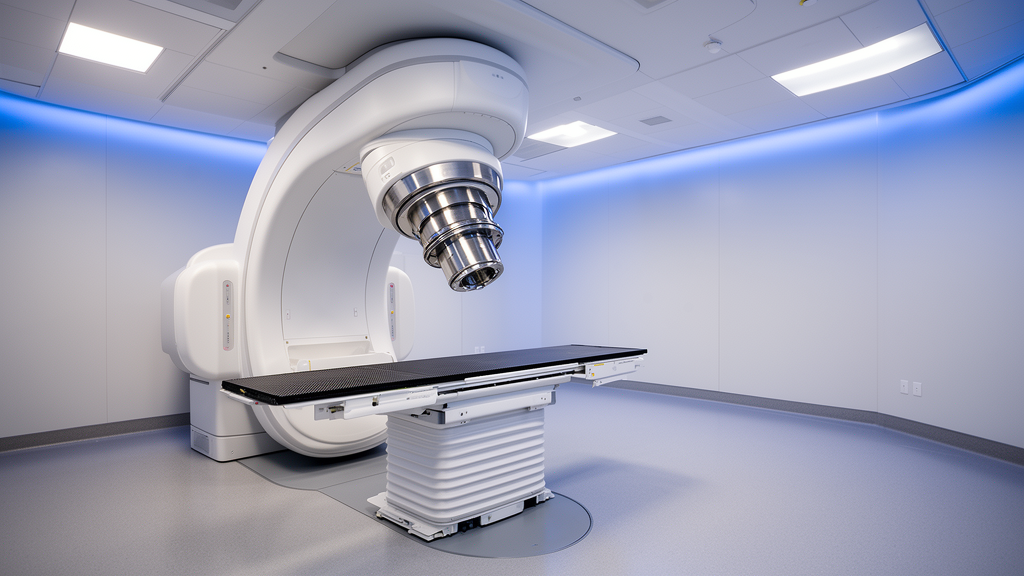
In a computational and experimental radiation oncology physics investigation restricted to 6 MV beam energy, expanding the prescribed primary-electron source dimensions produced substantial central-axis dose reductions reaching up to 56.34 percent in very small photon fields. Published as an original research study in Frontiers in Oncology by investigator Mina Magdy Habib, affiliated with Maadi Military Hospital and Ain Shams University in Cairo, Egypt, the project demonstrated a stationary endpoint-sensitivity chain linking effective primary-electron source representation, linear accelerator head transport, downstream photon angular phase space, and field-size-dependent dosimetric response.
The research addressed an incompletely characterized problem in clinical medical physics, where very small radiation fields are known to exhibit high sensitivity to both experimental measurement conditions and computational radiation-source representations. Despite widespread recognition of this sensitivity, the direct physical connection between effective primary-electron source width, downstream photon angular phase space, and field-size-dependent dosimetric response had remained incompletely characterized in radiotherapy modeling. To resolve these interconnected factors, the investigation combined physical measurements of empirical detector variability on a clinical treatment unit with controlled Monte Carlo endpoint simulations. By examining both empirical chamber data and numerical source perturbations, the study sought to clarify how electron source representations at the accelerator head translate into altered photon phase space and dosimetric changes within irradiated media.
To quantify physical measurement variability under clinical operating conditions, the author evaluated five distinct ionization-chamber datasets acquired on a clinical Elekta Versa HD linear accelerator. These physical detector measurements covered a broad range of field sizes, spanning from reference fields of 20 by 20 centimeters squared down to narrow fields of 3 by 3 centimeters squared. Analysis of the experimental datasets demonstrated that empirical measurement variability climbed steeply as field dimensions contracted toward small-field boundaries. Specifically, the mean experimental coefficient of variation increased from 2.46 percent for the broad 20 by 20 centimeter fields to 15.45 percent for the 3 by 3 centimeter fields, confirming that empirical ionization-chamber dosimetry becomes increasingly dispersed as beam dimensions shrink toward very small field sizes.
To investigate the computational source parameters driving these responses, the author developed a generalized Elekta Versa HD model equipped with an Agility multileaf collimator within the EGSnrc and BEAMnrc Monte Carlo simulation architecture. The computational framework evaluated two prescribed stationary Gaussian source endpoints designated as M1 and M2. The baseline M1 endpoint was configured as a symmetric source having a full width at half maximum of 0.15 centimeters in both transverse dimensions, specified as FWHMx equal to FWHMy at 0.15 centimeters. In contrast, the M2 endpoint was prescribed with an expanded, asymmetric Gaussian distribution having a full width at half maximum of 0.35 centimeters along the x-axis and 0.60 centimeters along the y-axis, providing two defined source configurations to test downstream transport effects.
Dose calculations and pre-phantom phase-space analyses were carried out using DOSXYZnrc across four specific square field geometries: 3 by 3, 2 by 2, 1 by 1, and 0.5 by 0.5 centimeters squared. Within this study design, the 3 by 3 centimeter field served as the essential experimental and Monte Carlo overlap, directly linking empirical ionization-chamber measurements with computational transport outputs. The three smaller field sizes—2 by 2, 1 by 1, and 0.5 by 0.5 centimeters squared—were evaluated as controlled Monte Carlo endpoint-sensitivity analyses to examine source-width dependencies in narrow beam regimes. In addition, the baseline M1 source model was benchmarked against empirical commissioning data by comparing its central-axis depth-dose predictions against a 10 by 10 centimeter percentage depth dose curve measured with a CC13 ionization chamber.
The comparative calculations revealed pronounced dosimetric differences between the two source models across the four field sizes, accompanied by substantial modifications in photon angular phase space. On the central beam axis, the enlarged M2 source produced dose reductions relative to M1 of 8.48 percent for the 3 by 3 centimeter field, 8.27 percent for the 2 by 2 centimeter field, 29.59 percent for the 1 by 1 centimeter field, and 56.34 percent for the 0.5 by 0.5 centimeter field. Simultaneously, analysis of pre-phantom phase-space data demonstrated that the corresponding M2-to-M1 ratios of the 95 percent angular-containment solid angle were 1.275 at 3 by 3 centimeters, 1.498 at 2 by 2 centimeters, 2.415 at 1 by 1 centimeter, and 3.835 at 0.5 by 0.5 centimeters. This four-field comparison demonstrated a clear field-size progression in angular containment, while revealing that dosimetric amplification is observable-dependent rather than universally monotonic.
The investigation concluded with specific methodological boundaries and qualifications regarding the interpretation and application of these findings. While the M1 benchmark supported reference depth-dose behavior against CC13 commissioning measurements, lateral-profile findings were strictly restricted to controlled numerical sensitivity because absolute lateral agreement was not independently established within this study alone. Furthermore, the author emphasized that the demonstrated result represents a stationary endpoint-sensitivity chain linking primary-electron source representation, linac-head transport, photon angular phase space, and small-field response, rather than dynamic operational measurements. No time-resolved source dynamics were measured or simulated during the investigation; instead, a reduced covariance formulation was retained strictly as a prospective framework for testing whether a stationary effective source can represent unresolved accelerator-source states.
Subject of Research: Primary electron source width sensitivity and measurement variability in small-field photon dosimetry
Article Title: Toward dynamic Monte Carlo source modeling: measurement variability and primary electron source-width sensitivity in very small photon fields
Article References: Habib, M. M. (2026). Toward dynamic Monte Carlo source modeling: measurement variability and primary electron source-width sensitivity in very small photon fields. Frontiers in Oncology, 16, Article 1968378. https://doi.org/10.3389/fonc.2026.1968378
Image Credits: AI Generated
DOI: 10.3389/fonc.2026.1968378
Keywords: small-field dosimetry, primary electron source, source width, photon angular phase space, BEAMnrc, EGSnrc, DOSXYZnrc, Elekta Versa HD, Agility multileaf collimator, angular containment, angular divergence, 6 MV photon beam, ionization chamber, percentage depth dose, central-axis dose, measurement variability, stationary Gaussian source
News Source: Nathaniel Bowman. (November 14, 2026). Wider Electron Source Reduces Small Field Photon Dose Up to 56 Percent. Scienmag.