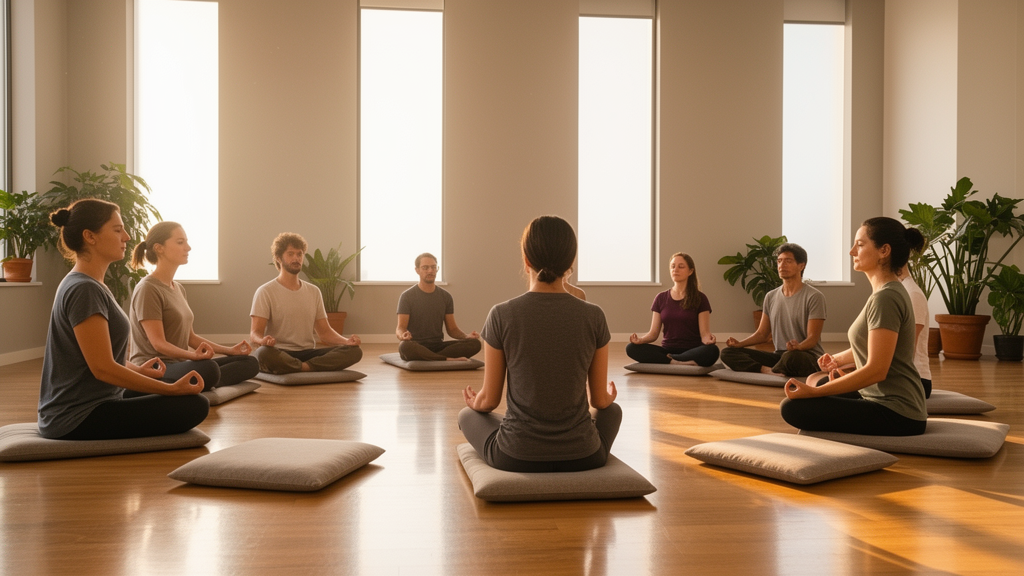
A community-based behavioral trial investigating an eight-week mindfulness program has demonstrated high feasibility and participant acceptability alongside preliminary gains in psychological and physical well-being, according to original research conducted by investigators at Kyung Hee University in Seoul, Republic of Korea. Published in Frontiers in Public Health within the journal’s Public Health Education and Promotion section, the single-arm mixed-methods study evaluated the Mindfulness-based Vitality Promotion (MVP) curriculum among community-dwelling individuals enrolled in a lifelong learning setting. Standardized quantitative self-report questionnaires administered before and after the eight-week intervention revealed statistically significant pre-to-post improvements in both integrative vitality and overall well-being. Because the study utilized a single-arm, uncontrolled observational design, the research team presented these outcome changes as preliminary indicators rather than definitive proof of treatment efficacy.
In addition to the documented gains in vitality and general well-being, the quantitative questionnaire data demonstrated statistically significant pre-to-post reductions across three key psychological distress measures: depression, fatigue, and anxiety. However, the eight-week intervention did not yield statistically meaningful improvements across all measured health domains. The authors reported that no statistically significant changes were observed between baseline and completion assessments for pain, sleep disturbance, digestive symptoms, anger, or self-reported mindfulness.
The conceptual framework underlying the Mindfulness-based Vitality Promotion program addresses public health challenges associated with accelerating global population aging. In their study background, the authors noted that age-related psychophysiological conditions have emerged as pressing public health concerns internationally. The research team identified vitality as an inherent human capacity, asserting that promoting and sustaining vitality is essential for fostering healthy aging and sustaining long-term well-being.
The empirical evaluation was conducted by research team members Seok-In Yoon, Hui-Yeong Park, Jae-Hong Yoo, Sun-Yong Chung, and corresponding author Jong Woo Kim, taking place within a lifelong learning environment with 35 community-dwelling participants. The clinical trial was formally submitted to the Clinical Research Information Service of the Republic of Korea under trial identifier KCT0009961 on October 8, 2024, prior to the commencement of participant enrollment, and trial registration was finalized on November 28, 2024. The behavioral curriculum was administered over an eight-week duration, structured around weekly instructional meetings where each session lasted 90 minutes. Data collection combined quantitative self-report instruments with qualitative semi-structured interviews conducted after program completion.
Feasibility and acceptability assessments were systematically evaluated using predefined operational metrics, specifically program retention rates, session attendance figures, and formal participant satisfaction responses. The intervention achieved robust retention: of the 35 community members who enrolled, 31 completed the full eight-week program, yielding a program completion rate of 88.6 percent. Participants maintained consistent involvement throughout the scheduled curriculum, registering a mean attendance of 6.37 out of the eight available 90-minute sessions. Among the 30 individuals who completed the end-of-program satisfaction survey, 28 respondents (93.3 percent) indicated their willingness to participate in the program again, while all 30 respondents (100 percent) confirmed they would recommend the program to others.
To complement the numerical survey metrics, the researchers carried out semi-structured qualitative interviews to capture nuanced participant perspectives, identifying four prominent thematic categories.
In their concluding assessment, the Kyung Hee University researchers determined that these mixed-methods findings deliver essential preliminary evidence supporting the practical feasibility and acceptability of the Mindfulness-based Vitality Promotion program within adult lifelong learning environments. Nonetheless, the authors maintained appropriate scientific caution, explicitly noting the limitations inherent in an uncontrolled, single-arm feasibility design.
Subject of Research: Feasibility and preliminary outcomes of an eight-week mindfulness-based vitality promotion program
Article Title: Feasibility and acceptability of a mindfulness-based vitality promotion program in a lifelong learning setting: a single-arm mixed-methods study
Article References: Yoon, S.-I., Park, H.-Y., Yoo, J.-H., Chung, S.-Y., & Kim, J. W. (2026). Feasibility and acceptability of a mindfulness-based vitality promotion program in a lifelong learning setting: a single-arm mixed-methods study. Frontiers in Public Health, 14, Article 1990679. https://doi.org/10.3389/fpubh.2026.1990679
Image Credits: AI Generated
DOI: 10.3389/fpubh.2026.1990679
Keywords: mindfulness-based vitality promotion, vitality, healthy aging, lifelong learning, mixed-methods study, single-arm trial, community-dwelling adults, program feasibility, program acceptability, psychological well-being, depression reduction, fatigue reduction, anxiety reduction, participant retention, session attendance, participant satisfaction
News Source: Glenn Wilkins. (November 14, 2026). Mindfulness Vitality Program Shows Feasibility and Well-Being Improvements in Preliminary Study. Scienmag.