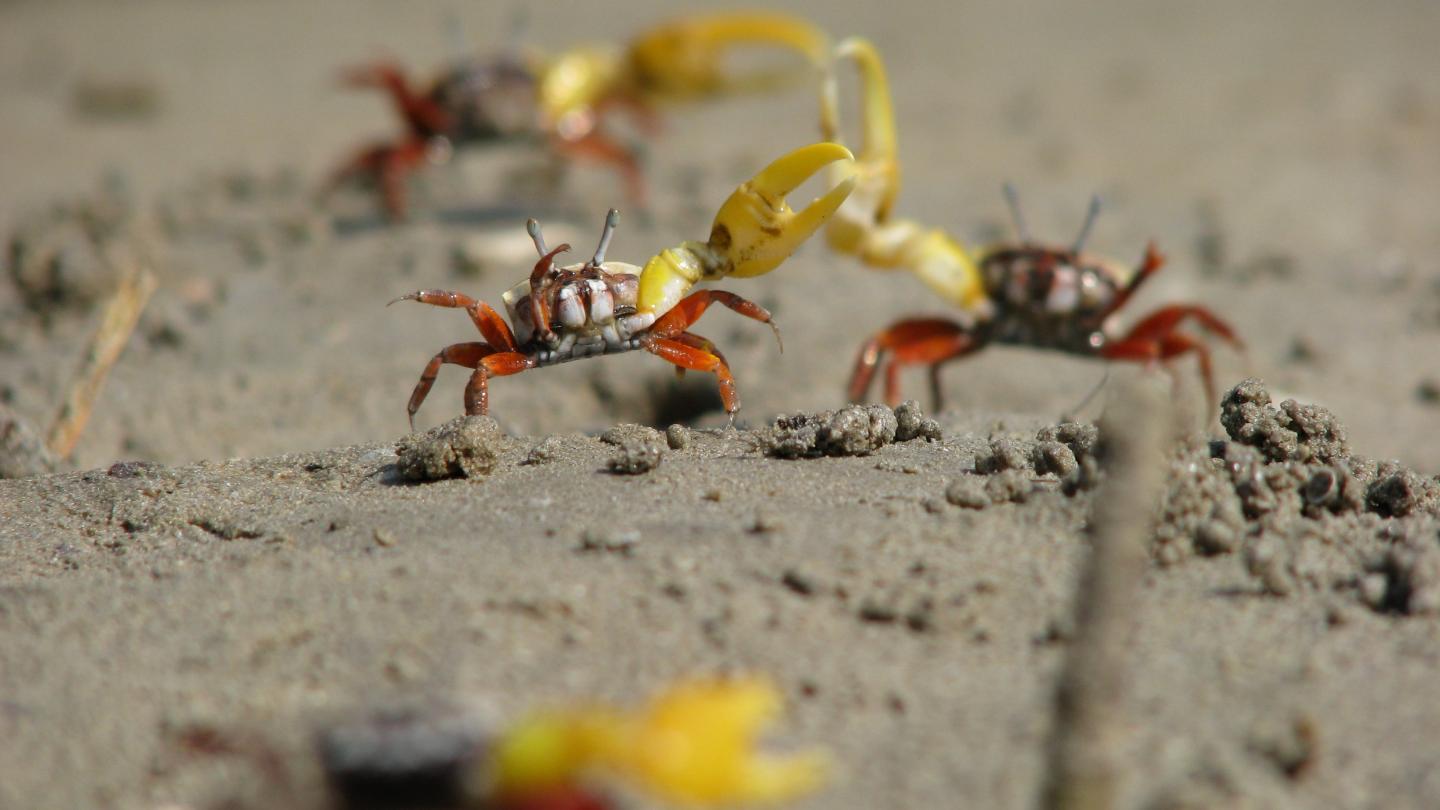
New research has resolved a mystery over why female fiddler crabs visit and leave many males during mating season, and found the females aren't just being picky.
The research found the females are actually searching for a safe haven from birds and other predators rather than hunting for the perfect match.
Researcher Professor Patricia Backwell from The Australian National University (ANU) said the findings overturn previous theories and helped scientists better understand the breeding habits of fiddler crabs, which are crucial to the ecological health of mangroves, salt marshes and muddy beaches around the world.
"This behaviour of visiting and supposedly rejecting successive males has always been taken as a defining feature of female choosiness, but this study shows that things are not always what they seem," said Professor Backwell, from the ANU Research School of Biology.
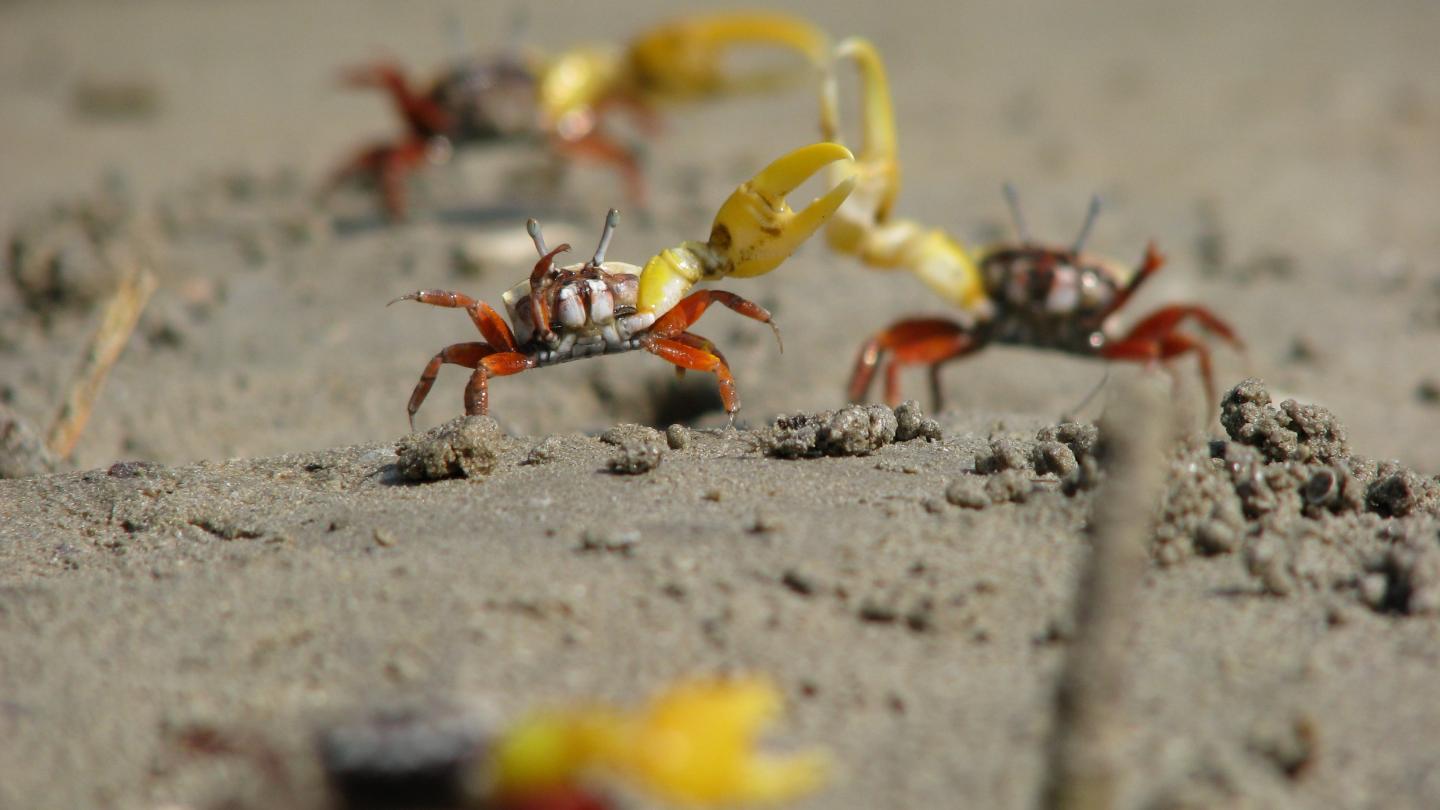
Male fiddler crabs are known for having one claw that is considerably larger than the other. Fiddler crabs are found in mangroves and salt marshes and on sandy or muddy beaches of West Africa, the Western Atlantic, Eastern Pacific and Indo-Pacific.
Professor Backwell said female fiddler crabs visited successive displaying males in their burrows to identify safe places to hide in the event of predator attacks, and not because they were searching for a perfect mating partner.
"If a bird attacks, female fiddler crabs can move quickly and directly back to the last burrow it visited," said Professor Backwell, who is based in Darwin at the moment to conduct field work.
"Having this map of burrow positions is essential if they are to survive a bird attack, and this is true for females who are looking for a mate and those who are looking for a burrow."
Co-lead researcher Dr Marianne Peso said the team conducted experiments to observe and compare the behaviour of mate- and burrow-searching females.
The team noticed female fiddler crabs not seeking a mate visited successive males before settling in a new burrow in the same manner as mate-searching females.
"We watched displaced females move across the mudflat, testing mate preferences with male-mimicking robotic crabs, examining male reactions to the females and testing the females' response to a simulated bird predator," said Dr Peso, who was based at ANU at the time of the study and is now at Macquarie University Department of Biological Sciences.
"In all experiments, mate-searching and burrow-searching females behaved identically.
"They all visited courting males, they found the same robotic males attractive, males treated them in the same way as potential mates and all the females retreated to the last burrow they visited when swooped by the plastic bird."
###
Professor Backwell received funding for the study from an Australian Research Council Discovery Grant.
The study was published in the Royal Society Open Science journal: http://rsos.royalsocietypublishing.org/content/3/8/160339
Watch a video about research on fiddler crabs on the ANU YouTube channel: https://youtu.be/CuIj6cQ9Mnw
Media Contact
Patricia Backwell
[email protected]
61-402-677-968
@ANUmedia
http://www.anu.edu.au/media