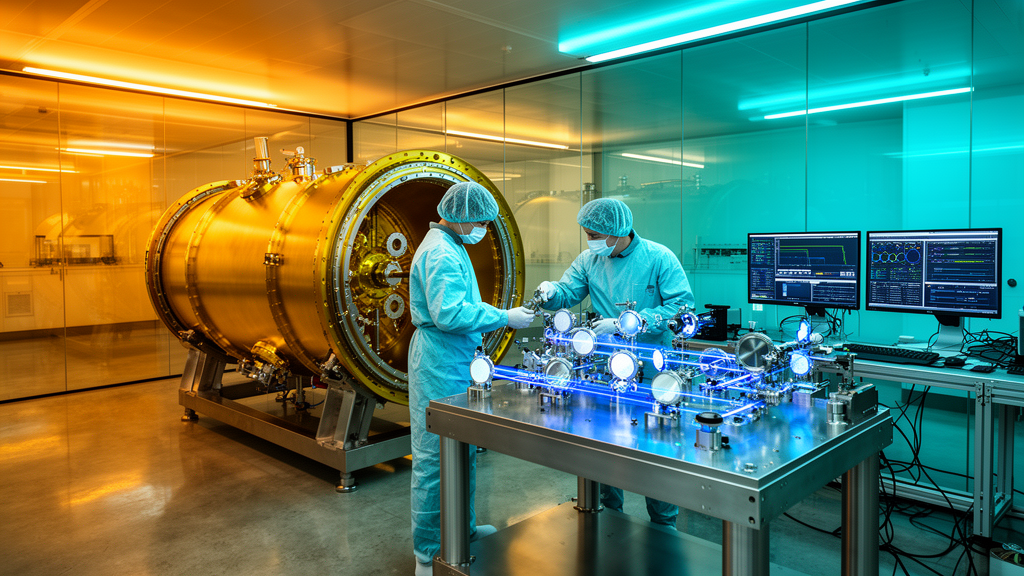
The University of Chicago and Toyota have entered into a multi-year collaborative research agreement aimed at accelerating the development of quantum technologies for future mobility, sustainable transportation, and secure vehicle systems. By bridging foundational quantum science developed at the university with Toyota’s industrial expertise, the initiative addresses foundational engineering challenges across sensing, communications, and energy storage. Scientists and engineers involved in the project anticipate that quantum technologies could redefine mobility systems and support infrastructure by bypassing the physical limitations inherent in classical systems.
The collaboration initially launches with five collaborative research projects, drawing heavily upon the faculty, students, and resources of UChicago’s Pritzker School of Molecular Engineering (UChicago PME). The overall program focuses on five key technical areas: communication, sensing, materials discovery, theoretical modeling and prediction, and electronic properties. Over the course of the agreement, the participating parties aspire to build an expansive joint research portfolio supported by up to $1 million in annual funding from Toyota.
David Awschalom, director of the Chicago Quantum Institute and the Chicago Quantum Exchange, as well as the Liew Family Professor of Molecular Engineering at UChicago PME and lead researcher on the initiative, emphasized the value of pairing academic discovery with industrial insights. Awschalom stated that this integration accelerates the timeline for moving quantum technologies out of the laboratory and into operational transportation frameworks, offering major opportunities to push the boundaries of science and engineering.
A core technological focus of the initiative involves extremely precise sensing. While quantum sensors routinely measure environmental changes with unprecedented accuracy in laboratory settings, researchers will investigate translating the technology to improve vehicle capabilities beyond the limits of current classical sensor systems. In addition, the initiative investigates secure communications, developing methods to convey and protect critical data transmissions among connected vehicles, roadside infrastructure, and regional control centers.
The collaboration also relies on computational techniques based on quantum simulations to drive materials discovery for the design of quantum sensors, transceivers, and data links. Giulia Galli, the Liew Family Professor of Molecular Engineering at UChicago and a theory team leader, noted that the goal is to address deep technical questions shaping energy storage over a 20-year horizon. Through advanced computational modeling, researchers aim to predict and design materials with novel electronic properties to enable detailed monitoring of energy storage systems.
Workforce development represents another key objective of the initiative, designed to prepare future quantum scientists by embedding UChicago PME students into projects addressing practical industry challenges. The initial phase of research will fund up to eight UChicago graduate students across both theoretical and experimental laboratories. According to Awschalom, directly investing funding into students and postdoctoral researchers provides early immersion in collaborative research, demonstrating how fundamental quantum mechanics can scale to address real-world transportation and energy challenges.
Overall coordination for the joint projects will be managed by a joint steering committee comprising representatives from UChicago and the Toyota Research Institute of North America. To facilitate direct technical collaboration, UChicago is hosting two visiting scientists from Toyota within the Awschalom and Galli laboratories. Jeff Makarewicz, Toyota’s group vice president for advanced research and technical resources, noted that the partnership grants Toyota access to fundamental discoveries, advanced talent, and novel computational approaches, while offering UChicago the opportunity to translate research into tangible societal impact.
Subject of Research: Quantum technology collaboration for future mobility and vehicle systems
Article Title: UChicago, Toyota collaborate to advance quantum technologies for future mobility and transportation
Article References: UChicago, Toyota collaborate to advance quantum technologies for future mobility and transportation. Original publication (Bibliographic details unavailable.)
Image Credits: AI Generated
DOI: Not provided
Keywords: Quantum sensing, Secure communications, Energy storage, Future mobility, Materials discovery, Theoretical modeling, Electronic properties, University of Chicago, Toyota, Pritzker School of Molecular Engineering, David Awschalom, Giulia Galli, Jeff Makarewicz, Toyota Research Institute of North America, Quantum simulation, Vehicle data transmission, Roadside infrastructure, Workforce development
News Source: Katie Riggs. (November 14, 2026). UChicago and Toyota Partner to Develop Quantum Technologies for Future Mobility. Scienmag.