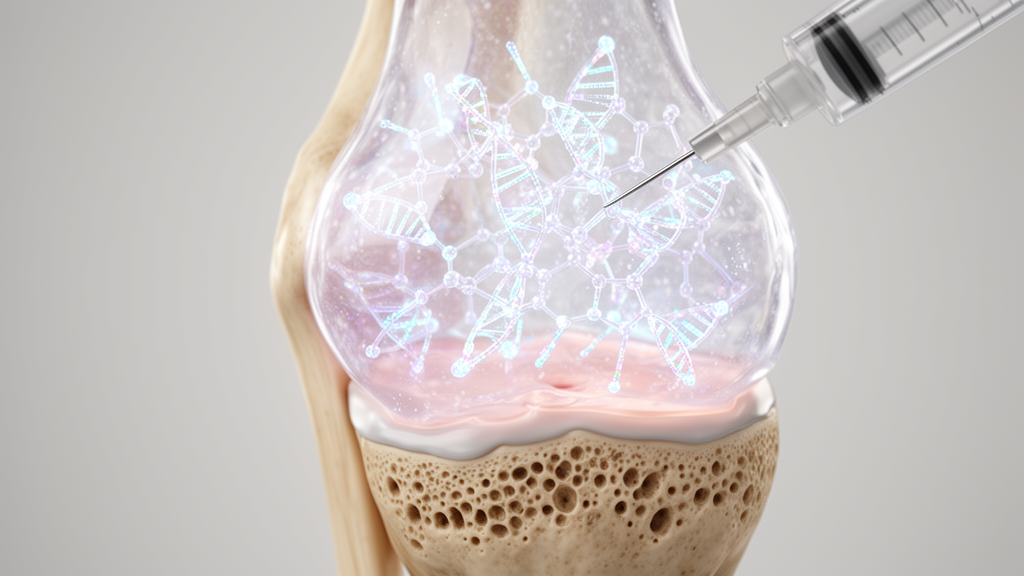
Biomedical researchers have engineered an injectable, gene-activated dynamic hydrogel designed to deliver semaphorin 3A plasmid DNA directly into knee joints, demonstrating cartilage matrix preservation and structural bone protection in animal and cellular models of severe environmental stress. Joint degeneration in osteoarthritis is increasingly understood as an interconnected pathology involving reciprocal signaling among inflammatory immune cells, senescence-prone stromal cells, and the structural osteochondral unit comprising articular cartilage and subchondral bone. While environmental extremes such as cold temperatures and hypobaric hypoxia disrupt whole-joint homeostasis by imposing severe bioenergetic challenges and oxidative burdens, localized interventions capable of mitigating these coupled immune, mitochondrial, and structural disruptions have remained limited. To evaluate a localized therapeutic approach without relying on a separate surgical or chemical joint-injury protocol, the investigative team established an integrated experimental framework assessing an engineered dynamic biomatrix across cultured chondrocytes, stressed macrophages, stromal reporter cultures, and living rats subjected to chronic hypoxic-cold conditions.
The material platform, designated ODCP, was synthesized through reversible catechol-boronate ester crosslinking established between dopamine-modified oxidized hyaluronic acid and phenylboronic acid-modified chondroitin sulfate. Hyaluronic acid was initially oxidized using sodium periodate at a specific repeating-unit molar ratio of 0.20 for six hours in the dark, quenched with ethylene glycol, dialyzed, and coupled with dopamine hydrochloride under nitrogen using carbodiimide chemistry to achieve a proton nuclear magnetic resonance degree of substitution of approximately 29 percent. Simultaneously, chondroitin sulfate was conjugated with 3-aminophenylboronic acid to yield a phenylboronic acid degree of substitution of approximately 39 percent, with both modifications confirmed by diagnostic aromatic resonance signals. When these complementary polymer solutions were combined at an equal volume ratio without extraneous crosslinking agents, the dynamic network formed an elastic, self-supporting hydrogel within one minute during vial-inversion tests, while retaining smooth continuous extrudability through fine syringe needles and maintaining deposited shapes.
Scanning electron microscopy of lyophilized ODCP demonstrated an interconnected porous architecture characterized by sheet-like polymeric matrix walls, which provided an adaptable structural scaffold for molecular encapsulation. Rheological characterization using a parallel-plate geometry at 25 degrees Celsius established that the dynamic hydrogel displayed frequency-dependent viscoelasticity, where the storage modulus exceeded the loss modulus at elevated frequencies, reflecting reversible bond relaxation under slower deformations while sustaining elastic integrity under rapid strain. In strain-sweep tests, the network maintained linear viscoelastic stability at low strain amplitudes before yielding under large mechanical deformations. When subjected to alternating cyclic strains transitioning repeatedly between 1 percent and 640 percent, high-strain intervals disrupted network elasticity, yet returning to low strain instantly and repeatedly restored the storage-modulus-dominated state across successive cycles, confirming the mechanical recovery needed for intra-articular injection and subsequent network reformation under physiological shear.
To assemble the complete gene-activated matrix designated Sema3a@ODCP, researchers incorporated a purified non-viral pAAV-backbone expression plasmid encoding the full-length rat semaphorin 3A coding sequence under the control of a cytomegalovirus promoter into the aqueous polymer solution prior to gelation. The therapeutic expression plasmid measured 6,957 base pairs, while a matched 4,650-base-pair empty vector, termed pAAV-MCS, served as an inactive comparative control designated EV@ODCP. Sanger sequencing chromatograms validated the identity of the therapeutic plasmid, confirming the sequence fidelity of both vector-insert junctions and overlapping internal reading frames. Both plasmids were expanded in bacterial cultures, isolated using endotoxin-free preparation protocols, and integrated at a final concentration of 100 micrograms per milliliter without adding secondary chemical transfection reagents or viral packaging particles, ensuring equalized polymer composition and nucleic acid mass across all treated groups.
The direct biological efficacy of Sema3a@ODCP on chondrocyte homeostasis was first investigated in primary rat articular chondrocytes subjected to interleukin-1-beta as an established inflammatory challenge. Stimulation with interleukin-1-beta suppressed baseline gene expression of semaphorin 3A and type II collagen while inducing the degradative catabolic enzymes matrix metalloproteinase-13 and ADAMTS-4. Although treatment with the empty-vector control hydrogel produced only marginal effects on this catabolic profile, Sema3a@ODCP significantly enhanced semaphorin 3A transcript levels, restored type II collagen expression, and markedly decreased matrix metalloproteinase-13 and ADAMTS-4 expression. Corresponding immunofluorescence staining demonstrated parallel recoveries in type II collagen and aggrecan core proteins alongside profound suppression of matrix metalloproteinase-13 protein, confirming that local plasmid delivery preserved primary chondrocyte extracellular matrix integrity under direct inflammatory stress.
Because synovial macrophages play an indispensable role in translating external physical stress into chronic joint inflammation, the researchers exposed cultured RAW 264.7 macrophages to an in vitro hypoxic-cold stress regimen comprising 1 percent oxygen and 33 degrees Celsius for 24 hours. This continuous dual exposure triggered a pronounced phenotypic shift toward a pro-inflammatory profile characterized by elevated CD86 surface expression and depleted CD206 levels, alongside marked upregulation of tumor necrosis factor-alpha and stagnant interleukin-10 secretion. Flow cytometric analysis across independent biological replicates showed that treatment with Sema3a@ODCP counteracted this trajectory, substantially decreasing the CD86-positive, CD206-negative subpopulation while expanding the CD86-negative, CD206-positive fraction. Immunofluorescence quantification confirmed that macrophages receiving the semaphorin-loaded matrix exhibited the lowest overall CD86 and tumor necrosis factor-alpha signals and the highest CD206 and interleukin-10 expressions, indicating robust repolarization toward an inflammation-resolving phenotype.
Investigations into macrophage bioenergetics revealed that the phenotypic shift was tightly coupled to mitochondrial functional rescue under hypoxic-cold conditions. Staining with JC-1 dye showed that environmental stress caused mitochondrial membrane depolarization, shifting fluorescence from red polymeric aggregates to green monomers, whereas Sema3a@ODCP significantly elevated the aggregate-to-monomer fluorescence ratio, restoring mitochondrial membrane potential. Transmission electron microscopy confirmed that while stress caused mitochondrial swelling, severe vacuolization, and extensive fragmentation of internal cristae, macrophages treated with Sema3a@ODCP maintained elongated mitochondrial morphologies with dense, organized cristae. Furthermore, intracellular adenosine triphosphate quantification demonstrated that the gene-activated hydrogel significantly restored cellular energy reserves compared with the empty-vector matrix, establishing parallel improvements in cellular respiration, structural organelle integrity, and anti-inflammatory marker expression.
The study also evaluated whether mitigating macrophage dysfunction could prevent the transmission of senescence-like stress signals to neighboring bone marrow mesenchymal stromal cells. Cultured macrophages exposed to hypoxic-cold stress exhibited extensive senescence-associated beta-galactosidase staining, which was markedly reduced following Sema3a@ODCP administration. When conditioned culture media collected from these treated macrophage groups were transferred onto naive rat bone marrow stromal cells for 48 hours, media from untreated, stressed macrophages provoked prominent increases in nuclear p21 and phosphorylated histone H2AX foci, reflecting heightened cell-cycle arrest and DNA damage signaling. Conversely, conditioned media derived from Sema3a@ODCP-treated macrophages significantly suppressed both stress markers in recipient stromal cells, while simultaneously upregulating transcription of cartilage-supportive genes, including SOX-9, aggrecan, and type II collagen, and repressing catabolic matrix metalloproteinase-13 expression.
To evaluate osteochondral preservation within living organisms, eight-week-old male Sprague-Dawley rats were housed in an environmental simulation chamber maintaining hypobaric hypoxia at 577 hectopascals, representing an altitude of approximately 4,500 meters, combined with a chilling temperature of 10 degrees Celsius for four hours daily over an eight-week duration. Experimental animals were allocated to receive 40-microliter intra-articular knee injections containing phosphate-buffered saline, empty-vector hydrogel, or Sema3a@ODCP at week four and week six, representing four micrograms of total plasmid DNA per administration, while unexposed normobaric animals maintained at ambient pressure and 23 degrees Celsius served as non-stressed controls. High-resolution ex vivo micro-computed tomography conducted at week eight revealed severe deterioration of subchondral bone architecture in saline-treated animals, marked by extensive declines in relative bone mineral density, bone volume fraction, trabecular number, trabecular thickness, and subchondral bone plate thickness.
Quantitative micro-computed tomography demonstrated that intra-articular Sema3a@ODCP administration provided the most pronounced structural protection among the stressed cohorts, producing statistically significant elevations in bone mineral density, bone volume fraction, and trabecular number relative to the empty-vector carrier. Complementary histological staining of sagittal knee sections with Safranin O/Fast Green and Masson’s trichrome showed that knees receiving saline exhibited severe articular surface irregularity, extensive loss of proteoglycans, and structural matrix disruption. In contrast, joints treated with Sema3a@ODCP preserved smooth, continuous cartilage surfaces, demonstrated significantly larger Safranin O-positive and Masson-positive areas, and yielded the lowest median Osteoarthritis Research Society International histopathology scores, confirming comprehensive structural protection across both soft cartilaginous and calcified skeletal joint compartments.
Tissue-level immunofluorescence and immunohistochemical examinations corroborated these macroscopic and structural observations within intact knee joints. Infiltration of CD86-positive inflammatory cells and nuclear accumulation of the cellular stress markers p21 and phosphorylated histone H2AX were pronounced in saline-treated stressed joints, but were markedly attenuated in animals receiving the semaphorin-delivering dynamic hydrogel, which conversely elevated CD206-positive signals. Furthermore, Sema3a@ODCP restored cartilage aggrecan area to levels approaching those of unexposed normobaric control rats, sharply diminished matrix metalloproteinase-13 and tumor necrosis factor-alpha staining, and raised local interleukin-10 concentrations. Comprehensive histopathological evaluations of harvested major organs, including heart, liver, spleen, lung, and kidney specimens, revealed no treatment-associated structural abnormalities or systemic toxicity at the conclusion of the eight-week experimental protocol.
While these experimental findings demonstrate that localized gene delivery via an adaptable catechol-boronate hydrogel can limit environmental joint degeneration, the investigators emphasized several explicit physiological and methodological limitations. Because the experimental design applied hypobaric hypoxia and cold temperatures simultaneously as a combined environmental stress protocol, the study was not configured to isolate the independent contributions of low oxygen tension versus cold exposure or to test synergistic interactions between them. Furthermore, the in vivo evaluations were conducted exclusively in male Sprague-Dawley rats with a small cohort size of three animals per experimental group at a single terminal endpoint two weeks following the second injection, without incorporating pre-treatment baseline imaging. Consequently, the observed outcomes demonstrate the attenuation of osteochondral changes during ongoing environmental exposure rather than the therapeutic reversal of established joint disease, highlighting the need for larger, sex-balanced, and longitudinal investigations to define translational viability.
Subject of Research: Local plasmid-delivering dynamic hydrogel for osteochondral protection under hypoxic-cold stress
Article Title: Injectable Sema3a plasmid–delivery hydrogel attenuates hypoxia–cold stress–associated osteochondral degeneration
Article References: Chen, Z., Zhong, Z., Tang, Y., Zhao, R., Yi, M., & Deng, X. (2026). Injectable Sema3a plasmid–delivery hydrogel attenuates hypoxia–cold stress–associated osteochondral degeneration. Frontiers in Cell and Developmental Biology, 14, Article 1962151. https://doi.org/10.3389/fcell.2026.1962151
Image Credits: AI Generated
DOI: 10.3389/fcell.2026.1962151
Keywords: Osteoarthritis, Hypoxic-cold stress, Dynamic hydrogel, Semaphorin 3A, Gene-activated matrix, Catechol-boronate crosslinking, Hyaluronic acid, Chondroitin sulfate, Plasmid delivery, Cartilage preservation, Subchondral bone, Macrophage polarization, CD206 marker, Mitochondrial membrane potential, Bone marrow mesenchymal stromal cells, Micro-CT imaging, OARSI histopathology score
News Source: Juliet Wilcox. (November 14, 2026). Injectable Gene-Activated Hydrogel Attenuates Environmental Joint Degeneration in Rat Study. Scienmag.