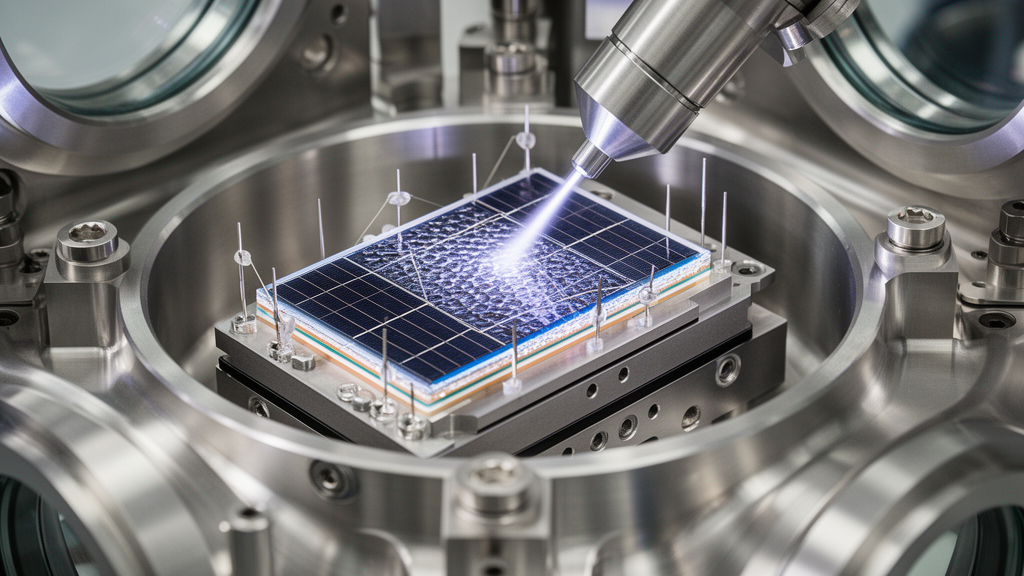
Scientists at the Brazilian Center for Research in Energy and Materials (CNPEM) in Campinas, São Paulo, have developed a specialized instrument for the Sirius particle accelerator that allows researchers to observe the interior of solar cells on a nanoscale while they are actively generating electricity. Unlike previous laboratory methods that analyzed isolated components in static conditions, this new platform enables the evaluation of complete photovoltaic devices under real operating conditions. The system simulates the daily environmental exposures that solar cells face, including fluctuations in light, heat, and humidity, providing a more accurate picture of how these materials behave in practical applications.
The development was supported by the São Paulo Research Foundation (FAPESP) and represents a significant advancement in the ability to study emerging solar technologies. The platform uses X-ray microscopy to investigate photovoltaic materials, with a primary focus on perovskite solar cells. These cells have advanced rapidly in recent years due to their high efficiency and the ability to manufacture them using simple processes at low temperatures without a vacuum. Despite this progress, questions regarding their long-term stability and degradation mechanisms remain unanswered, driving the need for advanced observational tools.
Rodrigo Szostak, a researcher at the Brazilian National Synchrotron Light Laboratory (LNLS-CNPEM) and the first author of the study published in the journal Photon Science, explains that the goal was to reproduce normal operating conditions to observe what happens within the material. The work was supported by a FAPESP postdoctoral fellowship awarded to Szostak. The core advantage of using X-rays for this type of research lies in their penetrating power, which allows for the examination of different layers of the device with minimal sample preparation. This reduces the risk that the experimental procedure itself might alter the structures intended for observation.
A critical challenge in this research is maintaining the sample’s position under extreme temperature fluctuations. To microscopically track changes caused by heating, the same region of the cell must be observed repeatedly. However, repeated exposure to X-rays can heat, expand, and displace the device. Given the scale of the experiment, even an almost imperceptible displacement can move the selected region out of the field of view. The team created a system with high mechanical stability to prevent the samples from shifting out of the X-ray beam’s focus, ensuring that the atomic structure and chemistry can be monitored accurately over time.
The solution involved developing a small chip on which the solar cell is built. The substrate is a piece of glass coated on one side with indium tin oxide (ITO), a transparent, electrically conductive base upon which the perovskite material is deposited. On the other side of the glass are two extremely thin platinum circuits: one functions as a heater, and the other as a temperature sensor. Passing current through the heater circuit produces heat, while the electrical resistance of the sensor circuit allows the temperature of the sample to be determined precisely. This design concentrates heating in an area of just 3 by 3 millimeters, minimizing thermal expansion in the experimental setup.
Tests with an infrared camera demonstrated that the temperature in this small heated area is quite uniform. At 150 degrees Celsius, the relative variation was only 0.85 degrees Celsius. The mount itself uses a titanium alloy with low thermal expansion and flexible elements that allow the glass to expand without accumulating stresses that could cause it to break. The system is thermally decoupled from the structures responsible for moving the sample to reduce heat transfer and unwanted displacements. Szostak notes that as far as the literature indicates, this holder likely offers the best positional stability ever achieved for this type of experiment.
In tests conducted at Sirius, the sample was repeatedly subjected to temperatures of 30 degrees Celsius and 150 degrees Celsius for approximately 20 hours. Over this 120-degree Celsius range, the vertical displacement was just 5 micrometers, and the horizontal displacement was about 1 micrometer. Crucially, these displacements were reproducible and reversible; when the temperature returned to its initial value, the sample practically returned to its previous position. After thermal stabilization, the residual movement was small enough to not cause significant distortions in the images produced during the scans.
Temperature control in the system proved to be both fast and precise. The programmed temperature was reached in less than two minutes, and at 150 degrees Celsius, it remained stable with general fluctuations of less than 0.1 degrees Celsius for 50 minutes. The ITO-based chip can be used at temperatures up to 150 degrees Celsius, while experiments that do not require a conductive substrate can reach 300 degrees Celsius. The device also features a small, sealed chamber in which gases can circulate, allowing for the simulation of different atmospheric conditions and the investigation of the role of humidity in the degradation of perovskites.
Lighting is another essential component of the platform, as a solar cell must be illuminated while X-rays take measurements to study it in operation. The team opted for a broadband white LED because, among the options evaluated, it had the spectral distribution closest to sunlight and covered the wavelength range absorbed by the perovskite cell. However, the lighting system presents a trade-off. When placed directly in front of the cell, the LED can provide an irradiance equivalent to that of the sun, about 100 milliwatts per square centimeter. In the lateral configuration required to allow the X-ray beam to pass freely, the intensity reaching the cell corresponds to approximately 30% of the reference solar radiation, an issue the team is working to improve.
The experimental demonstration involved fabricating a complete perovskite cell on the chip and subjecting it to conventional electrical characterization and various X-ray analyses. The researchers obtained current-voltage curves and monitored the cell’s response when the illumination was turned on and off. This was made possible by the Carnaúba beamline, one of 12 beamlines installed at the Sirius accelerator, which is designed to perform analyses using an extremely focused X-ray beam. The apparatus functions like a multi-technique microscope, allowing the examination of electronic structure, atomic structure, and chemical composition in high resolution.
At the Tarumã station, where the device was installed, different techniques provide complementary information. X-ray diffraction investigates the crystalline structure, X-ray fluorescence maps the distribution of chemical elements, and X-ray absorption spectroscopy provides information on the chemical state of elements, bond distances, and coordination environments. In the experiment, X-ray fluorescence produced maps of the iodine and lead distribution in the device. Diffraction allowed the visualization of individual perovskite grains about two micrometers in diameter and provided information about their spatial orientation and the exact distance between atoms in their structure, known as crystal lattice parameters.
To demonstrate the platform’s capability, the researchers mapped the crystal structure of the perovskite at 40 degrees Celsius and then repeated the measurement after raising the temperature to 65 degrees Celsius. The expected increase in the lattice parameter could be observed directly, revealing how the microscopic structure transformed in response to a controlled external variable. This combination of macroscopic variable control and nanoscale observation allows for the investigation of relationships between microscopic changes and the loss or improvement of the cell’s ability to convert light into electricity.
The equipment is now a multi-user facility available to the research community, with several experiments currently underway. Although optimized for perovskite solar cells, the platform can be used for other applications, including organic solar cells, solid-state dye-sensitized cells, quantum dot cells, and light-emitting diodes. Any device or material that can be deposited on glass and studied under heating conditions can, in principle, be investigated using this versatile and highly stable X-ray microscopy platform.
Subject of Research: Development of an in situ X-ray microscopy platform for observing operating perovskite solar cells at the nanoscale.
Article Title: A new instrument at Brazil’s Sirius accelerator enables researchers to observe solar cells in operation
Article References: A new instrument at Brazil’s Sirius accelerator enables researchers to observe solar cells in operation. Original publication (Bibliographic details unavailable.)
Image Credits: AI Generated
DOI: Not provided
Keywords: Sirius accelerator, perovskite solar cells, X-ray microscopy, in situ characterization, CNPEM, FAPESP, Photon Science, nanoscale observation, photovoltaic stability, Carnaúba beamline, thermal cycling, lattice parameters, indium tin oxide, sample holder stability, broadband LED illumination
News Source: Denise Maddox. (November 14, 2026). Sirius Instrument Observes Operating Solar Cells at Nanoscale. Scienmag.