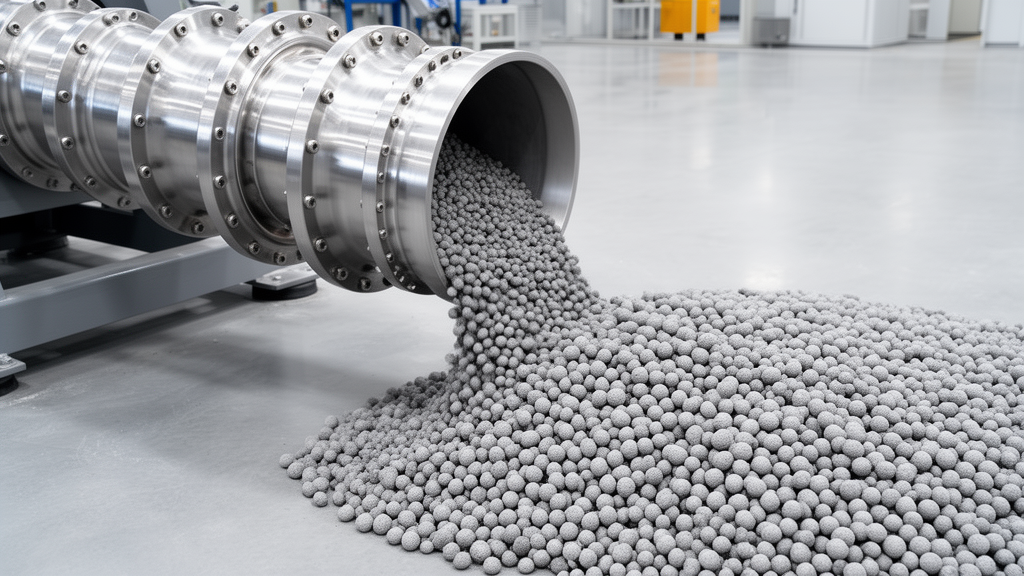
A research team has demonstrated that industrial lithium slag can be repurposed into artificial lightweight aggregates through an all-solid-waste, double-roll extrusion cold-bonding process without requiring Portland cement or commercial chemical activators. Rapid expansion across the lithium battery sector has generated vast quantities of lithium slag, with approximately nine to ten tons of powdery waste produced per ton of refined lithium carbonate. Historically, most of this residue has been consigned to surface impoundments, stockpiles, or landfills, occupying valuable land and posing environmental hazards through rainwater leaching of potentially harmful elements and soluble salts into surrounding soils and groundwater. Although lithium slag contains abundant silicon dioxide and aluminum oxide capable of pozzolanic reactivity, its powdery nature prevents direct use as coarse aggregate. By combining an all-solid-waste binder with mechanical extrusion compaction, the investigators established an energy-efficient manufacturing route that consolidates fine powders into lightweight artificial aggregates at ambient or moderately elevated temperatures.
To construct the aggregate matrix without Portland cement, the researchers developed an all-solid-waste binder using five industrial by-products: lithium slag, ground granulated blast-furnace slag, fly ash, desulfurization gypsum, and carbide slag. Sourced from Xinyu in Jiangxi Province, China, the lithium slag was dried and ball-milled to eliminate particle agglomeration and moisture variability before processing. Chemical analysis confirmed that the milled slag consisted predominantly of silicon dioxide at 48.24 percent, aluminum oxide at 23.48 percent, and sulfur trioxide at 13.22 percent by mass, alongside crystalline phases including beta-spodumene, gypsum, albite, quartz, and anhydrous sodium sulfate. Laser diffraction revealed median and ninetieth-percentile particle diameters of 45.23 and 101.26 micrometers for the slag, providing a coarse skeleton relative to the finer admixtures. Ground granulated blast-furnace slag contributed latent hydraulic reactivity, fly ash supplied supplementary aluminosilicates, desulfurization gypsum provided sulfate and calcium for sulfoaluminate formation, and carbide slag with 67.35 percent calcium oxide furnished the alkaline activation environment.
The mechanical forming process relied on continuous pressure-driven double-roll extrusion granulation, overcoming operational sensitivities associated with traditional disc pelletization. While conventional rotating disc methods depend on fragile liquid-bridge formation and cascading powder rolling that fluctuate with feeding rates, rotational speeds, and disc angles, double-roll extrusion applies direct mechanical compression between two counter-rotating rollers. This forced compaction drives rapid particle rearrangement, eliminates large void spaces, and consolidates the moist solid-waste mixture into cohesive agglomerates within roller cavities. The experimental trials utilized a laboratory-scale granulator operating at a rated motor power of three kilowatts, engineered to produce uniform ellipsoidal aggregate pellets with a target nominal diameter of approximately six millimeters. Initial green-pellet integrity was maintained through mechanical particle interlocking, dense packing, and capillary liquid-bridge tension, creating robust fresh particles that retained their shape during handling and discharge prior to the subsequent development of cementitious bonding during curing.
To determine suitable processing parameters, the authors systematically evaluated granulation behavior using a one-factor-at-a-time approach across varied moisture contents, roller speeds, and material feeding rates. Baseline operating conditions were established at fifteen percent moisture content, thirty revolutions per minute, and a feeding rate of 0.5 kilograms per second, which achieved a maximum granulation rate of 90.6 percent. Deviations in moisture content produced pronounced non-monotonic effects: at ten percent moisture, insufficient wetting yielded weak liquid bridges and excess loose fines, resulting in only 65.0 percent granulation, whereas twenty percent moisture caused wet mixture to adhere firmly to the roller cavities, impeding release and reducing yield to 73.2 percent. Altering roller speeds reduced efficiency to 83.7 percent at twenty-five revolutions per minute and 81.9 percent at thirty-five revolutions per minute. Overloading the feed rate to 0.8 kilograms per second decreased granulation to 79.5 percent, whereas the optimized condition produced uniform ellipsoidal particles with an average shape coefficient of 1.15.
Physical testing confirmed that all manufactured aggregates satisfied the density criteria specified for lightweight aggregates in national standard GB/T 17431.1–2010. Across all evaluated proportions and curing regimes, apparent densities ranged from 1555 to 1608 kilograms per cubic meter, loose bulk densities spanned 744 to 856 kilograms per cubic meter, and twenty-four-hour water absorption varied between 8.6 and 12.8 percent. Performance was strongly influenced by the ratio of blast-furnace slag to fly ash within the thirty-percent binder fraction, while the lithium slag, gypsum, and carbide slag contents remained fixed at fifty, ten, and ten percent, respectively. Formulation A2, containing twenty percent blast-furnace slag and ten percent fly ash, exhibited the highest apparent density of 1608 kilograms per cubic meter, a loose bulk density of 855 kilograms per cubic meter, and the lowest water absorption of 8.6 percent. Excess fly ash replacement diminished density and increased water absorption due to reduced calcium-bearing gel formation and increased connected porosity.
Mechanical evaluations demonstrated consistent compressive strength development that progressed steadily with curing age across all aggregate mixtures. Crushing tests conducted on twenty specimens per batch showed that formulation A2 reached single-particle compressive strengths of 4.6 megapascals at three days, 6.3 megapascals at seven days, and 7.5 megapascals at twenty-eight days following twelve hours of steam curing at sixty degrees Celsius. Conversely, completely replacing blast-furnace slag with fly ash in formulation A4 reduced twenty-eight-day particle strength to 3.9 megapascals due to deficient hydraulic reactivity. The researchers established strong linear correlations between single-particle compressive strength and cylinder compressive strength, yielding determination coefficients of 0.975 at seven days and 0.968 at twenty-eight days. Water-resistance testing showed that formulation A2 retained a saturated cylinder strength of 4.99 megapascals compared to an oven-dry strength of 6.08 megapascals, giving a softening coefficient of 0.82. Extending steam curing to twenty-four hours in sample B4 yielded a twenty-eight-day particle strength of 7.7 megapascals and a softening coefficient of 0.83.
Microstructural analyses using X-ray diffraction, Fourier transform infrared spectroscopy, mercury intrusion porosimetry, and scanning electron microscopy clarified the reaction mechanisms governing aggregate performance. Hydration primarily generated poorly crystalline calcium-aluminosilicate-hydrate gels and ettringite alongside residual quartz, beta-spodumene, mullite, gypsum, and calcite. Mercury intrusion porosimetry demonstrated that formulation A2 achieved marked pore refinement, exhibiting a macropore fraction of forty percent for pores exceeding one thousand nanometers, compared to sixty-three percent in formulation A4. Similarly, steam-cured aggregate B4 exhibited a macropore fraction of forty-two percent, whereas naturally cured sample B1 contained seventy-five percent macropores. Compressive strengths correlated negatively with macropore fractions, yielding determination coefficients of 0.688 for single-particle strength and 0.684 for cylinder strength. Scanning electron micrographs confirmed that mechanical compaction during extrusion brought solid particles into intimate contact, enabling continuous calcium-aluminosilicate-hydrate gels to bridge interparticle boundaries and fill capillary spaces. In contrast, higher fly ash replacement or natural curing produced discontinuous matrix bonding, persistent unreacted particles, and larger structural voids.
Durability assessments under alternating environmental conditions highlighted the stability imparted by pore refinement and continuous matrix bonding. When exposed to twenty consecutive wetting-drying cycles comprising twenty-four hours of water immersion followed by oven drying at sixty degrees Celsius, all samples exhibited their most rapid mass loss during the first three cycles. This initial degradation resulted mainly from the detachment of loosely bonded surface particles and friable edge regions formed during granulation. As cycling advanced, mass loss rates slowed substantially as the durable internal core resisted further abrasion. After twenty cycles, total cumulative mass loss for formulation A2 remained limited to approximately 8.8 percent, while twenty-four-hour steam-cured aggregate B4 demonstrated the highest stability with a mass loss of 7.8 percent. In contrast, poorly bonded mixtures experienced greater deterioration, with cumulative mass losses reaching 16.8 percent for formulation A4 and 15.5 percent for sample B1, although all specimens maintained recognizable ellipsoidal outlines without undergoing complete structural disintegration.
Environmental safety and carbon footprint assessments demonstrated that the cold-bonded aggregate system effectively confines heavy metals while maintaining high carbon efficiency. Toxicity characteristic leaching procedure tests revealed that raw lithium slag initially released copper at 0.31 milligrams per liter and zinc at 0.13 milligrams per liter, alongside detectable nickel, silver, and chromium. Following granulation and cementitious immobilization, leaching concentrations for all analyzed heavy metals, including thallium and mercury, declined substantially in cured aggregates, with formulations A2 and B4 exhibiting the lowest releases. All measured concentrations fell well below regulatory limits in standards GB 5085.3–2007 and GB 18598–2019, reflecting chemical immobilization and physical encapsulation within the dense hydrate gel matrix. Cradle-to-gate carbon calculations revealed total emissions of 46.14 kilograms of carbon dioxide equivalent per ton for formulation A2 and 61.79 kilograms for formulation B4. Factoring in load-bearing capacity, formulation A2 achieved the lowest environmental-strength ratio at 6.14 kilograms of carbon dioxide per megapascal, demonstrating superior carbon efficiency compared to extended thermal curing.
Despite these encouraging performance results, the researchers outlined clear engineering boundaries and scaling considerations that govern the practical deployment of this technology. With their moderate compressive strengths and low loose bulk densities, these cold-bonded lithium slag aggregates are appropriate for non-structural lightweight concrete, engineering backfill, road subbase courses, and lightweight embankment fill, rather than high-strength structural concrete elements. Industrial scale-up of the double-roll extrusion process will require careful calibration of roller dimensions, nip clearances, rotational speeds, and feeding rates to accommodate batch variations in solid-waste feedstocks, especially regarding fluctuating moisture contents, particle sizes, and mineral compositions. Furthermore, the simplified carbon assessment excluded transportation logistics, plant infrastructure, and equipment manufacturing, necessitating comprehensive life-cycle assessments to quantify broader ecological impacts. The authors also highlighted that long-term durability evaluations under realistic field conditions, including cyclic freeze-thaw exposure, aggressive sulfate environments, prolonged immersion, and extended leaching of soluble salts and sulfate species, remain necessary before widespread commercial adoption can proceed.
Subject of Research: Cold-bonded lightweight aggregates produced from lithium slag using double-roll extrusion
Article Title: Valorization of lithium slag into lightweight aggregates by double-roll extrusion cold bonding: Performance and microstructural mechanisms
Article References: Liu, Y., Wang, L., Zhou, C., & Zhao, B. (2026). Valorization of lithium slag into lightweight aggregates by double-roll extrusion cold bonding: Performance and microstructural mechanisms. Case Studies in Construction Materials, 25, Article e06725. https://doi.org/10.1016/j.cscm.2026.e06725
Image Credits: AI Generated
DOI: 10.1016/j.cscm.2026.e06725
Keywords: Lithium slag, Lightweight aggregates, Double-roll extrusion, Cold bonding, Ground granulated blast-furnace slag, Fly ash, Desulfurization gypsum, Carbide slag, Cement-free binders, Single-particle compressive strength, Cylinder compressive strength, Mercury intrusion porosimetry, Pore refinement, Toxicity characteristic leaching procedure, Wetting-drying cycles, Carbon emission intensity, Environmental-strength ratio, Softening coefficient
News Source: Denise Maddox. (November 14, 2026). Cold-Bonded Extrusion Converts Lithium Slag Into Durable Lightweight Construction Aggregates. Scienmag.