• HOME
  • NEWS
  • EXPLORE
    • CAREER
      • Companies
      • Jobs
    • EVENTS
    • iGEM
      • News
      • Team
    • PHOTOS
    • VIDEO
    • WIKI
  • BLOG
  • COMMUNITY
    • FACEBOOK
    • INSTAGRAM
    • TWITTER
Sunday, February 8, 2026
BIOENGINEER.ORG
No Result
View All Result
  • Login
  • HOME
  • NEWS
  • EXPLORE
    • CAREER
      • Companies
      • Jobs
        • Lecturer
        • PhD Studentship
        • Postdoc
        • Research Assistant
    • EVENTS
    • iGEM
      • News
      • Team
    • PHOTOS
    • VIDEO
    • WIKI
  • BLOG
  • COMMUNITY
    • FACEBOOK
    • INSTAGRAM
    • TWITTER
  • HOME
  • NEWS
  • EXPLORE
    • CAREER
      • Companies
      • Jobs
        • Lecturer
        • PhD Studentship
        • Postdoc
        • Research Assistant
    • EVENTS
    • iGEM
      • News
      • Team
    • PHOTOS
    • VIDEO
    • WIKI
  • BLOG
  • COMMUNITY
    • FACEBOOK
    • INSTAGRAM
    • TWITTER
No Result
View All Result
Bioengineer.org
No Result
View All Result
Home NEWS Science News Biology

There’s a close association between magnetic systems and certain states of brain…

Bioengineer by Bioengineer
January 24, 2018
in Biology, Science News
Reading Time: 2 mins read
0
Share on FacebookShare on TwitterShare on LinkedinShare on RedditShare on Telegram
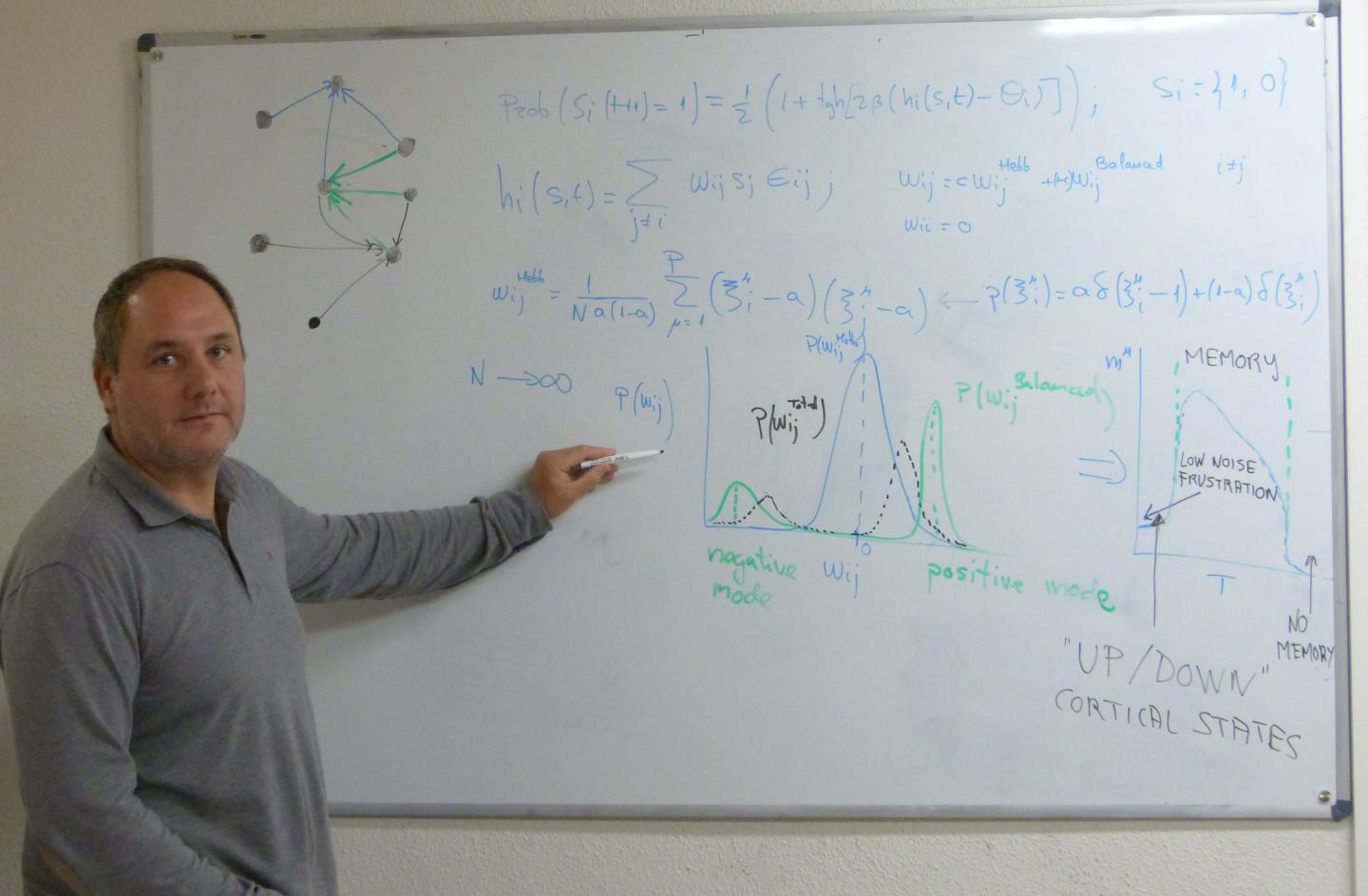
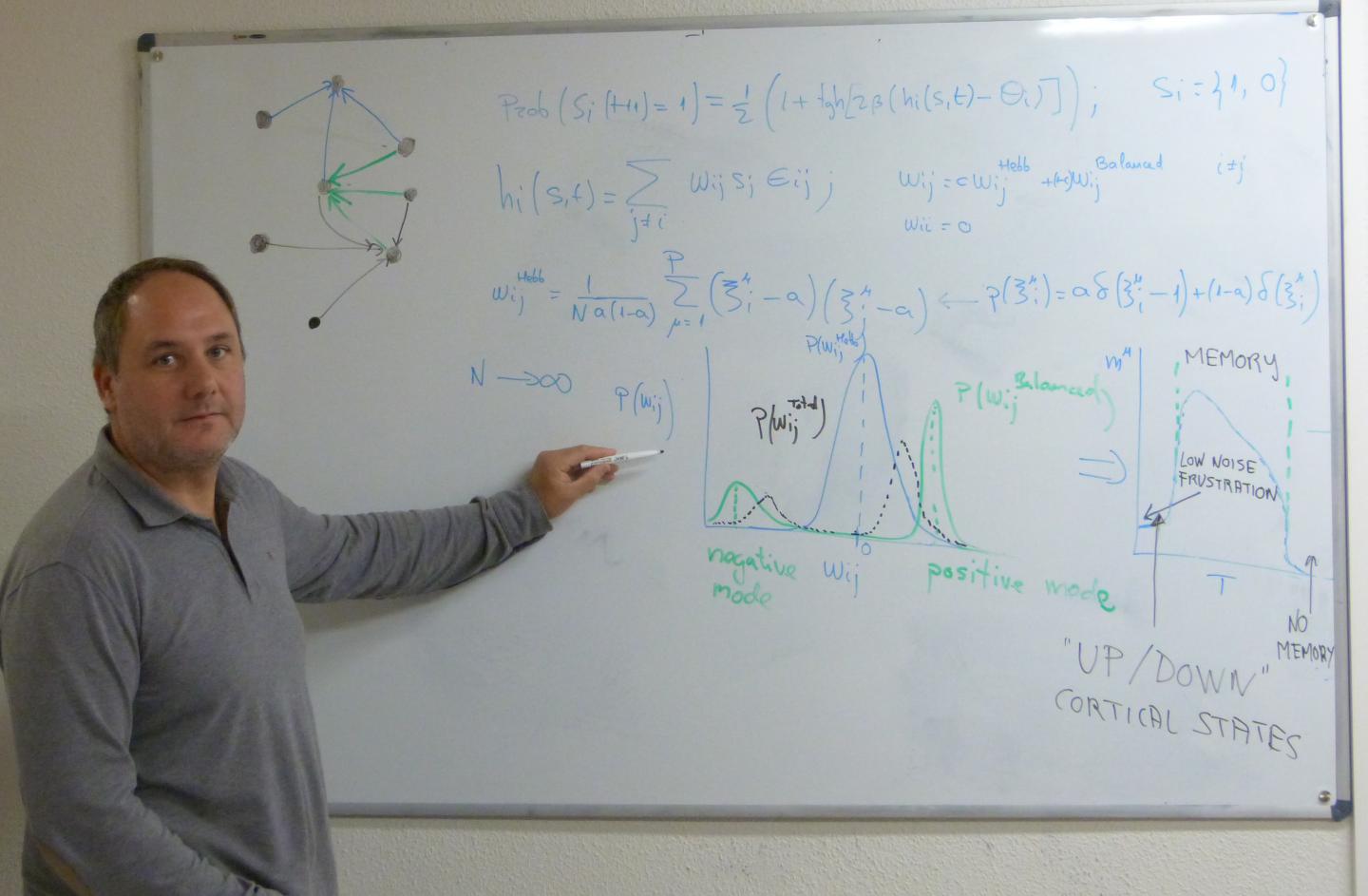
IMAGE

Credit: UGRdivulga

Scientists from the University of Granada (UGR) have proven for the first time that there is a close relationship between several emerging phenomena in magnetic systems (greatly studied by condensed matter physicists) and certain states of brain activity.

The researchers, who have published their work in the journal Neural Networks, have studied a brain model consisting of a balanced neuronal network with 80% excitatory synapses (that is, neuronal connections that favor the transmission of information between neurons) and 20% inhibitor synapses (neuronal connections which prevent said information from being transmitted).

Interestingly, the initial objective of the UGR scientists was to study how the autistic brain works, for which they intended to develop a mathematical model that would allow the neuronal connections of this disease to be analyzed.

However, as their research progressed they were able to demonstrate, both mathematically and through computer simulations, the existence of a type of state called "spin glass" in said system, which corresponds to states of low activity (Down) or high activity (Up). This has been widely described in the cortex of mammals, including the human brain.

The so called spin-glass states are magnetic systems that have been extensively described in low temperature disordered magnetic materials and also appear in artificial neural network models.

Spin-glass states are frozen disordered spin states due to frustration in the interactions between spins (physical property of subatomic particles, by which every elementary particle carries an intrinsic angular momentum whose value is fixed). Said states can be both ferromagnetic and antiferromagnetic, preventing the system from relaxing to the ground state or causing very long relaxation times.

In neuroscience, on the other hand, the spin-glass states manifest themselves by a frozen neuronal activity, and they appear (in the absence of thermal fluctuations or noise) due to the interference produced by the memorization of a macroscopic number of memories and the impossibility to discern among so many of them in the memory process.

In this paper, researchers have proven for the first time the constructive role and functionality of a particular type of spin-glass state in neuroscience. "In fact, we have proven both theoretically and through simulation that the Up and Down states observed in the activity of mammal brains would be but a mere manifestation of these spin-glass states", Joaquín Torres Agudo, professor from the Department of Electromagnetism and Physics of the Matter at the UGR and lead author of the study, explains.

This work constitutes an appropriate and novel theoretical framework to study the biological mechanisms of destabilization of these states that can induce transitions between Up and Down states, similar to the transitions commonly described during anesthesia processes or in the transition from wakefulness to sleep.

###

Media Contact

Joaquín Torres Agudo
[email protected]
34-958-241-000
@canalugr

http://www.ugr.es

Share13Tweet7Share2ShareShareShare1

Related Posts

Evaluating a Self-Care App for Chest Trauma Patients

February 8, 2026

Anesthesia Method’s Impact on Elderly Hip Fracture Recovery

February 8, 2026

Menopause Care: Insights from Workforce Review and Consultation

February 7, 2026

LRRK2R1627P Mutation Boosts Gut Inflammation, α-Synuclein

February 7, 2026
Please login to join discussion

POPULAR NEWS

  • Robotic Ureteral Reconstruction: A Novel Approach

    Robotic Ureteral Reconstruction: A Novel Approach

    82 shares
    Share 33 Tweet 21
  • Digital Privacy: Health Data Control in Incarceration

    63 shares
    Share 25 Tweet 16
  • Breakthrough in RNA Research Accelerates Medical Innovations Timeline

    53 shares
    Share 21 Tweet 13
  • Mapping Tertiary Lymphoid Structures for Kidney Cancer Biomarkers

    50 shares
    Share 20 Tweet 13

About

We bring you the latest biotechnology news from best research centers and universities around the world. Check our website.

Follow us

Recent News

Evaluating a Self-Care App for Chest Trauma Patients

Anesthesia Method’s Impact on Elderly Hip Fracture Recovery

Menopause Care: Insights from Workforce Review and Consultation

Subscribe to Blog via Email

Enter your email address to subscribe to this blog and receive notifications of new posts by email.

Join 73 other subscribers
  • Contact Us

Bioengineer.org © Copyright 2023 All Rights Reserved.

Welcome Back!

Login to your account below

Forgotten Password?

Retrieve your password

Please enter your username or email address to reset your password.

Log In
No Result
View All Result
  • Homepages
    • Home Page 1
    • Home Page 2
  • News
  • National
  • Business
  • Health
  • Lifestyle
  • Science

Bioengineer.org © Copyright 2023 All Rights Reserved.