Orthopedic surgeons evaluating total knee arthroplasty techniques have demonstrated that combining robotic-arm assistance with a lateral parapatellar approach and an adapted patellar drilling guide effectively corrects complex valgus knee deformities. In a clinical investigation led by Yasushi Oshima, Hiroki Yoshida, and Tokifumi Majima, published in the journal Arthroplasty, researchers documented successful outcomes across ten knees in nine patients suffering from advanced osteoarthritis complicated by fixed valgus alignment. Rather than presenting a simple mirror image of medial compartment osteoarthritis, valgus malalignment involves contracted lateral structures, elongated medial stabilizing ligaments, lateral femoral condyle hypoplasia, and rotational distortions that historically complicate implant placement and joint balance.
The structural characteristics of valgus deformity create substantial challenges during conventional joint reconstruction. In these knees, the medial soft-tissue structures, including the medial collateral ligament, become stretched or attenuated, while the lateral soft tissues—encompassing the iliotibial band, lateral collateral ligament, and lateral retinaculum—are pathologically tight and contracted. These pathological changes frequently lead to pronounced medial instability and patellar maltracking. Entering through a lateral parapatellar arthrotomy offers direct surgical exposure to the contracted lateral compartment and facilitates selective soft-tissue releases, yet surgeons rarely employ it. In Japan, for instance, registry data show the lateral approach is selected in only half a percent of primary total knee arthroplasties, compared to more than seventy percent utilizing the traditional medial parapatellar route, largely due to unfamiliarity and anatomical hurdles.
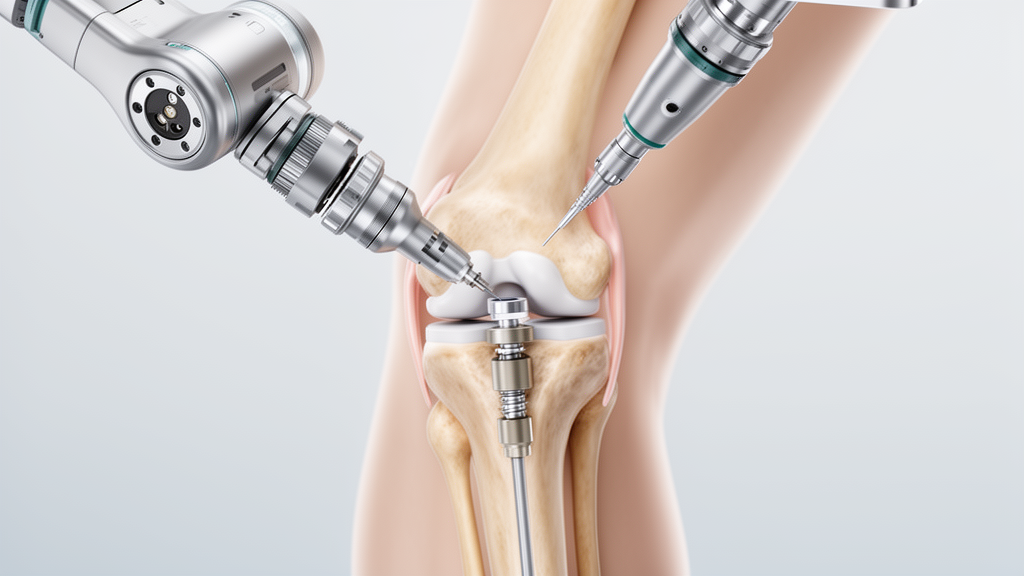
To overcome the technical hurdles associated with lateral-entry knee replacement, the investigators integrated semi-active robotic technology to execute three-dimensional preoperative planning, objective gap assessment, and haptically guided bone resections. Preoperative computed tomography scans encompassing the full length of each affected lower extremity were obtained according to standard imaging protocols and converted into patient-specific three-dimensional surgical models. Intraoperatively, the surgical team inserted bicortical tracker pins into the distal femur and proximal tibia to establish dynamic optical tracking, accompanied by hemicortical checkpoint pins positioned outside the anticipated implant zones. Anatomical landmarks were registered directly against the virtual model to confirm precise skeletal geometry. The semi-active robotic cutting blade provided visual, tactile, and auditory boundaries to ensure cuts aligned exactly with the virtual plan, reducing manual variance and permitting precise intraoperative bone resection without extensive collateral soft-tissue disruption.
A critical consideration during robotic resection through the lateral approach arose from standard system programming, which was originally designed exclusively for a medial parapatellar entry. In contrast, lateral arthrotomy requires retracting the patella medially, which causes the pre-programmed robotic bone blade to move directly toward the displaced patellar tendon during proximal tibial resection. To resolve this hazard without compromising accuracy, the operating surgeon maneuvered the cutting blade under careful manual guidance within the programmed safety envelope while physically shielding the patellar tendon using a surgical elevator. This protective modification successfully prevented tendon injury across all procedures, allowing the robotic arm to complete the planned bone resections smoothly and reliably along the targeted lateral entry corridor.
Soft-tissue balancing was directed using the system’s dynamic balancing software before performing definitive bone cuts. Medial and lateral tibiofemoral joint gaps were measured under manual stress testing in near-extension at ten degrees of flexion and with dedicated gap instruments at ninety degrees of flexion. Because medial soft tissues in valgus knees are typically attenuated, the investigators preserved primary medial stabilizers, including the deep medial collateral ligament, avoiding unnecessary medial releases and focusing instead on removing osteophytes. Persistent lateral tightness was addressed systematically: the anterior insertion of the iliotibial band at Gerdy’s tubercle was released up to one-third of its width in five of the ten knees, and supplementary pie-crusting was required in only a single knee. Because the robotic system calculated and verified gap symmetry prior to cutting, no additional soft-tissue releases were required following bone resection, achieving a balanced, rectangular joint space without destabilizing the medial compartment.
To achieve anatomical congruency, the team employed onlay oval patellar components, which offer superior bone coverage, reduced lateral patellar contact, smaller tilt angles, and decreased lateral underhang compared with circular designs. However, standard asymmetric patellar drill guides provided by implant manufacturers are configured strictly for medial-to-lateral eversion. When applied from the lateral side, the orientation is inverted, making conventional templates unusable. To resolve this geometric mismatch, the authors developed a specialized reversed-asymmetric patellar drill template, manufactured by Stryker and approved by Japanese medical device authorities in September 2024. This dedicated guide allowed surgeons to accurately drill three stabilizing peg holes while maintaining appropriate anatomical rotation, preventing patellar overhang and ensuring proper seating of the resurfaced oval component.
To evaluate patellar kinematics quantitatively rather than relying on subjective manual tests such as the traditional no-thumb technique, the surgical team utilized the robotic system’s dynamic spatial tracking probe. In the three most recent surgical cases, surgeons drilled a small 2.0-millimeter hole to a depth of fifteen millimeters into the central patella without breaching the articular cartilage. Kinematic trajectories were mapped before bone resection and repeated following definitive prosthesis implantation with three temporary stabilizing sutures placed in the lateral retinaculum. Real-time monitor visualization confirmed that the resurfaced patella tracked smoothly within the femoral trochlear groove without lateral subluxation or abnormal tilt, providing objective confirmation of anatomical alignment.
Patient outcomes demonstrated marked clinical and radiographic improvements following surgery. The cohort included nine patients undergoing ten primary replacements, representing Ranawat classification type II and type III deformities, as well as cases exceeding twenty degrees of valgus alignment or exhibiting uncorrectable deformity on preoperative stress testing. Postoperatively, the median knee extension angle improved significantly from a preoperative limitation of negative 5.0 degrees to a neutral 0.0 degrees, while median flexion reached 120.0 degrees. Median Visual Analog Scale pain scores dropped from 40.0 preoperatively to 7.5 postoperatively, accompanied by significant gains across all Knee Injury and Osteoarthritis Outcome Score subscales. Postoperative radiographic assessments confirmed accurate restoration of mechanical limb axes: median lateral femorotibial angles and hip-knee-ankle angles achieved neutral correction, while component orientation angles aligned closely with surgical targets.
Postoperative safety monitoring revealed no implant-related or technique-specific adverse events during the observation period. Patients began full weight-bearing rehabilitation on the first postoperative day and were monitored in the hospital for two to three weeks before transitioning to routine outpatient follow-up visits. Across all ten procedures, no occurrences of periprosthetic joint infection, periprosthetic fracture, revision total knee arthroplasty, or 90-day readmissions were recorded. Furthermore, there were no pin-site complications associated with the robotic optical trackers, nor were there fractures or structural complications at the patellar tracking hole sites.
The authors recognized limitations in their preliminary investigation, notably the single-center design, the modest cohort of ten knees across nine patients, and the relatively short follow-up interval. Additionally, robotic technology incurs increased institutional costs and extends operative time compared with standard manual techniques. Nonetheless, the investigators concluded that robotic-assisted execution effectively neutralizes the primary hazards of lateral parapatellar total knee arthroplasty in severe valgus knees. By combining haptic bone resection, protective soft-tissue retraction, dynamic gap measurement, and an inverted patellar drill template, the integrated protocol achieved accurate implant positioning, restored ligament balance, and verified stable patellar tracking, establishing a reproducible surgical framework for challenging knee deformities.
Subject of Research: Robotic-assisted total knee arthroplasty via the lateral parapatellar approach for valgus knee deformity
Article Title: Surgical technique of robotic arm-assisted total knee arthroplasty via the lateral parapatellar approach for valgus knee deformity
Article References: Oshima, Y., Yoshida, H., & Majima, T. (2026). Surgical technique of robotic arm-assisted total knee arthroplasty via the lateral parapatellar approach for valgus knee deformity. Arthroplasty, 8(1), Article 33. https://doi.org/10.1186/s42836-026-00387-6
Image Credits: AI Generated
DOI: 10.1186/s42836-026-00387-6
Keywords: total knee arthroplasty, valgus knee deformity, lateral parapatellar approach, robotic-assisted surgery, Mako robotic system, patellar tracking, onlay oval patellar implant, soft-tissue balancing, knee osteoarthritis, Ranawat classification, orthopedic surgery, tibiofemoral joint gaps, iliotibial band release, femorotibial angle, hip-knee-ankle angle, patellar drill template
News Source: Ophelia Keating. (November 14, 2026). Robotic Surgery via Lateral Approach Corrects Severe Valgus Knee Deformity. Scienmag.