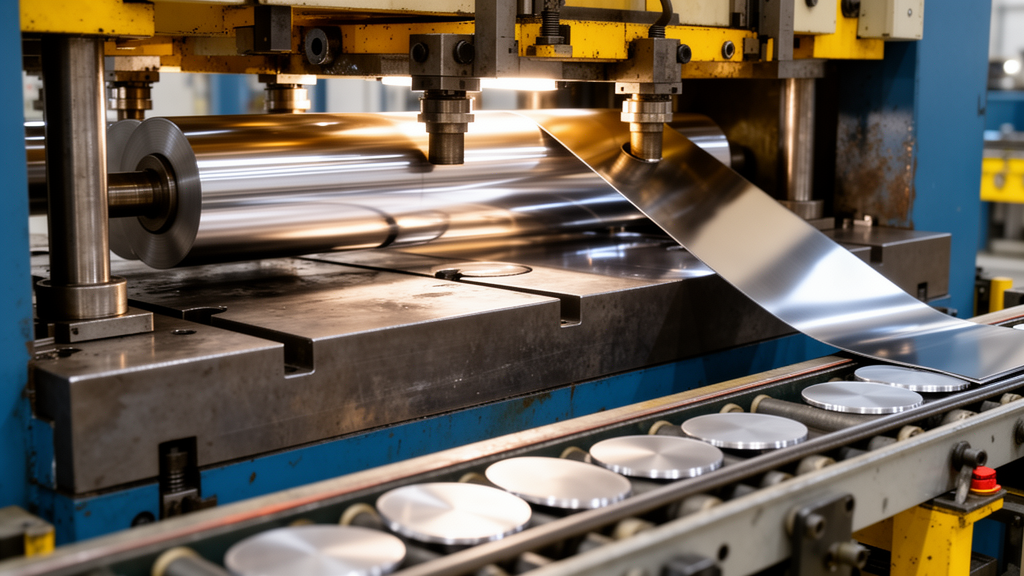
Mechanical engineers have developed a surrogate-assisted computational framework combining artificial neural networks and multi-objective evolutionary optimization to navigate the continuous parameter space of sheet metal blanking. In high-volume manufacturing across automotive, aerospace, and consumer product sectors, blanking components using punch-and-die tooling frequently produces edge burrs that deteriorate dimensional precision, compromise subsequent assembly, accelerate tool wear, and increase secondary finishing costs. Traditional parameter selection has relied heavily on empirical shop-floor trials or statistical design of experiments, such as Taguchi methods and response surface models, which evaluate only isolated, discrete combinations of operating conditions. By confining process parameters to fixed grid intervals, conventional methods routinely miss superior operating conditions situated in the continuous gaps between sampled test levels. To resolve this limitation, researchers constructed an integrated optimization pipeline combining experimental burr measurements with physics-based mechanical equations, allowing continuous multi-objective exploration without necessitating hundreds of additional physical shearing trials.
The experimental foundation of the investigation utilized a consolidated multi-material dataset encompassing four widely used engineering sheet metals: SS316 stainless steel, C11000 copper, AA1100-H14 aluminium, and C26000-H02 brass. These metals were selected specifically to provide contrasting mechanical behaviors, displaying pronounced differences in shear strength, hardness, tensile resistance, and work-hardening tendencies. All physical blanking trials were conducted under controlled laboratory settings using a 10-ton hydraulic press fitted with a hardened tool-steel punch and die assembly maintaining a constant punch diameter of 10 mm. Experiments were executed under dry cutting conditions to eliminate lubricating boundary layers and isolate the pure geometric influences of sheet thickness and punch-to-die clearance. The initial dataset was compiled using a Taguchi L25 orthogonal array layout investigating five distinct sheet thickness levels between 0.5 mm and 1.5 mm alongside five punch-die clearance levels ranging between 5 percent and 15 percent of sheet thickness, generating 25 discrete parameter combinations per material and 100 experimental observations across the four metals.
Burr height served as the solitary experimental response variable, defined as the maximum protrusion measured along the blanked cut edge. Measurements were recorded using a digital height measurement apparatus calibrated to a least count of 0.0001 mm, averaging multiple readings along the blank circumference to suppress local measurement scatter. Rather than building separate regression models for each metal, the authors configured a unified single-hidden-layer feedforward neural network capable of generalizing across all four material systems simultaneously. The network received six normalized inputs consisting of continuous sheet thickness, continuous punch-die clearance, and four one-hot encoded binary variables denoting material identity. Using one-hot flags allowed the network to learn material-specific deviations from baseline shearing mechanics without incorporating mutually correlated constitutive properties like hardness and tensile strength, which could introduce numerical redundancy into a dataset comprising 100 observations.
To establish the most effective neural architecture, the researchers executed a systematic search spanning hidden-layer configurations between 5 and 25 neurons, running 20 independent Levenberg-Marquardt backpropagation training trials per configuration to account for random weight initializations. Across 420 evaluated network candidates, a 6-12-1 topology featuring 12 hidden neurons with hyperbolic tangent sigmoid transfer functions and a linear output neuron delivered the best balance between training convergence and generalization. The optimal 12-neuron network achieved a mean squared error of 6.714 × 10⁻⁶, a root mean squared error of 0.00259 mm, and a coefficient of determination of 0.99505 across the combined dataset. Performance diagnostics verified that the Levenberg-Marquardt algorithm converged rapidly without overfitting, while residual histograms and sequential sample tracking confirmed an approximately symmetric error distribution around zero without systematic bias or error clustering.
The reliability of the 12-neuron surrogate model was rigorously tested through repeated five-fold cross-validation. The 100-sample database was randomly split into four training folds and one testing fold across 10 independent iterations, yielding 50 validation runs and 1000 cross-validated predictions. Across these 50 cycles, the neural model demonstrated stable generalization, achieving a mean coefficient of determination of 0.850 with a standard deviation of 0.145, an average root mean squared error of 0.0128 ± 0.0054 mm, and a mean absolute error of 0.0089 ± 0.0027 mm. Sensitivity analyses further validated that the learned response surfaces conformed to established cutting mechanics: predicted burr heights decreased as sheet thickness increased and scaled upward with wider punch-die clearances. Steel displayed the greatest sensitivity to parameter shifts, whereas copper produced the smallest absolute burr formations across the entire parameter envelope. Material-wise residual checks showed root mean squared errors remaining below 0.02 mm for all four metals.
The neural surrogate was subsequently bench-tested against six common machine learning regression algorithms implemented in the MATLAB Regression Learner environment, including fine regression trees, ordinary linear regression, interaction-augmented linear models, fine Gaussian support vector machines, squared exponential Gaussian process regression, and ensemble regression trees. Although the squared exponential Gaussian process regression slightly surpassed the neural network in raw validation fit with an R² of approximately 0.97 and an RMSE near 0.006 mm, the 12-neuron neural network was retained as the surrogate engine because of its thoroughly verified 420-trial optimization history, robust cross-validation stability, and computationally rapid evaluation speed required for extensive population-based iterative searches. Comparative percentage error profiles further demonstrated that the neural network delivered substantially more uniform residual spreads than conventional response surface methodology or classical linear regressions, which exhibited larger systematic deviations at higher burr levels.
To formulate a multi-objective manufacturing optimization problem, the authors integrated the predictive neural surrogate with three physics-derived analytical functions describing the mechanical kinetics of the blanking operation. While burr height represented cut-edge quality, the framework simultaneously evaluated blanking force to reflect press and tooling structural loads, shearing energy to capture overall machine power consumption, and specific work defined as shearing energy per unit of sheared area to serve as a normalized metric of process efficiency. Analytical formulations derived blanking force from material shear strength (specified as 350 N/mm² for steel, 150 N/mm² for copper, 80 N/mm² for aluminium, and 255 N/mm² for brass), sheared perimeter (31.416 mm), sheet thickness, and an empirical clearance factor. Shearing energy incorporated penetration factors, while specific work normalized energy across changing cut dimensions.
Multi-objective optimization was carried out using the Non-dominated Sorting Genetic Algorithm II (NSGA-II) operating through MATLAB’s gamultiobj solver. Optimization runs evaluated the two continuous decision variables within bounded ranges: sheet thickness between 0.5 mm and 1.5 mm, and clearance between 5 percent and 15 percent of thickness. Algorithmic parameters were standardized across all four metals using a population size of 100 individuals evolved across 150 generations, executing approximately 15,000 function evaluations per material and 60,000 evaluations across the entire study. The generated Pareto distributions clearly revealed that favorable trade-off solutions clustered heavily within narrow clearance bands between 5 percent and 7 percent, successfully discovering intermediate operational sweet spots that were inaccessible under the coarse discrete intervals of the initial Taguchi array.
Because commercial press shops must implement single operating points rather than entire theoretical solution sets, the researchers implemented a knee-point selection technique based on the normalized Euclidean distance to an idealized utopia point where all four objectives hypothetically reach their absolute minima. For all four materials, the calculated knee-point operating conditions converged within a constrained operational band: optimal sheet thicknesses ranged between 0.6161 mm and 0.7121 mm, while optimal clearances fell between 5.00 percent and 6.07 percent. Material-specific differences mirrored mechanical strength disparities. Copper achieved the lowest burr height of 0.0384 mm alongside minimal blanking force of 3474 N and shearing energy of 2568 N·mm. Conversely, SS316 steel demanded the highest blanking force of 9540 N and shearing energy of 8139 N·mm to manage its pronounced shear resistance, while aluminium and brass occupied intermediate operational states.
To verify the physical validity of the computational solutions, the team selected twelve representative Pareto-optimal conditions across diverse front sectors and conducted independent physical validation trials on the blanking press. Because evolutionary algorithms produce non-standard decimal thicknesses, physical tests utilized the nearest commercially available gauge thicknesses, with maximum thickness variances remaining below 0.01 mm. Experimental measurements closely mirrored the neural predictions, displaying absolute errors ranging from 0.00077 mm to 0.00449 mm and an overall mean absolute error of 0.0023 mm. Absolute percentage errors spanned 2.47 percent to 4.39 percent, yielding a mean absolute percentage error of 3.31 percent. Furthermore, signed percentage errors plotted symmetrically above and below zero, demonstrating that the surrogate framework maintained high fidelity without systematic underprediction or overprediction under practical shearing conditions.
Despite its documented precision, the authors outlined explicit technical boundaries governing the current methodology. The analytical equations employed for blanking force, shearing energy, and specific work exhibited strong mutual correlations (r = 0.95 to 1.00), which compressed the dimensionality of objective conflict and potentially constrained the diversity of generated Pareto fronts. Additionally, representing materials via one-hot categorical vectors effectively encoded the specific empirical responses of the four tested alloys but prevented the surrogate from extrapolating predictions to uncharacterized metals without retraining. The experimental boundaries also maintained invariant punch geometry under dry shearing, omitting operational variables such as tool wear progression, dynamic punch velocities, thermal heating, and fluid lubrication regimes. Future expansions of the framework aim to incorporate continuous mechanical property descriptors such as ductility and strain hardening, adaptive online learning, and real-time digital twin monitoring to transition surrogate-assisted multi-objective optimization into smart industrial sheet metal stamping lines.
Subject of Research: Surrogate-assisted continuous multi-objective optimization of sheet metal blanking
Article Title: Surrogate assisted artificial neural network and NSGA II framework for continuous multi-objective optimization of sheet metal blanking
Article References: Bhoir, S., & Verma, M. (2026). Surrogate assisted artificial neural network and NSGA II framework for continuous multi-objective optimization of sheet metal blanking. Discover Mechanical Engineering, 5(1), Article 171. https://doi.org/10.1007/s44245-026-00352-2
Image Credits: AI Generated
DOI: 10.1007/s44245-026-00352-2
Keywords: sheet metal blanking, artificial neural network, NSGA-II, burr height prediction, multi-objective optimization, Pareto-optimal solutions, knee-point selection, Taguchi experimental design, manufacturing engineering, punch-die clearance, shearing energy, blanking force, surrogate modeling, SS316 stainless steel, C11000 copper, AA1100 aluminium, C26000 brass
News Source: Denise Maddox. (November 14, 2026). Neural Networks and Evolutionary Algorithms Optimize Continuous Sheet Metal Blanking Operations. Scienmag.