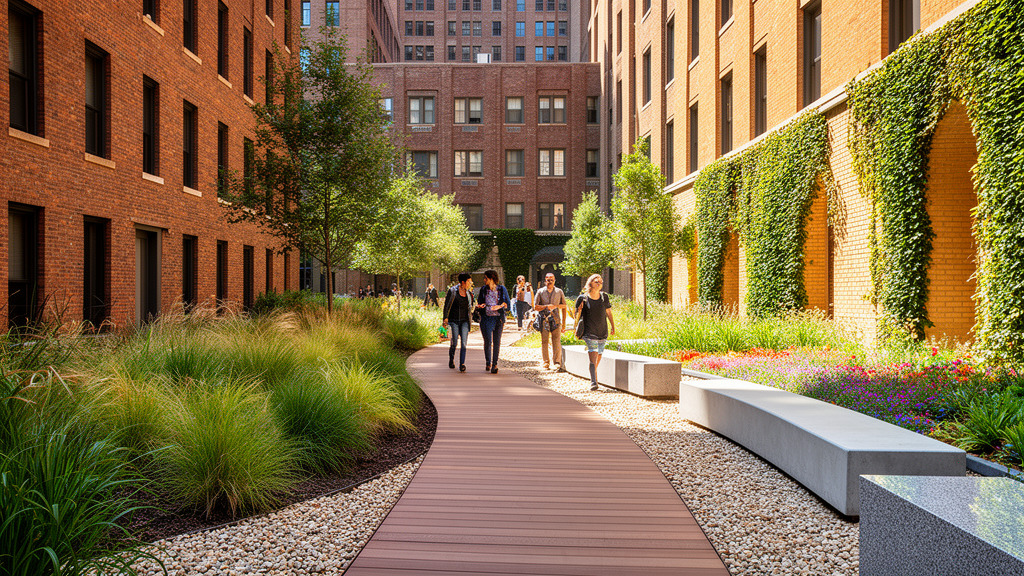
A theoretical and morphological investigation published in City, Territory and Architecture by architectural researchers Maddalena Rossi and Iacopo Zetti proposes that the fragmented, residual spatialities proliferating across contemporary intermediate cities should no longer be categorized as irrecoverably degraded wastelands, but rather as pivotal spatial reservoirs with latent regenerative potential. Rather than dismissing peripheral gaps as planning failures, the authors construct an interpretive and methodological bridge linking macro-scale urban transformation theories directly to local-level design interventions aimed at community reclamation.
The conceptual baseline of the study rests upon the evolving discourse surrounding the intermediate city, widely recognized through the concept of the Zwischenstadt introduced by Thomas Sieverts in the late 1990s and translated internationally in 2003. According to Sieverts and subsequent urban geographers cited by the authors, traditional nineteenth- and twentieth-century spatial binaries that strictly counterposed urban density against rural landscape have been rendered obsolete by late-capitalist territorial restructuring. Instead, contemporary settlements increasingly configure into diffused, discontinuous, and functionally hybrid city-regions characterized by fragmented land uses where residential quarters, industrial clusters, and commercial facilities sit in immediate physical proximity. The authors contextualize this phenomenon within Edward Soja’s theories of post-metropolitan regional urbanization, noting that intermediate settlement dynamics manifest marked polycentricity with multiple decentralized activity nodes lacking an absolute organizing core. These territories operate through fluid relational geographies governed by technological, economic, and logistical flows rather than immutable architectural perimeters, unfolding across complex temporal trajectories where spaces expand, contract, and continuously mutate under fluctuating socio-economic pressures.
Within this expanding territorial fabric, the authors identify a pervasive proliferation of in-between spaces, drawing upon an extensive body of spatial literature that previously catalogued them under various pessimistic or diagnostic rubrics. Prior research cited in the paper has characterized these zones as neglected spatialities, residual grey areas, underutilized intra-spaces, or infra-ordinary reverse cities structured around spatial emptiness rather than architectural fullness. The authors argue that this widespread emergence is directly driven by an intertwining of two structural drivers: first, a capitalist development model that prioritizes the aggressive extraction of financial capital from speculative urban expansion while remaining systematically indifferent to historical cultural heritage and public realm quality; and second, a pervasive lack of overarching strategic guidance across intermediate territories. In the absence of comprehensive master planning that treats regional growth as an evolutionary organic whole, intermediate cities have historically been shaped through disconnected sectorial rationales, isolated piecemeal developments, and fragmented additions that reduce planning responses to reactive, emergency remedial measures.
To rigorously delineate the specific physical and functional nature of these territories before intervening, the authors synthesize extant theoretical literature to establish seven universal characteristics intrinsic to all in-between spaces. The primary shared trait is multi-scalarity, meaning these formations exist simultaneously across all regional dimensions from microscopic roadside slivers to expansive infrastructural corridors, generating diverse cross-scalar interrelations between localized environments and global logistical flows. Second, these spaces operate as loci of profound relationality, acting as connective interfaces that continuously recalibrate socio-spatial metabolisms and oscillate between structural connection and infrastructural disconnection. Third, they possess inherent transience, existing within non-Euclidean temporal registers as open-ended, dynamic formations suspended in the present and oriented toward future mutation. Fourth, they occupy eccentric positions, situated off-center across overlapping polarities where decentralizing and recentralizing economic forces collide. Fifth, they exhibit intrinsic diversity, manifesting as intensely hybrid ecological, cultural, and aesthetic environments shaped by spontaneous human and non-human activities. Sixth, they represent politically incomplete realms lacking institutional representation and clear citizenship structures. Finally, they consistently disrespect administrative borders, sprawling across fragmented jurisdictions that historically obstruct coherent governance.
To transition from abstract theoretical characterizations to empirical reality, Rossi and Zetti conducted a systematic methodological reconnaissance centered on the Florence-Prato conurbation, an archetypal European intermediate-city landscape located in central Italy, with supplementary verifications across broader Italian territorial contexts. Adapting the inventory methodology formulated by French author Georges Perec, who championed the meticulous cataloguing of everyday, infra-ordinary phenomena to illuminate unnoticed spatial conditions, the researchers deployed high-resolution aerial photography coupled with targeted on-site field surveys. This reconnaissance mapped all residual land formations across the conurbation, meticulously recording their dimensional perimeters, physical boundaries, and informal ground patterns. By systematically recording strips of unused terrain, highway shoulders, railway verges, and transitional parcels, the authors constructed a comprehensive spatial inventory designed to overcome outmoded twentieth-century functional partitions, establishing an empirical foundation capable of capturing the nuanced material complexity of contemporary intermediate environments.
By interpolating two decisive parameters extracted from their empirical inventory—the physical size of the land parcels and the nature of their ongoing management, including their historical origins, developmental trajectories, degree of abandonment, and applicable planning controls—the authors formulated a structural taxonomy comprising five distinct typologies of in-between spaces, designated collectively as INTERspaces. The first category, INTERstitial spaces, comprises narrow infrastructural slivers along railway tracks and road alignments, under-utilized parking surfaces, transitional warehouse districts, and vacant parcels unsuitable for standard building developments. The second group, INTERvisible spaces, consists of vast visual interruptions and desolate perimeter zones framed by monolithic, mute residential blocks constructed without ecological consideration or aesthetic sensitivity. The third typology, INTERupted spaces, encompasses industrial carcasses, suspended construction sites, and brownfield ruins accumulated following post-Fordist manufacturing declines and technological transitions. The fourth classification, INTERcluding spaces, delineates precarious, stigmatized informal settlements established through the vital survival strategies of marginalized social minorities. Finally, INTERactive spaces represent residual parcels that have been spontaneously appropriated and revitalized through grassroots creative resistance and community self-organization.
Having demonstrated that all seven core theoretical attributes persist across each of the five classified INTERspace typologies, the researchers address the theoretical lineage of urban design to formulate a restorative planning paradigm rooted in the positive deployment of spatial disorder. Rossi and Zetti trace historical critiques of standardized modernism back to the post-World War II period, highlighting the foundational interventions of Team X and Italian architect Giancarlo De Carlo, who denounced rigid architectural functionalism for treating citizens as homogenized abstractions rather than dynamic social communities. De Carlo anticipated modern territorial dispersion by advocating for rhizomatic relational networks capable of discovering underlying order within apparent chaos. To reinforce this philosophical framework, the authors incorporate sociologist Richard Sennett’s classic propositions from The Use of Disorder, which argued that vibrant, mature urban life fundamentally requires embracing instability, environmental indeterminacy, and socio-spatial flux rather than enforcing deadening, predetermined functional zoning. Integrating recent elaborations from Pablo Sendra on assemblage theory and Ash Amin’s conceptualization of public space as lightly regulated, open, and improvised realms, the authors argue that disorder must become an active instrument for creative urban reconfiguration.
From this theoretical confluence, the authors articulate five operational co-design principles intended to guide architects and municipal authorities away from coercive social control and toward collaborative civic empowerment. First, urban design must be approached fundamentally as a process of open-ended spatial exploration rather than an individualized, static technical answer to an isolated, predetermined program. Second, designing within intermediate conditions must operate as an ongoing framework of collective social learning that integrates diverse community perspectives throughout every stage of implementation. Third, project methodologies must prioritize continuous experimentation within an expansive field of latent possibilities, encouraging localized pilot interventions over immutable blueprints. Fourth, interventions must consciously balance multiple time horizons, coordinating immediate temporary activations with multi-scalar regional rhythms. Fifth, both the conceptualization and governance of spatial transformations must remain adaptive and iterative, resolutely rejecting predictive-hierarchical planning dogmas in favor of responsive, community-grounded adjustments that accommodate emergent vernacular practices.
Synthesizing these principles with taxonomic insights derived from Gilles Clément’s observations on involuntary landscape art and spontaneous territorial modification, Rossi and Zetti establish a design matrix correlating six fundamental characteristics of in-between spaces with eight actionable urban design strategies. First, connecting seeks to link fragmented, infra-ordinary residual parcels into continuous rhizomatic networks of public space. Second, eroding introduces gradual dismantling processes to deconstruct sterile, monofunctional asphalt landscapes and single-use concrete surfaces. Third, exploring preserves complex, ambiguous spatial pockets that demand progressive physical discovery rather than immediate commercial legibility. Fourth, not completing intentionally maintains zones in deliberate states of indeterminacy, acknowledging that unfinished terrains provide vital, flexible stages for informal leisure and children’s play. Fifth, resignifying reinterprets obsolete architectural relics and historical palimpsests to assign fresh collective purposes to discarded structures. Sixth, blurring dissolves rigid spatial enclosures, converting hostile physical barriers into permeable connecting membranes. Seventh, disappearing harnesses spontaneous natural processes, allowing unmanaged ecological succession to regenerate neglected ground without invasive infrastructural intervention. Eighth, favouring multiple temporalities accommodates overlapping daily schedules and seasonal shifts to eliminate extensive spatial dead time.
In their concluding synthesis, Rossi and Zetti emphasize the critical theoretical and practical limitations governing their proposed framework. The authors explicitly state that their eight design strategies remain speculative, derived primarily through rigorous analytical argumentation, morphological classification, and pedagogical experimentation within an academic Department of Architecture rather than empirical long-term field validation. They stress that these spatial tactics do not constitute an exhaustive catalog of design possibilities, because authentic field verification cannot occur through unilateral architectural decree, but requires prolonged co-design processes directly embedded alongside local communities and marginalized stakeholders. Furthermore, the seventh theoretical characteristic of in-between spaces—their trans-scalar governance fragmentation across conflicting municipal boundaries—cannot be solved purely through architectural design tools, demanding instead dedicated administrative innovations and cohesive multi-jurisdictional policy platforms.
Subject of Research: Urban design strategies and theoretical classification frameworks for in-between spaces in intermediate cities
Article Title: Planning in-between spaces: from a theoretical perspective to urban design strategies for marginalised urban fabrics
Article References: Rossi, M., & Zetti, I. (2025). Planning in-between spaces: from a theoretical perspective to urban design strategies for marginalised urban fabrics. City, Territory and Architecture, 12(1), Article 35. https://doi.org/10.1186/s40410-025-00286-4
Image Credits: AI Generated
DOI: 10.1186/s40410-025-00286-4
Keywords: intermediate cities, in-between spaces, urban design strategies, Zwischenstadt, Florence-Prato conurbation, spatial fragmentation, regenerative urbanism, public space production, Giancarlo De Carlo, Richard Sennett, disordered design, multi-scalar urbanisation, spatial inventory, infra-ordinary, assemblage theory, urban morphology, community co-design
News Source: Denise Maddox. (November 14, 2026). Urban Design Framework Reframes Neglected In-Between Spaces as Regenerative Public Assets. Scienmag.