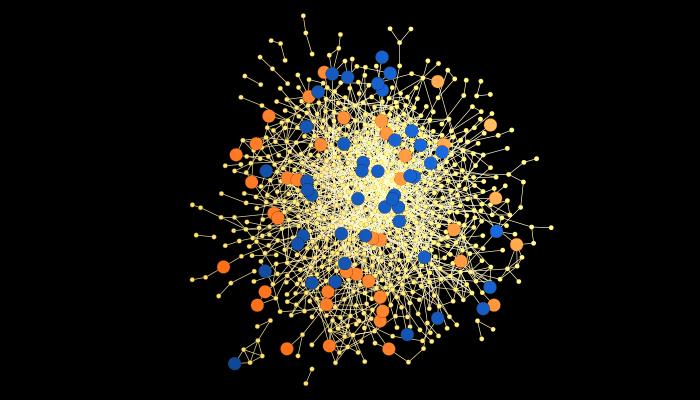
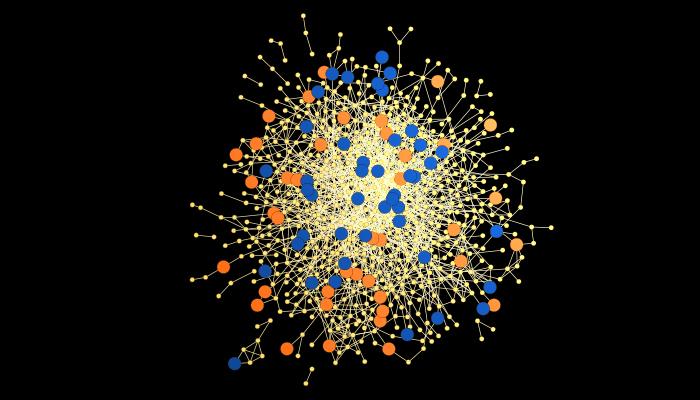
Using anonymous mobile phone data, Aalto University doctoral researcher Talayeh Aledavood has tapped into patterns in people’s behaviour. She has found out that our ‘chronotypes’ – our inherent periods of sleep during a 24-hour-period – correlate with the size of our social networks and how much we are in contact with others and also the kind of chronotypes with whom we interact.
Night owls – people who go to sleep late – tend to have wider social networks than morning persons. Night owls are also more central in their own networks and – distinctively more than early birds – stick to their kind and interact with others who stay up late.
“The digital breadcrumbs our daily phone use leaves behind can be used to monitor our behaviour. They provide a picture of our activities, movements, and communication,” says Aledavood.
In her dissertation, Aledavood has used such digital traces to investigate people’s patterns of behaviour. Times of sleep can be inferred from periods of no smartphone use. The timing of calls made to friends and the size of our social networks, based on calls, texts, or emails, reveal our social habits. It’s a lot harder to get accurate information like this from, for example, surveys, and it’s possible to widen the scope of the study up to entire countries.
How to use mobile data in mental health care
While providing interesting knowledge of our sleep patterns’ correlations with social interactions and networks, Aledavood’s research has wider implications. Her findings may very well open a way to understand and treat mental health issues.
Data collected and linked together from mobile devices, active social media use and other digital platforms could work as indicators for different mental disorders. Aledavood has outlined a method to collect data for this purpose.
“There are no clear-cut biomarkers for detecting mental disorders as there are for diabetes or tumours, so you have to find new ways to seek them out. Disruptions in sleep rhythms can indicate several mental disorders, and my plan is to infer these disturbances from data collected from people’s use of digital devices,” Aledavood explains.
Aledavood’s ultimate goal is to develop automated systems that can help patients to seek professional help before their condition turns severe. Making visualisations, for example, from the data collected could assist health care professionals to get an in-depth view of their patient’s condition.
Privacy has to be built in
Aledavood stresses that the privacy and information security of all study participants and particularly patients are crucial.
“The data collection method we have developed has been designed to secure people’s privacy from the get-go. Privacy matters of course in all walks of our digital lives, and unlike the multitude of openly available mobile phone apps that are not scientifically validated or ethically approved, future research and clinical use of our methods will go through strict ethical evaluation. We have to be sure that a data collecting method or app is actually beneficial for a patient’s well-being and treatment,” Aledavood reminds.
###
Talayeh Aledavood will continue her research at the Helsinki University Hospital. She has recently won the prestigious James S. McDonnell postdoctoral fellowship that will support her work on digital behaviour patterns for the next three years.
Aledavood defended her doctoral thesis ‘Temporal patterns of human behavior’, supervised by professor Jari Saramäki, at Aalto University Department of Computer Science 5 December 2017.
Media Contact
Talayeh Aledavood
[email protected]
358-505-632-634
@aaltouniversity
http://www.aalto.fi/en/
Original Source
http://www.aalto.fi/en/current/news/2017-12-07