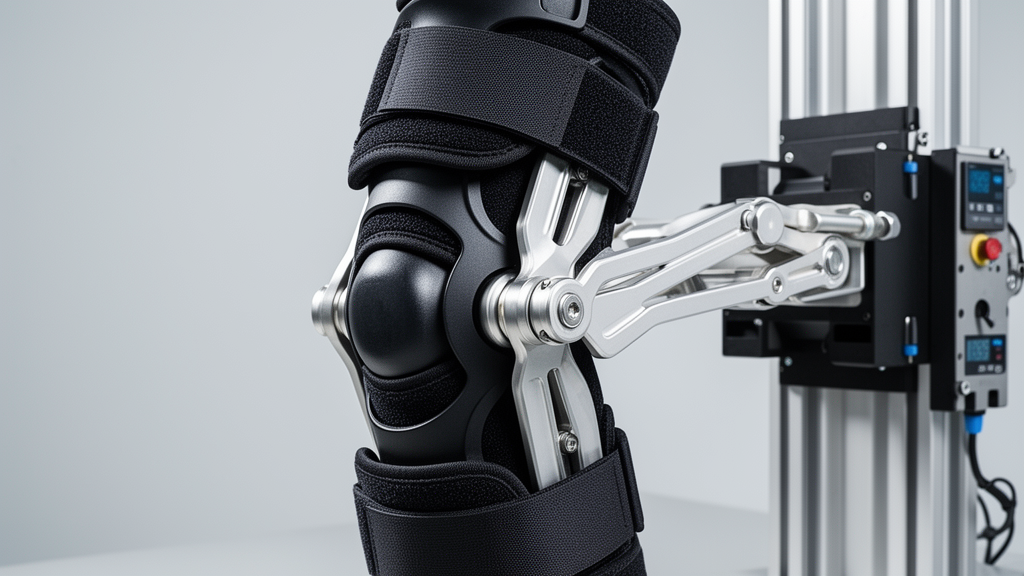
A standardized biomechanical evaluation using a mechanical surrogate limb has demonstrated marked variability in how commercially available knee braces resist valgus deformation when subjected to controlled coronal loading. Researchers investigating nine commercial knee braces prescribed for medial collateral ligament injuries recorded angular displacements ranging from 3 degrees to 12 degrees under a maximum applied torque of 19.4 Newton-meters. The resulting per-load stiffness measurements varied from 1.6 to 6.5 Newton-meters per degree, demonstrating a fourfold disparity between the stiffest and most compliant orthoses evaluated. Despite the wide dispersion of measured stiffness and angular compliance across the tested devices, all evaluated braces permitted measurable angular deviation under progressive external forces. The authors noted that while these measurements rigorously document device-specific mechanical resistance on a standardized rigid apparatus, the bench findings describe benchtop behavior rather than clinical protection or in-vivo joint stabilization.
The medial collateral ligament serves as the primary static restraint against valgus stress across the human knee joint and comprises three distinct anatomical components: the superficial medial collateral ligament, the deep medial collateral ligament, and the posterior oblique ligament. Clinical literature reports that injuries to this ligamentous complex represent some of the most common knee injuries among active populations, with documented incidence rates between 0.24 and 7.3 per 1,000 person-years occurring frequently during contact sports, skiing, and tennis. Because the medial collateral ligament possesses substantial intrinsic healing potential, non-operative management remains standard practice for most isolated sprains and tears. Hinged orthoses are widely prescribed for Grade II and Grade III injuries to shield healing tissue from disruptive valgus torques during early mobilization. However, preclinical biomechanical performance across marketed devices has historically demonstrated wide divergence without uniform consensus performance standards or mandatory preclinical clearance requirements.
To isolate the mechanical properties of each brace from physiological variability, the investigators constructed a specialized lower limb mechanical surrogate modeled on the anatomical dimensions of an adult human leg. The surrogate featured a total length of 101.5 centimeters and a designated tibial lever arm of 46.5 centimeters extending from the central joint hinge to the distal point of load application. Rather than attempting to replicate complex human knee motion, the knee articulation was deliberately replaced by a single-degree-of-freedom coronal hinge incorporating an open medial compartment to simulate total medial collateral ligament deficiency. Cruciate ligaments, menisci, capsular structures, and dynamic muscular contractions were deliberately omitted from the framework to eliminate confounding biological variables. A sleeve of closed-cell polyethylene foam simulated baseline soft-tissue compliance over the underlying structural frame, ensuring that all measured resistance was governed strictly by the orthosis mounted to the standardized geometry.
Testing was conducted in full knee extension, reflecting the functional position in which supportive orthoses are typically fitted during early rehabilitation to resist valgus displacement. Progressive valgus torques of 5.7, 11.4, and 19.4 Newton-meters were applied by suspending standardized masses of 1.25, 2.5, and 4.25 kilograms from the lever arm. These torques were chosen to represent sub-injury loading conditions compatible with historical orthosis benchmarks while falling safely below intact biological failure thresholds. Kinematic responses were captured using a stationary 4K video camera recording at 30 frames per second aligned orthogonally to the coronal plane. Kinovea software tracked three digitized coordinate angles spanning the mechanical axis, proximal-medial landmarks, and distal-lateral landmarks relative to unloaded baselines. For each device and load step, trials were repeated three times with complete removal, re-donning, and re-tensioning between runs to capture practical donning repeatability.
Across all tested orthoses, median angular deformation increased progressively across the torque levels, rising from 3 degrees at 5.7 Newton-meters to 7 degrees at 11.4 Newton-meters, and reaching 8 degrees under maximum loading. Corresponding median stiffness values were 1.9 Newton-meters per degree at the lowest load level, 1.6 Newton-meters per degree at intermediate load, and 2.4 Newton-meters per degree at maximum applied torque. Only one device met the defined criteria for high stiffness by exceeding 4 Newton-meters per degree at peak torque, while four devices exhibited moderate stiffness between 2 and 4 Newton-meters per degree, and four devices displayed low stiffness below 2 Newton-meters per degree. Rank ordering among braces proved broadly consistent across progressive torques, as supported by Spearman correlation coefficients between 0.5 and 0.7, although specific models shifted position between light and heavy loads.
The evaluation also examined the progressive deformation ratio, defined as the angular deformation observed at peak torque divided by the displacement measured at initial torque, to characterize dynamic mechanical responsiveness. Seven orthoses demonstrated progressive stiffening behavior with ratios below the linear threshold of 3.4, indicating stabilizing resistance as external loads increased. In contrast, two devices exhibited progressive compliance with ratios equal to or exceeding 3.4, yielding substantial angular displacement under heavy loading despite demonstrating relatively low initial deformation under light loading. Continuous video monitoring confirmed that no physical migration or slippage along the limb sleeve occurred during testing, indicating that progressive compliance stemmed from structural deformation within the frame, hinges, strap interfaces, and underlying padding rather than gross displacement of the orthosis.
Exploratory analyses examined whether gross structural material classifications could account for the observed mechanical differences. Tested devices were categorized as rigid frames, semi-rigid designs, or soft textile constructions. While rigid frames demonstrated numerically greater stiffness and lower median angular deformation at peak torque compared to semi-rigid and soft devices, the differences did not reach statistical significance in non-parametric Kruskal-Wallis testing. The semi-rigid category exhibited wide internal variability spanning almost the entire spectrum of measured compliance. The authors emphasized that the statistical comparison was severely underpowered at below 10 percent power due to the sample size of nine devices, meaning that material category cannot be definitively confirmed or dismissed as an explanatory factor without testing larger cohorts across multiple manufacturing lines.
Similarly, descriptive comparisons between wrap-around closures and pull-on sleeves revealed overlapping mechanical performance across all applied torques. Although wrap-around designs demonstrated lower median deformation at each progressive load step, individual values across both categories spanned broad, overlapping intervals without reaching statistical significance. The brace exhibiting the highest total deformation at 19.4 Newton-meters was itself a wrap-around model, while pull-on sleeves matched the resistance of several wrap-around devices. Furthermore, independent qualitative assessments of brace stability conducted by blinded orthotic evaluators showed high inter-rater agreement but exhibited only weak to moderate correlations with actual quantitative stiffness measurements. Subjective evaluations reached statistical significance at only one intermediate load condition, highlighting that manual handling and aesthetic rigidity do not reliably predict objective mechanical resistance to valgus displacement.
To place the measured mechanical displacements into physical perspective, the authors noted that geometric conversion on an average 60-millimeter knee joint indicates that each single degree of coronal angular rotation corresponds to approximately one millimeter of medial joint line widening. Consequently, even the stiffest brace allowing 3 degrees of angular deflection permitted approximately 3 millimeters of medial opening on the surrogate, a displacement comparable to complete ligamentous rupture on radiographic stress imaging. The most compliant orthosis permitted 12 degrees of deflection, equivalent to 12 millimeters of unconstrained opening. Although estimated physiological adduction moments during level walking reach 40 to 50 Newton-meters, the authors cautioned that externally applied benchtorques represent distinct biomechanical conditions and cannot be directly translated into dynamic physiological loading.
The study authors outlined critical methodological constraints that prevent extrapolating benchtop findings to patient outcomes. The mechanical surrogate deliberately lacked dynamic musculature, menisci, cruciate ligaments, and intact joint capsules, thereby modeling an absolute worst-case loading scenario where the external orthosis functioned as the exclusive coronal restraint. In living patients, residual soft tissue structures and active neuromuscular reflexes distribute joint loads, which would substantially reduce absolute angular displacement. Additionally, the experimental apparatus evaluated static coronal valgus restraint in full extension and did not evaluate dynamic or rotational resistance, such as anteromedial or posteromedial instability governed by the deep medial collateral ligament and posterior oblique structures. Consequently, the authors concluded that these laboratory findings establish device-level mechanical benchmarks without providing evidence for or against the clinical efficacy of knee bracing in patient care.
Subject of Research: Biomechanical valgus resistance of commercial knee braces
Article Title: High variability in resistance to valgus deformation among knee braces indicated for medial collateral ligament injuries: a standardized bench-model biomechanical comparison
Article References: Pechlivanidou, E., Stacheter, M., Wahl, P., & Jacobi, M. (2026). High variability in resistance to valgus deformation among knee braces indicated for medial collateral ligament injuries: a standardized bench-model biomechanical comparison. Archives of Orthopaedic and Trauma Surgery, 146(1), Article 348. https://doi.org/10.1007/s00402-026-06519-6
Image Credits: AI Generated
DOI: 10.1007/s00402-026-06519-6
Keywords: knee braces, medial collateral ligament, biomechanics, valgus deformation, mechanical stiffness, orthotics, bench testing, joint stability, sports medicine, orthopedic devices, ligament injury, rehabilitation engineering, coronal plane laxity, motion tracking, load response, surrogate limb model
News Source: Ophelia Keating. (November 14, 2026). Benchtop Testing Reveals Substantial Mechanical Differences Among Commercial Knee Braces. Scienmag.