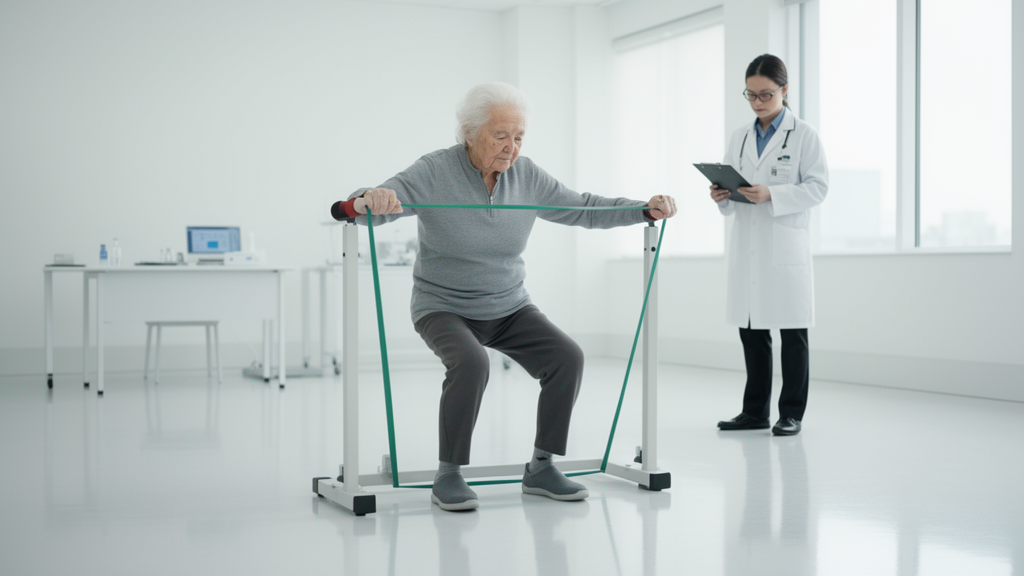
To resolve persistent deficits in the transparency, methodological reproducibility, and synthesis of geriatric physical activity research, an international consortium of exercise scientists, human movement specialists, and gerontologists has established the Physical Exercise Training Interventions in Older Adults reporting guideline, designated as PETIO. Published in the European Review of Aging and Physical Activity, this consensus-driven framework functions as a dedicated extension to the widely adopted Consolidated Standards of Reporting Trials statement, tailoring trial documentation specifically to aging cohorts. The guideline introduces an expanded checklist that systematically addresses critical elements often omitted in published randomized controlled trials, including participant baseline characteristics, exercise dosing structured around frequency, intensity, time, and type principles, explicit delivery settings, and detailed tracking of adherence and adverse events. By standardizing trial reporting, PETIO provides researchers, peer reviewers, and journal editors with an instrument designed to enhance reporting completeness, mitigate potential bias, and facilitate the accurate translation of trial findings into clinical practice.
The development of PETIO emerges against the backdrop of a demographic shift in which the global population of individuals aged sixty and older is projected to double by 2050. While exercise demonstrates broad clinical efficacy, improving mobility, preventing falls, reducing chronic disease, and enhancing cognitive and psychological health, evaluating these benefits remains constrained by pervasive reporting deficits. Compared to pharmacological trials, non-pharmacological exercise studies frequently demonstrate lower methodological reporting quality, higher risk of bias, and less frequent reporting of adverse events. Geriatric populations present substantial heterogeneity in physical fitness, multimorbidity, and psychosocial circumstances that directly alter intervention outcomes. When investigators omit detailed baseline assessments or fail to describe how exercise protocols are tailored to address vulnerabilities, readers cannot evaluate whether outcomes stem from the intervention or uncontrolled confounding factors. Standardized reporting protocols are therefore essential to distinguish genuine clinical efficacy from implementation failures and to prevent bias in subsequent systematic reviews.
Prior to the formulation of PETIO, clinical investigators relied on generic reporting frameworks that lacked the specificity required to capture the multimodal complexity of geriatric exercise interventions. Widely utilized checklists such as TIDieR, CERT, and i-CONTENT provided foundational structures for describing experimental regimens, but systematic evaluations revealed persistent shortcomings in their application to older populations. For instance, existing tools frequently neglected to establish standardized frameworks for quantifying exercise dosage, omitted guidelines for reporting individualized progression or tailoring, and failed to incorporate parameters relevant to digital delivery and assistive technologies. Furthermore, while the general CONSORT statement and the SPIRIT checklist offer robust scaffolding for conventional clinical trials, neither framework provides specialized prompts for documenting age-related physiological adaptations, participant cognitive impairment, baseline functional status, or digital literacy. Consequently, published literature has suffered from substantial reporting voids, making it exceedingly difficult for independent researchers to replicate complex intervention protocols or accurately aggregate data within quantitative meta-analyses.
To establish an evidence-based guideline addressing these omissions, the development team implemented a six-stage methodological sequence guided by established international principles for health research reporting guidelines. The initial conceptualization stage centered on a modified three-round Delphi process conducted through electronic surveys distributed to two hundred ninety-seven expert members of the European COST Action PhysAgeNet. In the first Delphi round, ninety-three participating specialists submitted open-ended statements defining exercise intensity classifications—specifically light, moderate, vigorous, and high intensities—while identifying structural reporting priorities for geriatric interventions. In the second round, sixty-seven panel members evaluated these collected statements using a ten-point Likert agreement scale ranging from zero for total disagreement to ten for total agreement. The third Delphi round engaged seventy-two experts to establish consensus regarding recommendations for reporting intensity when objective or subjective measurement metrics are absent. Across these preliminary iterations, overall agreement scores ranged between 6.7 and 8.8 points out of ten, establishing strong professional consensus that standardized exercise intensity reporting is a prerequisite for valid evidence synthesis.
The second stage involved an exhaustive literature search across electronic indexing databases, including PubMed, Google Scholar, Scopus, and Web of Science, to identify existing reporting guidelines applicable to physical exercise trials without temporal restrictions. The investigators evaluated candidate checklists against predefined criteria requiring an explicit focus on randomized trials, inclusion of exercise-specific variables like frequency, intensity, time, and type, sufficient detail to ensure reproducibility, applicability to human populations including older adults, and comprehensive outcome reporting structures. This systematic review identified several prominent frameworks, including CONSORT, CERT, SPIRIT, TIDieR, and the rehabilitation-specific TIDieR-Rehab checklist. Although CERT offered nineteen items across seven operational categories spanning materials, provider characteristics, delivery mode, setting, dosage, tailoring, and adherence, it lacked explicit recommendations addressing aging heterogeneity and emerging digital modalities. Meanwhile, the i-CONTENT scale was evaluated but ultimately excluded as a foundational source due to limited available documentation regarding its formal development process, leaving CONSORT as the primary structural foundation.
During the third development stage, twenty-eight interdisciplinary experts from the PhysAgeNet consortium convened in a hybrid-format meeting to draft and refine specific items by extending the core CONSORT checklist. The panel concluded that CONSORT provided the most comprehensive structural foundation, but determined that substantial expansions were necessary across the abstract, introduction, and methods sections. For journal abstracts, the panel mandated the explicit inclusion of participant age, sex distributions, and core exercise parameters structured around the frequency, intensity, time, and type framework, recognizing that systematic review screening relies heavily on abstract completeness. In the introduction, the experts established a requirement to report the theoretical models and mechanistic rationales underlying the intervention design, addressing a common failure where connections between initial hypotheses and chosen physical outcomes remained unarticulated. The drafting group systematically examined the relevance, structural placement, and phrasing of each prospective item, defining previously ambiguous terminology and reorganizing twelve potentially confusing items into five distinct reporting prompts to ensure clarity.
The newly formulated PETIO items within the methods section mandate exhaustive descriptions of participant characteristics and operational intervention mechanics for both experimental and control groups. Recognizing that geriatric intervention outcomes are heavily moderated by baseline physical and cognitive status, the guideline requires researchers to document participant comorbidities, educational attainment, medication profiles, depressive symptoms, and cognitive impairment levels such as mild cognitive impairment or dementia. For interventions incorporating digital health tools, virtual reality exergames, or wearable activity trackers, investigators must detail participant technology familiarity, digital literacy, and the specific motivational strategies utilized, including goal setting and online platforms. Crucially, the checklist enforces meticulous reporting of exercise dosing progression, supervision levels, adverse events, participant dropout rationales, and objective compliance metrics, such as attendance logs or wearable sensor data. Furthermore, PETIO places explicit emphasis on documenting control group conditions, warning that passive control designs like waitlists or usual care can inflate apparent intervention benefits by ignoring the therapeutic impact of social interaction.
In the fourth stage of the project, the extended checklist comprising one hundred eight distinct items was converted into an online questionnaire administered via LimeSurvey to all four hundred forty-two registered members of the PhysAgeNet network for formal consensus evaluation. Across this initial consensus round, quantitative agreement ratings demonstrated exceptionally high overall endorsement, ranging from a mean of 7.55 to a perfect 10.00 points out of ten across different reporting categories. Item 12a, requiring authors to describe the statistical methods used to compare experimental groups for primary and secondary outcomes, achieved unanimous maximum approval, whereas item 5i2, which recommended reporting participant beliefs and stereotypes regarding exercise effects, received the lowest mean rating of 7.55. In addition to numerical ratings, panel members contributed fifty-one qualitative free-text statements addressing abstract constraints, item specificity, language phrasing, and concerns regarding redundancy. During the fifth development stage, Working Group 1 of PhysAgeNet held a face-to-face meeting to review this qualitative feedback, creating a dedicated guidance table with explicit justifications and examples.
The sixth and final development stage subjected the refined guideline to an external consensus evaluation involving independent editors of prominent peer-reviewed journals that regularly publish geriatric exercise research. Out of three hundred eleven editors identified and invited via email, thirty-nine participated in an online survey evaluating two hundred eight checklist items, yielding thirty-one fully completed valid response datasets. Editor agreement scores remained remarkably high, ranging from 6.67 out of ten for item 3.2.05 regarding educational attainment metrics to 9.77 for item 4.1.4 detailing exercise session duration in minutes. Statistical comparisons using one-way analysis of variance in SPSS revealed significant divergence between expert and editor ratings on several key items: item 2b, item 5b concerning exercise physiology adaptations and progression rules, item 5e5 addressing tailoring versus generic protocols, and item 5e6 detailing simultaneous or consecutive intervention components. In each instance of statistical divergence, journal editors assigned significantly higher importance ratings than scientific experts, demonstrating that publishing gatekeepers place an exceptionally high premium on transparent physiological descriptions and individualized protocol adaptation.
While the resulting PETIO guideline provides an essential pre-submission checklist to enhance the rigor of randomized trials, the authors acknowledge several inherent methodological boundaries and outline clear priorities for future development. PETIO is explicitly formulated as a descriptive reporting checklist rather than an evaluative quality-assessment scale; it does not assign empirical thresholds of study validity such as those established by the Risk of Bias 2 or GRADE frameworks. Furthermore, the guideline has not yet undergone formal prospective pilot testing across active research workflows, remains primarily tailored to quantitative randomized trials rather than qualitative methodologies, and provides a generalized geriatric scope rather than disease-specific recommendations for distinct clinical pathologies. Looking forward, the research consortium plans to evaluate user implementation through mixed-methods pilot studies, develop interactive digital checklist tools, translate the guideline into major European languages through the PhysAgeNet network, and align future iterations with emerging open science and patient involvement standards. Adopting PETIO as a complementary companion to CONSORT provides the scientific community with an indispensable mechanism to eliminate reporting omissions, enhance data synthesis, and advance geriatric exercise science.
Subject of Research: Methodological reporting standards for randomized exercise trials in older adults
Article Title: Reporting randomised trials of physical exercise or training interventions in older adults: the PETIO guideline
Article References: Wollesen, B., Asuako, P. A. G., Herden, M., Giannaki, C. D., Langeard, A., Lamberti, N., Mack, M., Audiffren, M., Netz, Y., & Voelcker-Rehage, C. (2025). Reporting randomised trials of physical exercise or training interventions in older adults: the PETIO guideline. European Review of Aging and Physical Activity, 22(1), Article 24. https://doi.org/10.1186/s11556-025-00390-x
Image Credits: AI Generated
DOI: 10.1186/s11556-025-00390-x
Keywords: PETIO guideline, randomized controlled trials, older adults, physical exercise, FITT principles, CONSORT statement, PhysAgeNet, Delphi process, exercise intensity, multimorbidity, adherence tracking, digital health technology, exergaming, reproducibility, systematic reviews, control group design, geriatric rehabilitation, clinical trial reporting
News Source: Beatrice Stafford. (November 14, 2026). New PETIO Guideline Sets Methodological Reporting Standards for Geriatric Exercise Trials. Scienmag.