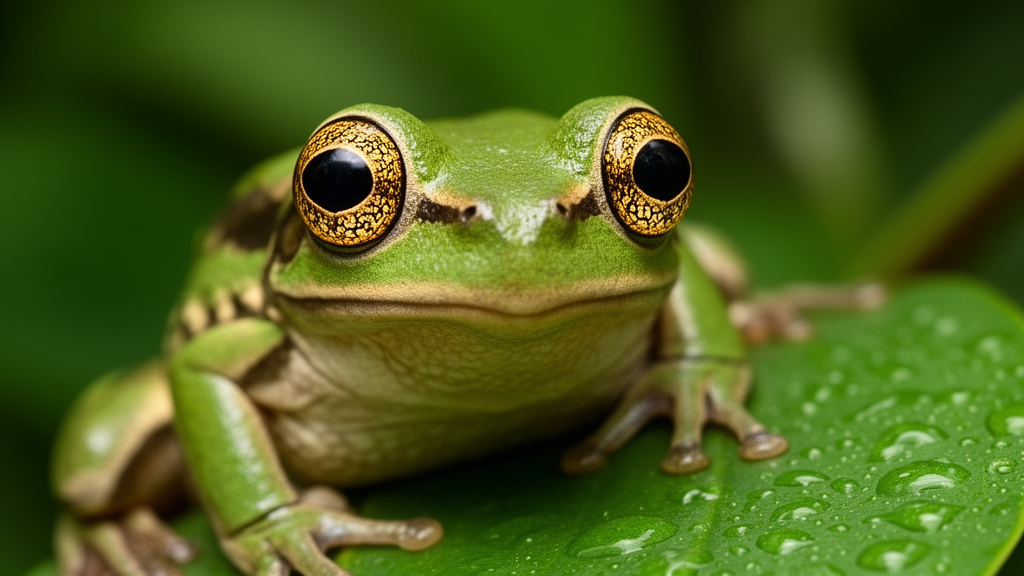
A peer-reviewed study published in the open-access journal Herpetozoa shows that naturally occurring iris patterns offer a reliable, non-invasive method for identifying individual Amazonian treefrogs in the wild. Conducted by researchers studying Osteocephalus oophagus, the investigation revealed that the species possesses distinctive golden irises marked by fine black radial lines that form patterns reminiscent of human fingerprints. This natural feature allows field biologists to recognize individual frogs without relying on physical capture or invasive marking procedures, providing a more humane alternative for wildlife monitoring.
Identifying wild animals over time has traditionally required invasive physical interventions, such as tagging, branding, or clipping. In amphibian research, the standard approach has frequently relied on toe-clipping, a procedure that involves removing some of the animal’s digits. However, toe-clipping can significantly affect amphibian survival, physiology, and behavior. The research team noted that ethical considerations were central to their motivation, with lead author Dr. Mélissa Peignier pointing out the particular risks of toe-clipping for arboreal species: “Other studies have used toe-clipping, which involves removing some of the digits. Personally, I was uncomfortable with this approach, especially given that these are arboreal frogs that rely on their limbs to climb trees.”
The research was led by Dr. Peignier and colleagues at the Division of Behavioural Ecology at the University of Bern, with contributors from the Institute of Electronic Music and Acoustics at the University of Music and Performing Arts in Graz. “At the time, I was doing my PhD, studying Allobates femoralis in the field in French Guiana,” Dr. Peignier explained. “My first reaction was simply something along the lines of, ‘Wow, what beautiful eyes!’ That initial curiosity gradually turned into a genuine interest in the species, and I realised how little we actually know about them.”
The researchers conducted their field investigations across three consecutive rainy seasons from 2021 to 2023.
The identification protocol relied on contactless digital photography in the field. On repeat encounters, the researchers photographed each treefrog’s eyes without touching the animal and compared the new photographs against a reference library stored directly on a rugged tablet computer. Frogs that were successfully recognized using this tablet library were simply left undisturbed in their natural habitat. To ensure the accuracy and reproducibility of their visual assessments, the researchers independently verified all identifications using Wild-ID, an established software package designed specifically for photographic mark-recapture analysis.
The analysis confirmed that the fine radial lines across each frog’s golden irises were highly distinctive and sufficiently stable over time for short-term population monitoring. Within a single season, the researchers recaptured and reliably re-identified between 56 percent and 80 percent of the individual frogs. Because the methodology required no physical handling, the team was able to record individuals even during sensitive biological interactions. High-resolution eye photographs could even be taken of treefrogs in amplexus, the amphibians’ mating embrace, without disrupting their natural reproductive activity.
Dr. Peignier highlighted the broader importance of non-invasive research tools amidst ongoing environmental pressures: “In a world where biodiversity is declining at an alarming rate, it is essential that we minimise our impact on the animals we study. If we can reliably identify individuals using naturally occurring features, we may be able to reduce the need for more invasive marking techniques while still collecting the data needed to answer important scientific questions.” Working with the species also presented practical advantages in the field, as Dr. Peignier noted that “the frogs themselves are incredibly beautiful and surprisingly chill, which makes working with them a real pleasure.” However, the authors emphasized important caveats, stressing that suitability will vary between species and that the iris recognition approach must be evaluated on a case-by-case basis before wider adoption, even as it demonstrates considerable promise for amphibians with complex irises.
Subject of Research: Non-invasive individual identification of Amazonian treefrogs using iris patterns
Article Title: Iris patterns offer a non-invasive way to recognize individual Amazonian treefrogs
Article References: Iris patterns offer a non-invasive way to recognize individual Amazonian treefrogs. Original publication (Bibliographic details unavailable.)
Image Credits: AI Generated
DOI: Not provided
Keywords: Osteocephalus oophagus, amphibians, treefrogs, iris patterns, non-invasive monitoring, mark-recapture, Wild-ID, French Guiana, Iris, patterns, offer, non-invasive
News Source: Drew Townsend. (November 14, 2026). Distinctive Iris Patterns Enable Non-Invasive Identification of Amazonian Treefrogs. Scienmag.