• HOME
  • NEWS
  • EXPLORE
    • CAREER
      • Companies
      • Jobs
    • EVENTS
    • iGEM
      • News
      • Team
    • PHOTOS
    • VIDEO
    • WIKI
  • BLOG
  • COMMUNITY
    • FACEBOOK
    • INSTAGRAM
    • TWITTER
Saturday, February 7, 2026
BIOENGINEER.ORG
No Result
View All Result
  • Login
  • HOME
  • NEWS
  • EXPLORE
    • CAREER
      • Companies
      • Jobs
        • Lecturer
        • PhD Studentship
        • Postdoc
        • Research Assistant
    • EVENTS
    • iGEM
      • News
      • Team
    • PHOTOS
    • VIDEO
    • WIKI
  • BLOG
  • COMMUNITY
    • FACEBOOK
    • INSTAGRAM
    • TWITTER
  • HOME
  • NEWS
  • EXPLORE
    • CAREER
      • Companies
      • Jobs
        • Lecturer
        • PhD Studentship
        • Postdoc
        • Research Assistant
    • EVENTS
    • iGEM
      • News
      • Team
    • PHOTOS
    • VIDEO
    • WIKI
  • BLOG
  • COMMUNITY
    • FACEBOOK
    • INSTAGRAM
    • TWITTER
No Result
View All Result
Bioengineer.org
No Result
View All Result
Home Headlines

Novel type of cell death in Huntington’s disease may lead to…

Bioengineer.org by Bioengineer.org
January 24, 2018
in Headlines, Health, Science News
Reading Time: 2 mins read
0
Share on FacebookShare on TwitterShare on LinkedinShare on RedditShare on Telegram
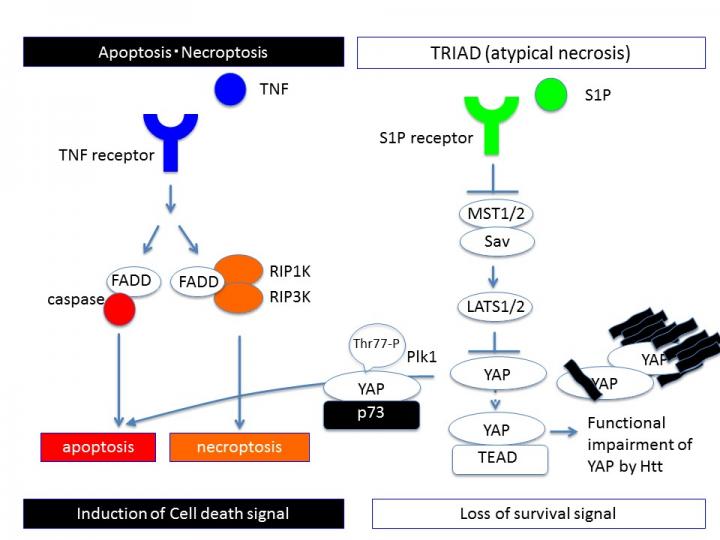
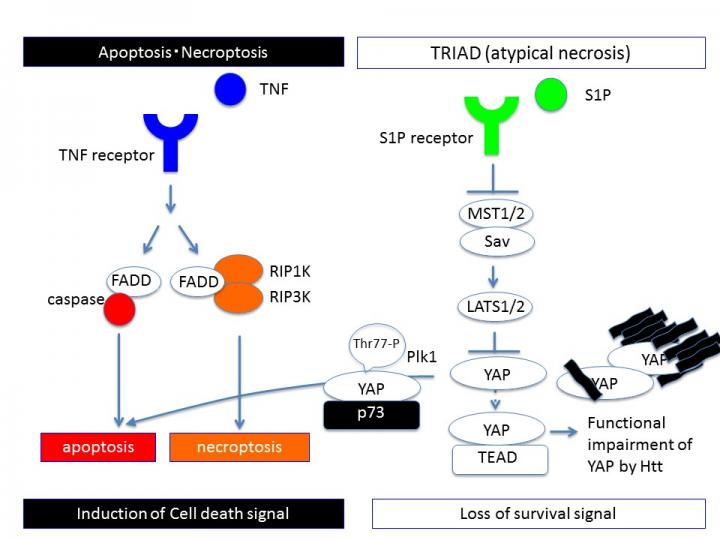
IMAGE

Credit: Department of Neuropathology,Medical Research Institute

Researchers centered at Tokyo Medical and Dental University (TMDU) identify novel type of cell death in Huntington's disease that may uncover new treatments.

Tokyo – In Huntington's disease (HD), the huntingtin gene is mutated, causing progressive neuronal death. This leads to defects in movement, behavior, and cognitive ability. Apoptosis, autophagy, and necrosis are the three main types of cell death, but researchers have not yet been able to determine what type of cell death causes neurodegeneration in the brain of HD patients.

In a new study, Tokyo Medical and Dental University-led researchers examined the nature of cell death in HD using newly developed imaging techniques. The effects of mutant huntingtin in neuronal cells were visualized by live cell imaging. With this approach, the authors identified a novel type of cell death associated with mutant huntingtin, which they called ballooning cell death (BCD). These cells gradually expanded like a balloon, until they ruptured.

To characterize the specific nature of BCD, the authors examined different cellular organelles by live cell imaging. "The endoplasmic reticulum was the main origin of ballooning," study first author Ying Mao explains. "Rupture of the endoplasmic reticulum into the cytosol was followed by gradual cell body ballooning, nuclear shrinkage, and cell rupture."

The authors observed the same phenomena in vivo using two-photon endoplasmic reticulum imaging in a HD mouse model.

Pharmacological inhibitors and genetic interventions showed that BCD was not like apoptosis or autophagy. "We noticed multiple similarities between BCD and a unique form of necrosis called TRIAD, which is caused by inhibition of RNA polymerase II in neurons," corresponding author Hitoshi Okazawa explains. "Based on our existing knowledge of how TRIAD is regulated, we were able to show that BCD is mediated by impaired TEAD/YAP transcription."

These revelations provided the opportunity to test potential therapeutic targets for HD. The researchers introduced S1P and up-regulated TEAD/YAP transcription in HD mice. This stabilized endoplasmic reticulum and completely stopped the decline of motor function, suggesting that targeting TEAD/YAP-dependent necrosis may lead to development of effective therapies for HD.

###

The article "Targeting TEAD/YAP-transcription-dependent necrosis, TRIAD, ameliorates Huntington's disease pathology" was published in Human Molecular Genetics at doi: 10.1093/hmg/ddw303

Media Contact

Hitoshi Okazawa
[email protected]

http://www.tmd.ac.jp/english/

Share12Tweet7Share2ShareShareShare1

Related Posts

Evaluating Pediatric Emergency Care Quality in Ethiopia

February 7, 2026

TPMT Expression Predictions Linked to Azathioprine Side Effects

February 7, 2026

Improving Dementia Care with Enhanced Activity Kits

February 7, 2026

Decoding Prostate Cancer Origins via snFLARE-seq, mxFRIZNGRND

February 7, 2026
Please login to join discussion

POPULAR NEWS

  • Robotic Ureteral Reconstruction: A Novel Approach

    Robotic Ureteral Reconstruction: A Novel Approach

    82 shares
    Share 33 Tweet 21
  • Digital Privacy: Health Data Control in Incarceration

    63 shares
    Share 25 Tweet 16
  • Study Reveals Lipid Accumulation in ME/CFS Cells

    57 shares
    Share 23 Tweet 14
  • Breakthrough in RNA Research Accelerates Medical Innovations Timeline

    53 shares
    Share 21 Tweet 13

About

We bring you the latest biotechnology news from best research centers and universities around the world. Check our website.

Follow us

Recent News

Evaluating Pediatric Emergency Care Quality in Ethiopia

TPMT Expression Predictions Linked to Azathioprine Side Effects

Improving Dementia Care with Enhanced Activity Kits

Subscribe to Blog via Email

Success! An email was just sent to confirm your subscription. Please find the email now and click 'Confirm' to start subscribing.

Join 73 other subscribers
  • Contact Us

Bioengineer.org © Copyright 2023 All Rights Reserved.

Welcome Back!

Login to your account below

Forgotten Password?

Retrieve your password

Please enter your username or email address to reset your password.

Log In
No Result
View All Result
  • Homepages
    • Home Page 1
    • Home Page 2
  • News
  • National
  • Business
  • Health
  • Lifestyle
  • Science

Bioengineer.org © Copyright 2023 All Rights Reserved.