

• HOME
  • NEWS
  • EXPLORE
    • CAREER
      • Companies
      • Jobs
    • EVENTS
    • iGEM
      • News
      • Team
    • PHOTOS
    • VIDEO
    • WIKI
  • BLOG
  • COMMUNITY
    • FACEBOOK
    • INSTAGRAM
    • TWITTER
Saturday, July 4, 2026
BIOENGINEER.ORG
No Result
View All Result
  • Login
  • HOME
  • NEWS
  • EXPLORE
    • CAREER
      • Companies
      • Jobs
        • Lecturer
        • PhD Studentship
        • Postdoc
        • Research Assistant
    • EVENTS
    • iGEM
      • News
      • Team
    • PHOTOS
    • VIDEO
    • WIKI
  • BLOG
  • COMMUNITY
    • FACEBOOK
    • INSTAGRAM
    • TWITTER
  • HOME
  • NEWS
  • EXPLORE
    • CAREER
      • Companies
      • Jobs
        • Lecturer
        • PhD Studentship
        • Postdoc
        • Research Assistant
    • EVENTS
    • iGEM
      • News
      • Team
    • PHOTOS
    • VIDEO
    • WIKI
  • BLOG
  • COMMUNITY
    • FACEBOOK
    • INSTAGRAM
    • TWITTER
No Result
View All Result
Bioengineer.org
No Result
View All Result
Home Headlines

Synaptic disorder

Bioengineer.org by Bioengineer.org
January 24, 2018
in Headlines, Health, Science News
Reading Time: 2 mins read
0
Share on FacebookShare on TwitterShare on LinkedinShare on RedditShare on Telegram
IMAGE

Credit: (Picture: Peter Heimann)

Motor neurons are the nerves that send impulses to the muscles to generate movement. Damage of these neurons can cause very diverse diseases, for example spinal muscular atrophy in children or adult amyotrophic lateral sclerosis.

Both disorders are characterised by muscle atrophy, palsy and ultimately by functional loss of muscles. The respiratory muscles are affected, too. The diseases are presently incurable; but their progress can be slowed down with drugs.

Autophagy as a new target for drugs

"So far, the development of new drugs has focused on preventing cell death mechanisms and on breaking down the protein aggregates in the affected nerve cells," Professor Michael Sendtner explains; he is the head of the Institute of Clinical Neurobiology of the Würzburg university hospital.

But now Sendtner with his colleague Patrick Lüningschrör and their team have identified another potential target for future drugs: It is the complex process of autophagy, as the researchers report in the journal Nature Communications. This process makes sure that the impulse transmission between motor neurons and muscles works permanently in normal function.

Aggregation of vesicles at synapses

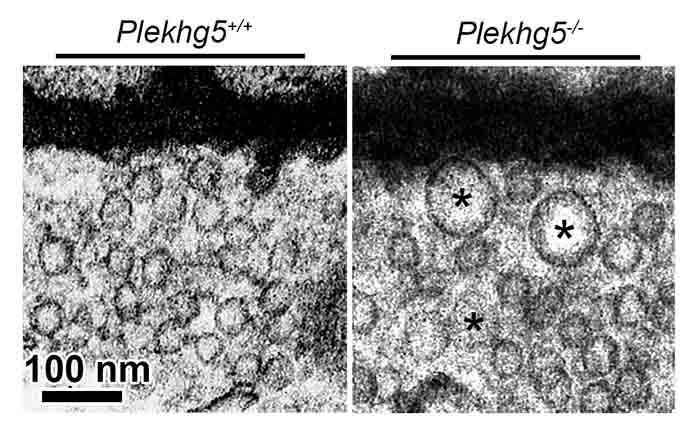
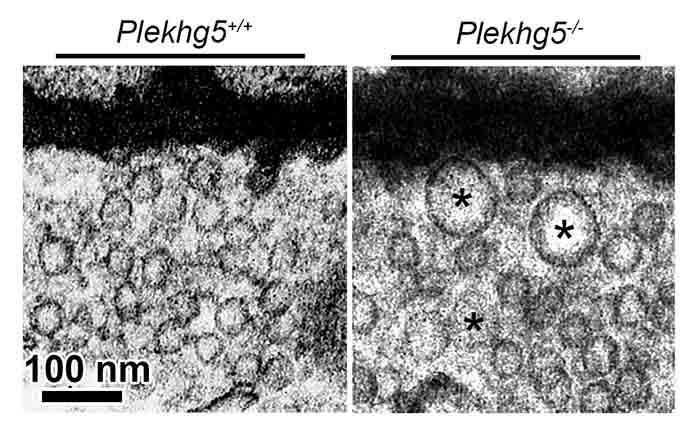
The PLEKHG5 gene was the starting point for the new insight. Mutations in this gene are known to trigger various forms of motor neuron disorders. The Würzburg scientists have now found out that this gene is crucial for autophagy: It controls the degradation of the synaptic vesicles that contain the neurotransmitter acetylcholine and transport the excitation from the nerve to the muscles.

When deactivating the PLEKHG5 gene at single motor neurons in a cell culture, autophagy is reduced causing the synaptic vehicles to agglomerate. And in mice disabling this gene triggers a motor neuron disorder which also entails massive vesicle aggregation.

Consequences for drug development

"The findings deliver substantial evidence that dysfunctional autophagy plays a central role in the development of motor neuron diseases," Sendtner says. He believes that this new finding will have to lead to a rethinking of the development of new drugs with a need for substances that prevent or reduce vesicle aggregation.

###

Media Contact

Prof. Dr. Michael Sendtner
[email protected]
49-931-201-44000
@Uni_WUE

https://www.uni-wuerzburg.de/

Original Source

https://www.uni-wuerzburg.de/en/sonstiges/meldungen/detail/news/stoerung_an_den_synapsen-1/ http://dx.doi.org/10.1038/s41467-017-00689-z


Share12Tweet8Share2ShareShareShare2

Related Posts

Steatosis Drives Liver Metastasis Diversity in CRC — Medicine

Steatosis Drives Liver Metastasis Diversity in CRC

July 2, 2026

Unlocking the Mysteries of Alzheimer’s Disease

July 2, 2026

Pensoft Introduces New Peer-Reviewed Journal of Regeneration to Advance Restorative Biology Across Species

July 2, 2026

Evolution-Inspired Biosensors Revolutionize Lipid Tracking in Real Time

July 2, 2026
Please login to join discussion

POPULAR NEWS

  • Detection of EDCs in Breast Milk and Infant Urine Up to Six Months Highlights Early Exposure Risks

    77 shares
    Share 31 Tweet 19
  • Saying Goodbye to PGY-6: Pediatric Fellowship Realities

    103 shares
    Share 41 Tweet 26
  • New Drug Candidate Developed at McMaster Shows Potential for Treating Brain Cancer

    58 shares
    Share 23 Tweet 15
  • KTU Researchers Explore Ultrasound’s Role in Enhancing Blood Flow Beyond Diagnostics

    53 shares
    Share 21 Tweet 13

About

BIOENGINEER.ORG

We bring you the latest biotechnology news from best research centers and universities around the world. Check our website.

Follow us

Recent News

Steatosis Drives Liver Metastasis Diversity in CRC

Unlocking the Mysteries of Alzheimer’s Disease

Pensoft Introduces New Peer-Reviewed Journal of Regeneration to Advance Restorative Biology Across Species

Subscribe to Blog via Email

Enter your email address to subscribe to this blog and receive notifications of new posts by email.

Join 83 other subscribers
  • Contact Us

Bioengineer.org © Copyright 2023 All Rights Reserved.

Welcome Back!

Login to your account below

Forgotten Password?

Retrieve your password

Please enter your username or email address to reset your password.

Log In
No Result
View All Result
  • Homepages
    • Home Page 1
    • Home Page 2
  • News
  • National
  • Business
  • Health
  • Lifestyle
  • Science

Bioengineer.org © Copyright 2023 All Rights Reserved.
