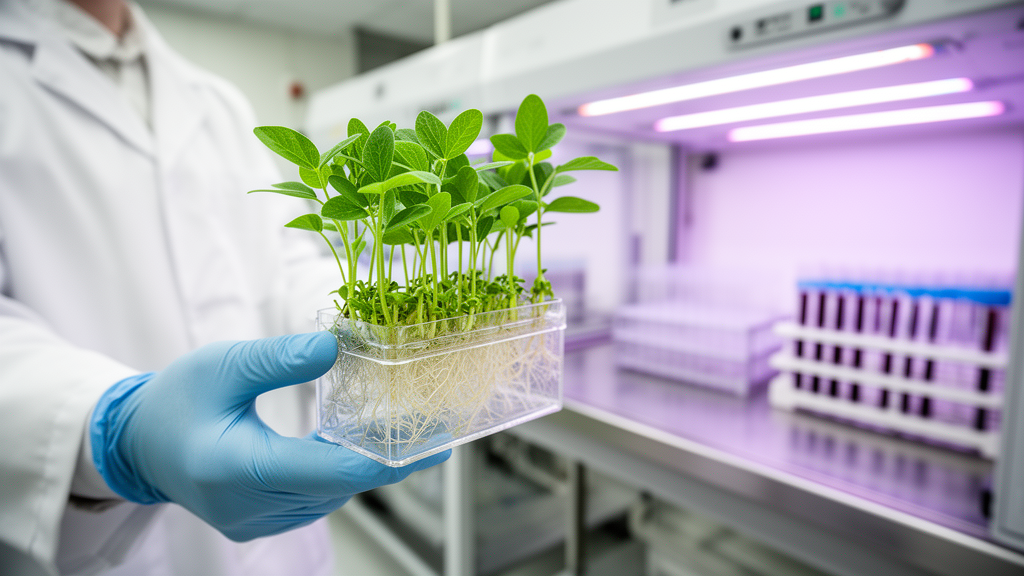
Agricultural researchers have developed an optimized ex-vitro hairy root transformation and CRISPR/Cas9 gene-editing protocol for soybean (Glycine max), integrating the system with high-throughput greenhouse bioassays against the devastating soybean cyst nematode (SCN; Heterodera glycines) to compress functional genomic evaluations to just fifty-three days. Cultivated soybean represents a cornerstone of global agriculture, supplying approximately fifty-nine percent of the world’s total oilseed production alongside vital protein meal for animal feed formulations. In 2022, worldwide production was spearheaded by Brazil with one hundred sixty-two million metric tons, followed closely by the United States at one hundred sixteen million metric tons. United States agricultural records for 2023 documented soybean cultivation across thirty-three point eight million hectares, generating an estimated total production value of sixty point seven billion dollars. Despite this massive economic footprint, soybean yields face continuous suppression from parasitic nematodes, with SCN standing as the foremost yield-limiting pathogen in the United States, inflicting billions of dollars in annual agricultural losses across production regions.
Deciphering the functional roles of specific soybean and nematode genes has long faced severe methodological bottlenecks. While reverse genetics has advanced from early silencing tools like RNA interference (RNAi) and virus-induced gene silencing (VIGS) to precise CRISPR/Cas9 editing, generating stable transgenic soybean lines remains intensely demanding. Conventional pipelines depend on Agrobacterium tumefaciens or particle bombardment to transform cotyledonary or embryonic tissues, followed by laborious whole-plant tissue culture regeneration. These established procedures take anywhere from two to three months of tissue processing up to a full year for whole-plant recovery, while suffering from genotype recalcitrance, high contamination risks, and low overall transformation frequencies. While Rhizobium rhizogenes—formerly known as Agrobacterium rhizogenes—transfers root-inducing plasmid T-DNA into plant genomes to generate transgenic hairy roots rapidly, traditional in-vitro protocols still demand sterile tissue culture and prevent shoot development. Detached-leaf hairy root systems also exhibit severe constraints because detached foliage undergoes natural senescence within thirty days, rendering it incompatible with the extended life cycles characteristic of sedentary plant-parasitic nematodes.
The life cycle of Heterodera glycines dictates strict technical parameters for reliable greenhouse phenotyping. Under favorable environmental conditions, SCN completes its developmental cycle within three to four weeks. Encapsulated eggs within field soil hatch to liberate motile second-stage infective juveniles (J2). These J2 larvae migrate through soil water films toward host roots, penetrating epidermal tissues using a sharp, protrusible feeding spear known as a stylet. Once within root tissues, the juveniles migrate intracellularly through cortical cells toward vascular bundles. Upon selecting an initial feeding cell, the nematode releases stylet-secreted effectors that reprogram host cellular machinery to form a specialized, multinucleated feeding structure termed a syncytium. After establishing this permanent feeding site within two to three days post-penetration, the parasites transition into sedentary obligate feeders, undergoing successive molts to achieve sexual maturity. Adult females swell into visible lemon-shaped forms protruding from the root surface, become fertilized by mobile adult males that vacate the root, and gradually fill with hundreds of eggs before their dying cuticles harden into durable, protective cysts.
To overcome the limitations of prior slant-cut hypocotyl techniques, the researchers standardized seedling cultivation and inoculation timing under non-sterile conditions. Soybean seeds were planted without chemical seed sterilization in standard twenty-five point four by fifty point eight centimeter propagation trays packed with Sun Gro Sunshine Number Five Propagation Mix with RESiLIENCE. The planting medium was prepared by blending four liters of propagation substrate with one point five to two liters of tap water. Seeds were positioned at depths of two to two point five centimeters and shielded with five point zero eight centimeter transparent humidity domes in a controlled greenhouse maintained at twenty-six to twenty-seven degrees Celsius under a sixteen-hour photoperiod delivering approximately three hundred micromoles per square meter per second. Outdoor day length significantly influenced seedling maturation rates despite supplemental lighting; seedlings reached inoculation readiness in five days during longer-day seasonal periods, whereas six days were required during shorter-day seasons. Seedling competence was defined by shoot morphology, requiring completely unfolded first true leaves.
The investigative team systematically tested three inoculation procedures using Rhizobium rhizogenes cucumopine strain K599 to identify the most robust transformation protocol. Seedlings aged five to six days had their primary root systems excised diagonally approximately one to one point five centimeters below the cotyledonary node using a sterile scalpel. In Method One (M1), seedlings were slant-cut in water, the exposed cut was coated with K599 bacterial paste from agar plates, and explants were placed directly into moist fine vermiculite. In Method Two (M2), cut hypocotyls were likewise inoculated with bacterial paste in vermiculite and supplemented with five milliliters of water delivered around each plant base. In Method Three (M3), hypocotyls were cut submerged in liquid K599 culture resuspended in quarter-strength Gamborg B-5 basal medium at pH 5.7, coated with bacterial mass, and supplemented with five milliliters of liquid bacterial suspension. Substrate moisture in coffee-filter-lined plastic pots holding nine explants each was strictly maintained at three hundred twenty-five to three hundred fifty milliliters of water per liter of vermiculite, slightly adjusting pH from seven point one to six point eight.
Careful humidity management and timely physical pruning proved essential for stimulating transgenic root emergence from basal callus tissue. Following inoculation, pots holding explants were sealed inside plastic bags in pairs and maintained in a Conviron Gen1000 growth chamber at twenty-six degrees Celsius under sixteen-hour photoperiods at two hundred twenty to two hundred forty micromoles per square meter per second. After nine days, bags were partially opened for initial acclimation, followed by complete removal at ten days post-inoculation. Explants exhibiting vigorous shoot elongation at this ten-day interval consistently showed adventitious root emergence from stems above the basal callus. The authors determined that manually excising these adventitious roots was crucial to prevent shoot dominance and stimulate transformed root initiation directly from callus tissue. Explants were transferred into clean vermiculite if surface mold appeared, placed into trays filled with one centimeter of water, covered with seven-inch high-humidity domes for four additional days, vented at fourteen days post-inoculation, and transferred to the greenhouse at sixteen days for two days of environmental acclimation.
Evaluation of transformed roots at eighteen days post-inoculation demonstrated that the modified M2-open method achieved outstanding transformation efficiencies across diverse soybean cultivars. Root systems were illuminated under a Clare Chemical Research dark reader hand lamp with specialized viewing glasses to detect green fluorescent protein (GFP) expression driven by a Cassava vein mosaic virus promoter cassette within the pCamGFP-CvMV-GWOX binary vector. The M2-open approach produced superior root vigor and higher transformation rates than sealed incubation regimes. When tested across multiple cultivars and plant introductions, the protocol successfully transformed accessions traditionally recalcitrant to conventional Agrobacterium methods. The susceptible cultivars Williams 82 and Essex yielded transformation efficiencies of ninety-seven percent and eighty-nine percent, respectively. Resistant accessions Forrest and Peking demonstrated transformation efficiencies of seventy-eight percent and sixty-three percent. Even challenging plant introductions PI 90763 and PI 437654 produced functional composite plants with transformation efficiencies of forty-three percent and thirty-three percent, confirming that although transformation responsiveness is genotype-dependent, the protocol reliably overcomes historical transformation barriers across varied agronomic germplasm.
To eliminate root architecture variability that could confound downstream nematode infection metrics, the researchers standardized each composite plant to a single transformed root. At eighteen days post-inoculation, all non-fluorescent adventitious and untransformed roots were excised, retaining exactly one vigorous GFP-positive root per plant. Composite seedlings were transplanted into individual thin-walled polyvinyl carbonate (PVC) cylinders measuring fifteen point twenty-four centimeters long by three centimeters wide, packed with an equal one-to-one volumetric mixture of sterile sand and soil. Twenty-four individual PVC cylinders were arranged inside closed-bottom plastic crocks in a completely randomized design. Following two days of greenhouse acclimation, plants were inoculated with eggs from Heterodera glycines inbred population PA3 (HG type 0). Each plant received one milliliter of purified egg suspension containing one thousand eggs, distributed evenly between two pencil-probed holes two to two point five centimeters deep on opposite sides of the stem. Inoculated crocks were maintained in temperature-controlled water tables at twenty-seven degrees Celsius under sixteen-hour lighting for twenty-eight days.
The operational validity of the pipeline was confirmed by targeting the major soybean cyst nematode resistance gene GmSHMT08 using dual-guide CRISPR/Cas9 mutagenesis. Using recombinant inbred lines ExF67 (resistant, carrying Forrest rhg1-a and Rhg4 alleles) and ExF63 (susceptible, carrying rhg1-a and Essex Rhg4), researchers deployed a dual single-guide RNA construct targeting exon one of GmSHMT08. The guide RNAs were positioned one hundred seven base pairs apart to produce an expected one-hundred-thirty base pair genomic deletion upon Cas9 cleavage. After twenty-eight days of nematode exposure, roots were washed over nested sieves, cysts were extracted using high-pressure water sprayers, and cyst numbers were counted under a stereoscope. ExF67 plants receiving the CRISPR/Cas9 construct exhibited statistically significant increases in cyst counts compared to empty vector ExF67 controls across three independent biological replicates (P < 0.001, Wilcoxon rank-sum test). Genomic DNA analysis using CTAB extraction and polymerase chain reaction confirmed an editing efficiency of ninety-one percent, resolving the diagnostic three-hundred-sixty-one base pair deletion band alongside the four-hundred-ninety-one base pair wild-type fragment.
Despite its proven efficacy, the authors highlighted critical methodological constraints inherent to the hairy root system. Because transformed hairy roots cannot regenerate intact fertile plants, mutations generated through this protocol cannot be transmitted through seeds to future generations. Furthermore, despite achieving ninety-one percent editing efficiency, most transformed roots exhibited chimeric editing profiles containing mixtures of edited and unedited wild-type cells. This mosaicism arises when transformed single cells divide into multi-cellular roots before Cas9 cleavage occurs, allowing subsequent independent editing events in daughter cells. This chimeric nature complicates the recovery of homozygous biallelic mutations throughout entire root systems, potentially confounding the analysis of dominant resistance genes while remaining reliable for recessive resistance alleles. Consequently, the authors emphasized that post-harvest verification via DNA sequencing of excised root tips is mandatory to correlate individual cyst counts with confirmed mutational events. Beyond validating GmSHMT08 and discovering GmSNAP02, this fifty-three-day platform provides a powerful, high-throughput tool for overexpression, RNA interference, and functional genomics across plant-nematode pathosystems.
Subject of Research: Optimized hairy root transformation and CRISPR gene editing for soybean cyst nematode bioassays
Article Title: A Rhizobium rhizogenes-mediated transformation method coupling CRISPR/Cas9 gene editing in soybean with high-throughput soybean cyst nematode greenhouse bioassays
Article References: Gamage, V. A., Strickland, L. W., & Mitchum, M. G. (2025). A Rhizobium rhizogenes-mediated transformation method coupling CRISPR/Cas9 gene editing in soybean with high-throughput soybean cyst nematode greenhouse bioassays. BMC Methods, 2(1), Article 30. https://doi.org/10.1186/s44330-025-00049-0
Image Credits: AI Generated
DOI: 10.1186/s44330-025-00049-0
Keywords: Soybean, Glycine max, Rhizobium rhizogenes, CRISPR-Cas9, Soybean cyst nematode, Heterodera glycines, Hairy root transformation, GmSHMT08, Composite plants, Greenhouse bioassays, Plant pathogen resistance, Hypocotyl slant cut, Reverse genetics, Root biology, Gene knockout, Nematode phenotyping
News Source: Juliet Wilcox. (November 13, 2026). Optimized Soybean Transformation Method Enables Rapid CRISPR Screening for Nematode Resistance. Scienmag.