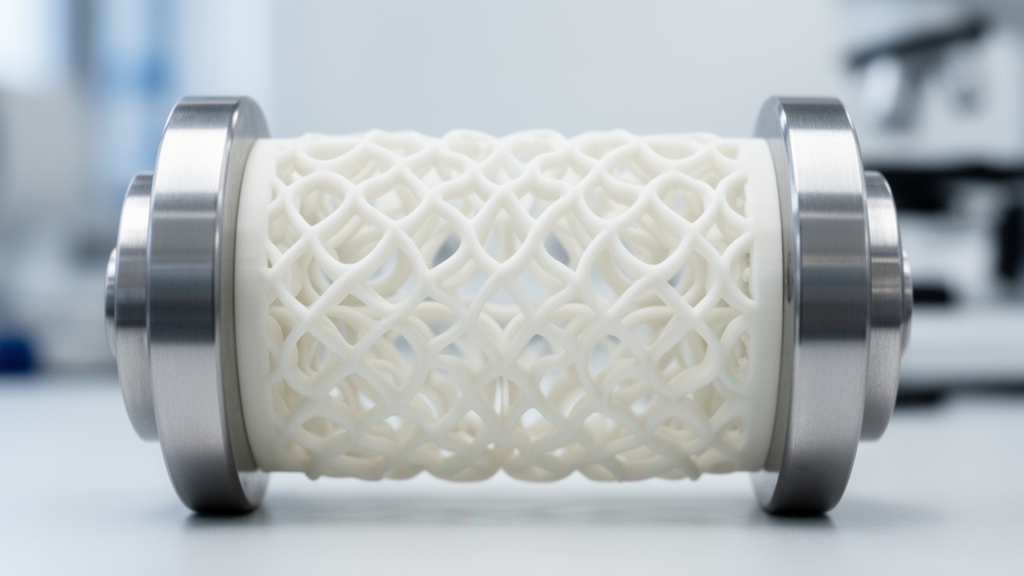
In an effort to address the mechanical limitations of spinal fusion for degenerated intervertebral discs, researchers have evaluated the comparative biomechanical performance of additively manufactured, single-material Gyroid structures made from thermoplastic polyurethane and polyether block amide. Degeneration of the intervertebral disc represents a major contributor to chronic low back pain and can substantially impair spinal function and patient quality of life. While surgical spinal fusion is commonly performed in advanced cases to stabilize the affected spinal segment, rigid immobilization alters physiological load transfer and restricts segmental motion, potentially contributing to adjacent segment degeneration. To mitigate these drawbacks, motion-preserving replacement concepts are being developed to restore disc height and load-bearing capacity while preserving mechanical mobility. Triply periodic minimal surface architectures, specifically Gyroid configurations, offer an attractive design pathway because their smooth curvature and continuous internal surfaces permit systematic tuning of structural properties such as unit-cell size, wall thickness, and relative density without introducing sharp internal transitions.
To investigate how base polymer chemistry influences structural performance, a team led by researchers at the Medical Center and Faculty of Medicine of the Albert-Ludwigs-University of Freiburg conducted a harmonized secondary analysis of specimen-level datasets from earlier experimental investigations. The study examined whether mechanical profiles could be altered fundamentally by selecting different classes of thermoplastic elastomers while maintaining an identical nominal Gyroid architecture. The research evaluated two thermoplastic polyurethane formulations, FlexHard and FlexMed, alongside two polyether block amide formulations, Spectrum and SainSmart. To ensure strict structural comparability, all investigated constructs shared an anatomically derived L4/L5 external geometry derived from the Toyota Total Human Model for Safety, configured with a nominal Gyroid unit-cell size of 6 mm and a nominal wall thickness of 0.75 mm without an enclosing peripheral wall, designated as geometry #08. The solid CAD models possessed a nominal height of 12.5 mm and flattened superior and inferior surfaces to provide plane-parallel contact areas of 395.50 square millimeters during mechanical compression.
Additive manufacturing of the specimens was carried out via material extrusion using 0.4-mm Nextruder nozzles, with filaments dried at 55 degrees Celsius for at least five hours prior to printing to minimize moisture uptake. The thermoplastic polyurethane specimens in the mechanical dataset had been printed on a Prusa MK4S system, while the polyether block amide specimens were produced on a Prusa CORE One+ system. Because the specimens originated from two independent experimental campaigns, three additional unloaded reference specimens per material were newly fabricated on the CORE One+ printer to conduct standardized dimensional, gravimetric, and stereomicroscopic evaluations. Dimensional measurements revealed that the thermoplastic polyurethane reference specimens closely reproduced the nominal 0.75-mm wall thickness, measuring 0.76 ± 0.02 mm for FlexHard and 0.75 ± 0.01 mm for FlexMed, representing deviations of 2.4% ± 2.0% and 0.9% ± 1.1%, respectively. In contrast, the polyether block amide reference specimens exhibited greater positive deviations, measuring 0.83 ± 0.05 mm for Spectrum and 0.84 ± 0.07 mm for SainSmart, corresponding to deviations of 11.8% ± 6.2% and 11.3% ± 9.3%. Mean specimen masses followed the trend of manufacturer-reported densities, recording 10.687 ± 0.006 g for FlexHard, 10.297 ± 0.006 g for FlexMed, 9.877 ± 0.006 g for Spectrum, and 8.820 ± 0.010 g for SainSmart.
Prior tensile testing of Type 5A specimens demonstrated significant baseline differences in small-strain elastic response among the four materials. Tensile modulus Et differed significantly across the formulations, with FlexHard exhibiting the highest modulus at 124.12 ± 6.56 MPa, followed by FlexMed at 90.23 ± 9.18 MPa, Spectrum at 53.42 ± 20.91 MPa, and SainSmart at 45.84 ± 16.61 MPa. While both polyurethane materials exhibited distinct yield points followed by stress drops, neither polyether block amide formulation showed a yield point up to the predefined testing limit of approximately 400% strain. Interestingly, the relative mechanical response shifted substantially at larger strains: at 100% strain, Spectrum reached a nominal tensile stress of 13.24 ± 0.19 MPa, which did not differ significantly from the 13.12 ± 0.48 MPa measured for FlexHard. At 200% strain, Spectrum sustained 16.85 ± 0.35 MPa, comparable to the 17.77 ± 1.20 MPa recorded for FlexMed, before all four materials separated into distinct stress levels at 300% strain in the descending order of FlexHard, FlexMed, Spectrum, and SainSmart.
Quasi-static compressive screening to 50% specimen height was conducted at a crosshead velocity of 5 mm per minute to establish mechanical eligibility for dynamic fatigue testing. A predefined engineering target corridor of 4,000 to 8,000 N at 50% compression was required for admission into subsequent cyclic protocols. FlexHard achieved the highest mean maximum force at 5,783 ± 727 N, significantly exceeding the values attained by FlexMed at 4,342 ± 204 N and Spectrum at 4,613 ± 202 N. Although Spectrum possessed a substantially lower tensile modulus than FlexMed, its maximum compressive force did not differ significantly from that of FlexMed, demonstrating that small-strain tensile properties alone cannot independently predict large-deformation structural behavior in complex Gyroid architectures. Conversely, the two evaluated SainSmart screening specimens reached maximum forces of only 3,072 N and 2,633 N, yielding a mean of 2,852 ± 311 N. Because SainSmart failed to reach the mandatory 4,000 N threshold, it was excluded from subsequent cyclic evaluations according to the study protocol.
Dynamic compression testing was carried out on three specimens each for FlexHard, FlexMed, and Spectrum using a servo-hydraulic system operating under sinusoidal compressive loading between 600 and 2,000 N at a frequency of 5 Hz. All nine tested specimens completed the full regimen of 700,000 cycles without exhibiting macroscopic or apparent mechanical failure. To ensure structural stabilization and eliminate early transient settling, the initial 100,000 loading cycles were designated as a conditioning phase, with exploratory comparative outcomes evaluated across the final 600,000 cycles. Across this interval, regression-based structural stiffness increased by 16.1% for FlexHard, rising from 5,948 ± 215 to 6,904 ± 249 N/mm, and surged by 76.5% ± 12.0% for FlexMed, climbing from 2,681 ± 58 to 4,729 ± 279 N/mm. In sharp contrast, Spectrum demonstrated cyclic softening, with its structural stiffness decreasing by 10.6% from 2,536 ± 92 to 2,268 ± 82 N/mm. Mean paired changes were +955 N/mm for FlexHard, +2,048 N/mm for FlexMed, and -268 N/mm for Spectrum, with mixed-design analysis of variance indicating significant effects for material, time, and their interaction.
Apparent viscoelastic moduli derived through harmonic regression revealed divergent trajectories between the polymer classes during the dynamic test sequence. Apparent storage modulus, reflecting elastic energy storage, increased by 30.9% ± 3.1% in FlexHard from 164.81 ± 4.16 to 215.60 ± 3.93 MPa, and rose by 44.1% ± 1.6% in FlexMed from 99.31 ± 1.07 to 143.15 ± 3.08 MPa. Spectrum exhibited a concurrent 10.3% ± 1.2% decrease in apparent storage modulus, dropping from 78.94 ± 1.96 to 70.86 ± 2.64 MPa. Mean apparent loss modulus, characterizing viscous energy dissipation, also showed numerical divergence, increasing by 9.3% ± 2.2% for FlexHard from 42.53 ± 1.09 to 46.45 ± 1.16 MPa and by 22.1% ± 4.9% for FlexMed from 27.56 ± 0.58 to 33.68 ± 2.03 MPa, while falling by 37.8% ± 7.7% in Spectrum from 10.72 ± 0.39 to 6.65 ± 0.63 MPa. However, following multiplicity adjustment via the Holm method, within-material changes in loss modulus did not attain statistical significance, yielding adjusted p-values of 0.053 for each group.
Energy dissipation metrics, including loss factor tan delta and specific damping capacity, showed downward trends over continuous cyclic loading in all three evaluated materials. Tan delta declined from 0.2581 ± 0.0001 to 0.2155 ± 0.0078 in FlexHard, from 0.2775 ± 0.0030 to 0.2351 ± 0.0092 in FlexMed, and from 0.1357 ± 0.0020 to 0.0940 ± 0.0115 in Spectrum, reflecting relative reductions of 16.5%, 15.3%, and 30.6%, respectively. Despite differences in relative changes, mean absolute reductions were remarkably consistent across groups, ranging between -0.0417 and -0.0426, which aligned with the absence of a statistically significant material-by-time interaction. Specific damping capacity, calculated by integrating force-displacement hysteresis loops against total loading work, decreased from 24.66% ± 0.49% to 19.36% ± 1.01% in FlexHard, from 25.45% ± 0.56% to 18.75% ± 0.68% in FlexMed, and from 10.78% ± 0.39% to 9.80% ± 0.26% in Spectrum. Throughout the entire dynamic interval, both polyurethane formulations preserved substantially higher mean damping capacities than Spectrum.
Dimensional recovery after mechanical loading identified a critical trade-off between energy dissipation and immediate geometric preservation. Immediately following the conclusion of the 700,000 cycles, the polyurethane replacements retained approximately 90% of their initial height, whereas Spectrum specimens exhibited superior immediate retention, preserving approximately 95% of initial height. However, after an unloaded rest interval of 24 hours, all three materials demonstrated substantial recovery, reaching between 97% and 99% of their original baseline dimensions. The authors noted that native intervertebral disc recovery is strongly governed by fluid transport, tissue composition, and poroelastic mechanics, whereas recovery in these synthetic Gyroid constructs is driven predominantly by polymer viscoelasticity and the reversible mechanical unbending of curved cellular walls. The near-complete restoration after 24 hours confirmed that immediate post-test height deficits represented reversible time-dependent strain rather than permanent structural breakdown or structural collapse.
The study highlights several methodological and translational limitations that frame its conclusions. The research was designed as an exploratory biomechanical proof of concept and did not assess biocompatibility, wear debris, material aging, or clinical performance. Testing was limited to uniaxial compression and did not include complex physiological modes such as shear, torsion, lateral bending, or flexion-extension. Furthermore, testing occurred in dry ambient laboratory air rather than under physiological fluid environments and body temperatures. The experimental group size was limited to three specimens per material for dynamic compression, and manufacturing conditions differed between the historical source datasets, meaning that observed responses characterize specific material-processing combinations rather than polymer chemistry in isolation. Consequently, the authors conclude that future development of 3D-printed spinal replacements will require prospective, multi-axis testing and joint optimization of material formulation, printing parameters, and cellular architecture to balance load capacity, cyclic adaptation, damping, and dimensional recovery.
Subject of Research: Comparative biomechanics of 3D-printed elastomeric gyroid intervertebral disc replacements under compressive loading
Article Title: Material-dependent viscoelastic performance of TPU and PEBA gyroid intervertebral disc replacements under quasi-static and cyclic compression
Article References: Shetty, S., Artamonov, I., Hippel, L., Mussler, J., Schmal, H., & Seidenstuecker, M. (2026). Material-dependent viscoelastic performance of TPU and PEBA gyroid intervertebral disc replacements under quasi-static and cyclic compression. Frontiers in Bioengineering and Biotechnology, 14, Article 2002553. https://doi.org/10.3389/fbioe.2026.2002553
Image Credits: AI Generated
DOI: 10.3389/fbioe.2026.2002553
Keywords: biomechanics, additive manufacturing, intervertebral disc replacement, gyroid structure, thermoplastic polyurethane, polyether block amide, viscoelasticity, cyclic compression, Material-dependent, viscoelastic, performance, PEBA
News Source: Denise Maddox. (November 13, 2026). 3D-Printed Gyroid Disc Replacements Show Material-Specific Biomechanical Trade-Offs Under Cyclic Loading. Scienmag.