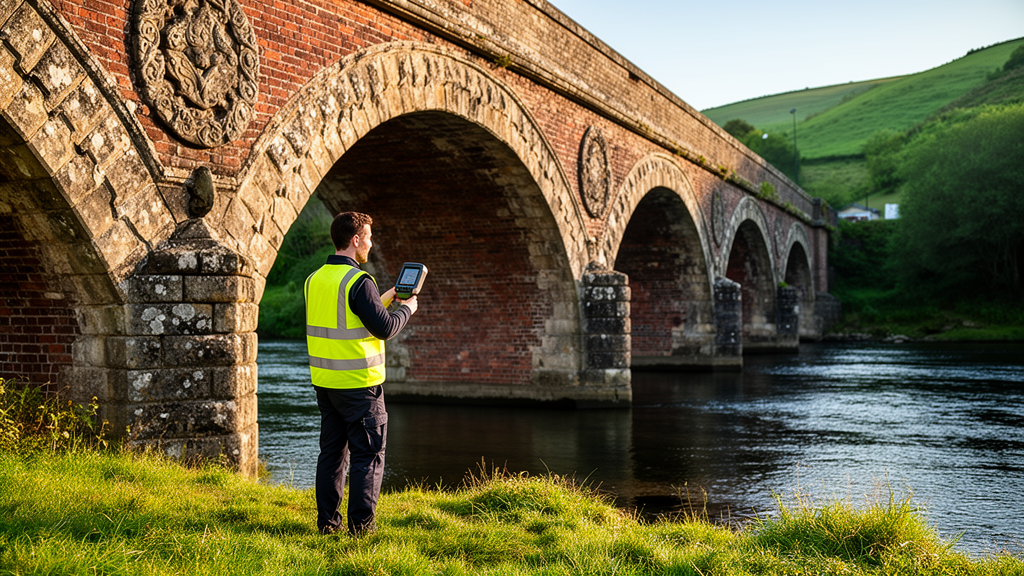
A research team has demonstrated an integrated artificial intelligence and Internet of Things framework designed to automate the structural health monitoring of historic masonry bridges, achieving reliable defect detection and localisation using a lightweight neural network. Operating within the TensorFlow Object Detection API, the system adapts the Single Shot MultiBox Detector MobileNetV2 architecture to identify critical structural deterioration across aged masonry assets.
Constructed to accommodate historic transit demands, these structures now endure escalating service loads, environmental weathering, and progressive material fatigue well beyond their original design expectations. Common structural manifestations of this ageing process include surface-level defects such as cracking, vegetation intrusion, missing masonry units, section loss, and salt leachate. Conventional structural assessments rely on manual General, Principal, and Special Inspections, which depend on visual and tactile examinations that are labour intensive, logistically cumbersome, and prone to observer subjectivity. Furthermore, conventional scaffolding and mobile elevated platforms present substantial economic, logistical, and safety hazards, particularly when deployed across high viaducts situated in remote or topographically irregular landscapes.
To establish a rigorous experimental foundation, the investigators conducted a comprehensive inspection case study on the Smardale Gill Viaduct, a Grade II* listed masonry arch structure located near Kirkby Stephen in Cumbria, United Kingdom. Originally constructed in 1860 to carry rail traffic and later repurposed as a pedestrian footpath, the viaduct comprises fourteen semi-circular arches spanning approximately 9.2 metres each, supported by intermediate slender piers with battered faces and buttressed wingwalls. The architectural fabric consists of dressed ashlar masonry along the four-hundred-millimetre arch rings, complemented by regularly coursed and rough-faced sandstone masonry. Because the highest pier rises approximately thirty metres above the valley floor, traditional rope access inspections were evaluated but rejected due to excessive cost projections, extended execution timelines, and prolonged fall hazards for inspection personnel operating under adverse weather conditions.
In place of physical access methods, the researchers implemented a non-destructive survey protocol combining high-resolution unmanned aerial vehicle photogrammetry with terrestrial Light Detection and Ranging laser scanning. The LiDAR sensor emitted rapid laser pulses toward the masonry surfaces, calculating precise spatial distances through time-of-flight measurements determined by the round-trip travel time of light. Simultaneously, drone flight passes captured dense overlapping two-dimensional imagery, which was processed through Structure from Motion algorithms to reconstruct three-dimensional spatial coordinates via projective transformation matrices accounting for focal lengths and camera orientations. To integrate the multi-modal spatial outputs into a singular geometric model, the team applied the Iterative Closest Point algorithm, which minimised the squared Euclidean distance between corresponding points in the LiDAR and photogrammetric clouds. The resulting digital twin was processed in Autodesk Recap Pro 2021, enabling one engineer to complete the primary baseline assessment in eight hours before secondary cross-validation.
The underlying machine learning architecture was built upon the Single Shot MultiBox Detector with a MobileNetV2 backbone, chosen specifically for its low parameter footprint and rapid inference capabilities on embedded edge platforms. Rather than training a neural network from scratch, the engineers implemented a transfer learning strategy utilising weights pre-trained on the Common Objects in Context benchmark, accelerating feature convergence while mitigating the risk of overfitting on specialised civil engineering data. The training objective optimised a compound loss function balancing multiclass cross-entropy loss for categorical identification against Smooth L1 loss for bounding box coordinate regression, ensuring numerical stability when processing extreme bounding outliers.
Model training was executed within a dedicated Python and Anaconda computational environment utilizing CUDA Toolkit version 11.2 and cuDNN acceleration on an NVIDIA GeForce RTX 3060 graphics processing unit equipped with 12 gigabytes of video memory and 3584 CUDA cores. The training regimen ran for fifty epochs with a batch size of sixteen, completing in approximately two hours on the GPU compared to an estimated eight hours under standard central processing unit execution. Real-time hardware monitoring via the nvidia-smi utility confirmed core utilization rates oscillating between 70 percent and 95 percent across a sixty-minute monitored interval, verifying optimal computational throughput. Amdahl’s Law calculations indicated a theoretical speedup factor of approximately 8.6 under an assumed 90 percent parallelizable workload, while observed per-step execution times stabilized between 1.10 and 1.12 seconds following initial overhead spikes.
The training corpus comprised over two thousand high-resolution images captured across diverse historic masonry bridges throughout the United Kingdom under varying illumination, shadow casting, and surface occlusion conditions. The images were initially acquired at nineteen-twenty by ten-eighty pixels before downsampling to three-hundred-and-twenty by three-hundred-and-twenty pixels to match model specifications. A rigorous manual annotation protocol using the LabelImg utility delineated damaged regions with rectangular coordinate boundaries, executed by a dedicated annotator with a random fifteen percent verification subset evaluated by an independent reviewer to enforce measurement consistency. Data cleaning eliminated blurred, duplicate, or mislabeled samples, after which min-max normalization scaled pixel values between zero and one.
Empirical evaluation of the trained model revealed balanced performance across both spatial localization and categorical classification. The model concluded training with a total loss value of 0.594, comprising a localization loss of 0.144, a classification loss of 0.305, and a regularization loss of 0.145. At an Intersection over Union threshold of 0.75, the model maintained a mean Average Precision of 0.700, alongside an Average Recall of 0.657 across all defect categories. Performance stratified by defect dimensions indicated a mean Average Precision of 0.600 for medium-sized structural anomalies and 0.668 for large-scale damage regions, corroborating theoretical expectations that expansive morphological defects exhibit more distinctive visual cues. Detailed TensorBoard diagnostics confirmed high detection accuracy rates across individual damage categories, identifying pier face cracking at 100 percent, missing abutment masonry units at 98 percent, open pier joints at 97 percent, missing wingwall units at 97 percent, pier section loss at 99 percent, and soffit spalling at 95 percent accuracy.
Validation against traditional manual inspection records showed strong concordance, with the artificial intelligence system matching expert engineering determinations across all major fracture, section loss, and stone displacement categories with accuracy exceeding 90 percent. Notably, the automated model demonstrated superior sensitivity in detecting chemical salt leachate, identifying extensive deposits not catalogued in manual inspection reports across accuracy rates of 91, 95, and 96 percent. While salt efflorescence does not represent an immediate mechanical rupture, the researchers noted that its presence indicates moisture migration and internal chemical leaching that accelerate long-term mortar deterioration. Furthermore, surface salt deposits frequently conceal underlying micro-cracks and joint decay from human visual observation. The system’s heightened sensitivity to these chemical indicators provides bridge managers with critical early warnings regarding moisture ingress before extensive masonry deterioration manifests.
To translate automated defect detections into actionable maintenance operations, the researchers integrated the detection pipeline with an external Microsoft SQL Server relational database through Python database interfaces. The system parses predicted defect labels, confidence scores, and bounding box dimensions, subsequently querying relational tables to retrieve standardized remediation procedures, risk priority levels, and recommended operational intervention timeframes aligned with BS EN 1504-9 standards. Notwithstanding these operational advantages, the authors highlighted that bounding-box object detection provides coarse spatial boundaries rather than granular damage quantification. Future development must integrate pixel-wise segmentation frameworks, such as SDDNet or attention-based encoder-decoder architectures, to measure precise crack widths, lengths, and spalling surface areas. Addressing these measurement refinements, alongside field sensor durability and conservation compliance, will support the broader adoption of automated artificial intelligence monitoring across heritage transport infrastructure.
Subject of Research: Automated structural defect detection in historic masonry bridges using SSD-MobileNetV2 and remote sensing
Article Title: Application of SSD-MobileNetV2 for automated defect detection in masonry bridges using AI and IoT
Article References: Amoako, E., Sheng, Y., Khalid, M., & Bock, M. (2025). Application of SSD-MobileNetV2 for automated defect detection in masonry bridges using AI and IoT. Advances in Bridge Engineering, 6(1), Article 31. https://doi.org/10.1186/s43251-025-00179-z
Image Credits: AI Generated
DOI: 10.1186/s43251-025-00179-z
Keywords: structural health monitoring, masonry bridges, SSD-MobileNetV2, deep learning, defect detection, Smardale Gill Viaduct, drone photogrammetry, LiDAR, TensorFlow Object Detection API, edge computing, computer vision, crack detection, bridge inspection, transfer learning, data augmentation, infrastructure maintenance
News Source: Blake Davidson. (November 13, 2026). Lightweight AI Framework Detects Historic Masonry Bridge Defects With High Accuracy. Scienmag.