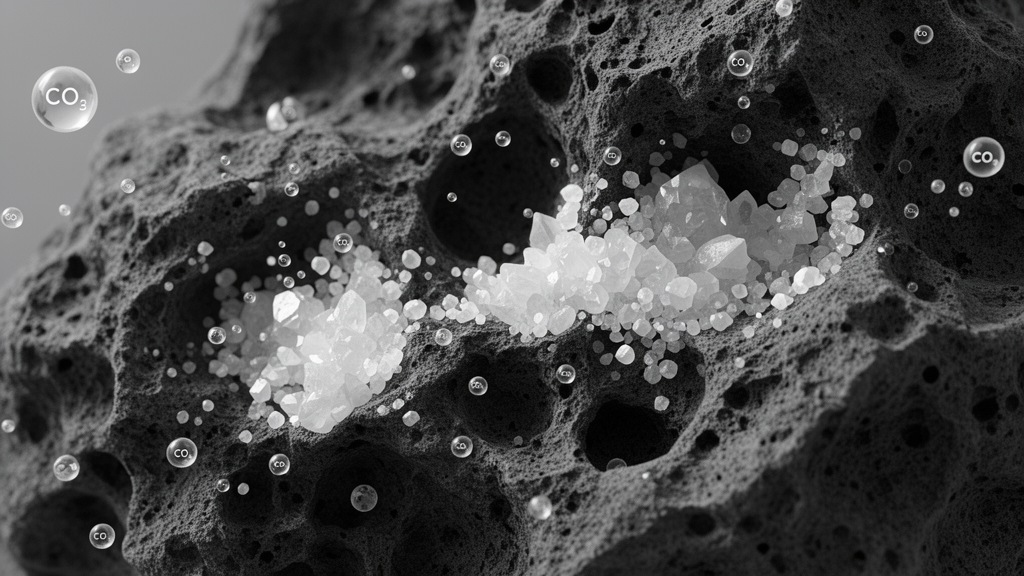
Hydrothermal batch reactor experiments and reactive transport geochemical modeling show that hypersaline volcanic reservoir rocks at northwest Türkiye’s Tuzla Geothermal Field can permanently immobilize injected carbon dioxide through secondary mineral precipitation under subsurface conditions of 200 degrees Celsius and 4.4 megapascals. Published in Geothermal Energy by Serhat Tonkul, Selçuk Erol, Alper Baba, and Simona Regenspurg, the study evaluated whether an active geothermal plant co-injecting carbon dioxide to prevent mineral scaling can expand into a permanent carbon storage facility. By tracking geochemical reactions over a nine-day trial, the authors demonstrated that the andesitic host rock supplies sufficient reactive divalent cations, predominantly calcium, to drive stable calcite precipitation alongside secondary aluminosilicates, providing a baseline for turning emissions abatement into permanent geologic storage.
The Tuzla Geothermal Field is an active hydrothermal system situated in northwest Türkiye, five kilometers from the Aegean Sea and eighty kilometers south of Çanakkale. The regional thermal regime has remained active since Miocene volcanism, leaving deep reservoir formations dominated by Miocene andesite and trachyandesite, capped by Neogene claystone and sandstone. Previous field operations documented by Topcu and colleagues established Tuzla as a pilot site in Türkiye for carbon dioxide co-injection, using industrial carbon dioxide to mitigate scale problems within boreholes and surface installations. That dosing system utilized a mobile heated tank for liquid carbon dioxide, an evaporator, pressure regulators, static mixers, and check valves to inject carbon dioxide gas directly into geothermal brine pumped from production wells at pressures below 25 bar. Although field engineers proved that co-injection limits scaling, the subsurface geochemical consequences of introducing carbonated hypersaline brine into the volcanic reservoir rock remained uncharacterized prior to this study.
To evaluate reservoir geochemistry under controlled conditions, the researchers employed a Berghof high-pressure batch reactor designed to operate safely up to 20 megapascals and 300 degrees Celsius. The 100-milliliter vessel contained ports for fluid sampling, gas injection, and gas sampling, along with a thermometer and a barometer. Six grams of andesite host rock were crushed and sieved to grain sizes below 125 micrometers, cleaned with analytical-grade acetone, rinsed with deionized water, and dried overnight at 105 degrees Celsius. Sixty milliliters of genuine geothermal brine collected from a Tuzla production well—possessing a hypersaline sodium chloride concentration of 11.72 moles per kilogram of water—were placed inside the reactor with the powdered rock. Before heating, the system was purged using nitrogen gas connected through the sampling port to eliminate dissolved oxygen, preventing non-representative oxidation of iron-bearing silicate phases during hydrothermal reaction.
Once sealed, the reactor was heated to 200 degrees Celsius, reaching 100 degrees Celsius within five to ten minutes and stabilizing at the target temperature within forty-five minutes. To prevent fluid boiling, a total pressure of 4.4 megapascals was applied, with carbon dioxide injected at 0.167 moles per kilogram of water at 0.1 milliliters per minute, establishing a partial pressure of 2.27 megapascals. Over the nine-day experiment, fluid aliquots were collected at 72, 144, and 216 hours through a sampling line protected by a micro-mesh stainless steel basket to prevent clogging. Dissolved major and minor elements were quantified using an Agilent 7500ce inductively coupled plasma mass spectrometer with pulse counting detectors calibrated against NIST-traceable multi-element standards repeated five times, while solution acidity was measured under standard laboratory conditions using an Accumet AR-20m meter and Thermo combination glass electrodes.
As acidic fluid attacked mineral surfaces, mineral buffering and ion-exchange reactions gradually moderated acidity. Dissolved silicon dioxide initially measured 189 milligrams per liter in native brine, rose to 210.01 milligrams per liter after 72 hours of rock leaching, and declined to 159.65 milligrams per liter at 144 hours before reaching 150.24 milligrams per liter at 216 hours. This trajectory reflected the initial dissolution of albite, which consumed hydrogen ions while releasing sodium and silica into solution alongside transient boehmite. Beyond 72 hours, secondary reactions consumed dissolved silica, transforming boehmite into secondary kaolinite, while sodium concentrations rose steadily from 18,001 to 18,473.12 milligrams per liter without precipitating secondary dawsonite.
Dissolved divalent and trivalent cations confirmed feldspar dissolution and secondary mineral trapping across the reaction sequence. Native brine contained an initial dissolved calcium concentration of 3090 milligrams per liter, originating primarily from anorthite dissolution in the volcanic host rock. Calcium levels decreased over time, falling to 2971.90 milligrams per liter at 216 hours as liberated calcium reacted with bicarbonate ions to precipitate crystalline calcite. This consumption reduced the fluid calcium-to-sodium ratio from 0.1717 to 0.1609 by the end of the trial. Potassium rose from 1809.19 milligrams per liter as acidic brine dissolved potassium feldspar and biotite, releasing cations that promoted kaolinite formation. Magnesium concentrations climbed sharply due to surface leaching and ion exchange on mica grains, while ferric iron rose from 5.49 to 6.42 milligrams per liter through hematite dissolution, whereas conservative chloride remained chemically constant throughout the experiment.
Mineralogical alterations before and after carbon dioxide exposure were characterized using Philips X’Pert Pro X-ray diffractometry, Spectro IQ II X-ray fluorescence, and FEI Quanta 250 scanning electron microscopy with energy-dispersive spectroscopy. Microscopic inspection of unreacted andesite revealed primary albite, potassium feldspar, subhedral quartz, hematite, and iron-rich biotite. Examination of post-reaction specimens revealed extensive neoformed mineral crystallization on rock surfaces. Energy-dispersive spectra confirmed the formation of rhombohedral calcite crystals precipitated from liberated calcium and bicarbonate ions, serving as the dominant carbonate trapping phase. Secondary kaolinite developed as booklet-like crystal clusters acting as cementing material, while needle-shaped crystals identified by X-ray diffraction as scolecite confirmed the formation of calcium aluminosilicates. Neither magnesite, siderite, nor dawsonite were detected, indicating kinetic nucleation barriers prevented magnesium and iron carbonate precipitation during the 216-hour trial, leaving calcite as the solitary dominant secondary carbonate mineral phase.
To simulate geochemical pathways and validate experimental findings, the authors performed numerical reactive transport simulations using PhreeqC 3.7.3 coupled with the Lawrence Livermore National Laboratory database. Reaction dynamics were calculated using transition state theory rate laws linking mineral dissolution rates to specific reactive surface areas, Arrhenius temperature-dependent rate constants, and thermodynamic driving forces. Specific surface areas were calculated using geometric spheres below 125 micrometers corrected by surface roughness factors between 1 and 20 for feldspars. Numerical simulations closely matched observed fluid evolutions and mineral mass alterations: plagioclase decreased from 16.14 to 11.91 weight percent, potassium feldspar fell from 11.40 to 5.84 percent, mica declined from 7.62 to 4.19 percent, and hematite dropped from 5.2 to 0.9 percent. Conversely, quartz increased from 55.7 to 63.40 percent, aluminosilicates rose from 4.71 to 6.32 percent, while newly formed calcite and kaolinite reached 5.13 and 2.33 weight percent.
The experimental and geochemical modeling results from the Tuzla Geothermal Field exhibit meaningful parallels and distinctions when compared against other carbon sequestration studies and field trials. In basaltic sequestration settings, such as Iceland’s CarbFix project at Hellisheidi where carbonated fluids are injected into basalt at alkaline pH near 9.5, rapid mineralization traps carbon dioxide into calcium and magnesium carbonates. In contrast, hypersaline volcanic systems like Tuzla operate at acidic conditions where plagioclase dissolution selectively favors calcite formation over dolomite or magnesite. Batch reaction experiments on granite and volcanic rocks by Ding, Suto, and Hangx similarly documented feldspar dissolution and secondary kaolinite-carbonate assemblages, supporting the consistency of aluminosilicate weathering under elevated hydrothermal pressures and temperatures.
Despite confirming permanent mineral trapping potential, the researchers highlighted key limitations when extrapolating laboratory batch trials to field-scale reservoir operations. Powdered rock in batch reactors maximizes solid-fluid contact area, accelerating reaction rates compared to natural fracture networks and pore geometries under reservoir conditions. High brine salinity, with 11.72 moles of sodium chloride, significantly lowers carbon dioxide solubility, potentially causing injected gas to accumulate in upper reservoir zones without convective mixing. Furthermore, precipitation of secondary kaolinite booklets and fibrous calcium aluminosilicates could cause pore clogging and reduce permeability, negatively affecting reservoir injectivity over extended injection campaigns. Nevertheless, the study provides valuable empirical evidence that volcanic rocks at the Tuzla Geothermal Field supply adequate divalent cations to convert dissolved carbon dioxide into stable calcite, demonstrating that existing anti-scaling co-injection systems can be broadened into viable carbon capture and storage operations.
Subject of Research: Mineral carbonation and CO2 sequestration in hypersaline volcanic geothermal reservoirs
Article Title: Fluid–CO₂ injection in a hypersaline volcanic systems: a reactive transport and experimental evaluation with application to the Tuzla Geothermal Field, Türkiye
Article References: Tonkul, S., Erol, S., Baba, A., & Regenspurg, S. (2026). Fluid–CO₂ injection in a hypersaline volcanic systems: a reactive transport and experimental evaluation with application to the Tuzla Geothermal Field, Türkiye. Geothermal Energy, 14(1), Article 2. https://doi.org/10.1186/s40517-025-00372-3
Image Credits: AI Generated
DOI: 10.1186/s40517-025-00372-3
Keywords: Tuzla Geothermal Field, carbon dioxide sequestration, mineral trapping, calcite precipitation, hypersaline brine, andesite, reactive transport modeling, PhreeqC, batch reactor experiment, anorthite dissolution, albite, kaolinite, scolecite, geothermal co-injection, scale prevention, transition state theory, secondary minerals, reservoir injectivity
News Source: Violet Maxwell. (November 13, 2026). Experiments Indicate Tuzla Volcanic Rocks Can Trap Carbon Dioxide as Calcite. Scienmag.