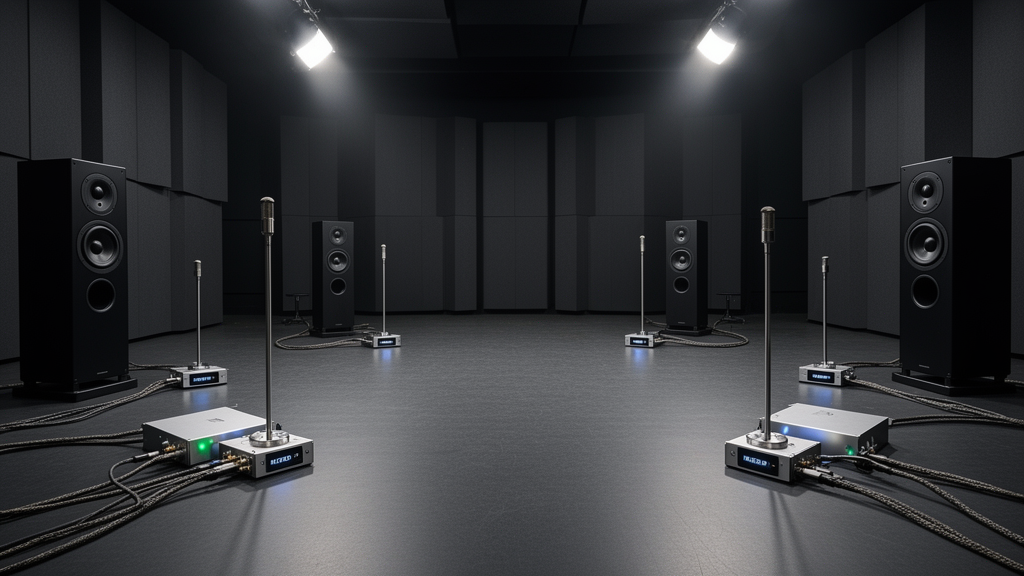
A research team has demonstrated an advanced active noise control framework capable of attenuating complex and non-stationary acoustic disturbances by coupling parameter-optimized signal decomposition with an exponentially expanded neural network architecture. Active noise control systems operate on the principle of destructive interference, deploying secondary sources such as loudspeakers to generate anti-noise acoustic waves of equal amplitude and inverted phase relative to unwanted primary sounds. While traditional active noise suppression platforms commonly depend on centralized controllers that coordinate sensor arrays across shared channels, handling multi-channel spatial fields often introduces computational bottlenecks and extensive physical wiring challenges. To address these operational constraints, the authors formulated a decentralized multi-channel active noise control system that allocates dedicated adaptive controllers to individual acoustic channels, allowing independent weight adaptation across distributed loudspeaker-microphone configurations.
The engineering approach integrates an efficient variant of variational mode decomposition with an exponential expanded random vector functional link artificial neural network. In conventional active noise cancellation architectures, linear filters such as the least mean squares algorithm and its filtered-X variants frequently experience degraded performance when confronted with dynamic, harmonic-rich, or highly non-linear disturbances generated by industrial machinery, transportation, and household appliances. While standard functional link networks introduce polynomial expansions to approximate non-linear acoustic transfer functions, their generalization capacity remains constrained in complex acoustic environments. The authors resolved these limitations by combining functional expansions with random weight projections and direct input-to-output connections, establishing an adaptive learning architecture capable of rapid coefficient updates without requiring computationally demanding iterative backpropagation routines.
To provide high-quality input features for the neural network, the system preprocesses incoming primary acoustic disturbances using efficient variational mode decomposition. The decomposition technique breaks down raw noise signals into distinct band-limited intrinsic mode functions by solving a constrained variational optimization problem. This formulation shifts mode spectra toward baseband representations via Hilbert transforms and exponential mixing, applying Gaussian smoothness constraints alongside quadratic penalties and Lagrangian multipliers to ensure reconstruction fidelity. Because the decomposition quality of variational mode decomposition is governed by the chosen number of modes and the balancing parameter that enforces data fidelity, improper manual configurations risk either incomplete separation or computational over-decomposition that inflates downstream processing times.
To automate the configuration of decomposition parameters, the researchers implemented a modified firefly algorithm guided by a weighted kurtosis index. The optimization index evaluates decomposed signal sequences by calculating the product of absolute kurtosis and the correlation coefficient between the original disturbance and the extracted modes, pinpointing components that capture prominent transient and non-stationary signal characteristics. The modified metaheuristic algorithm accelerates convergence toward global optima by tracking a single optimal firefly across generations, incorporating adaptive randomization parameters to balance exploration and diversification, and employing mutation mechanisms on sub-optimal positions to escape local minima. Within the investigated configuration, the optimization framework settled on three decomposed modes and a balancing parameter value of 2232 within five iterations, outperforming benchmark algorithms in convergence efficiency.
The three extracted band-limited intrinsic mode functions are subsequently routed through the cascading functional layers of the neural controller. The network architecture subjects the input sequences to dual non-linear transformations, beginning with Chebyshev polynomial expansions that model smooth harmonic variations and oscillatory dynamics. These transformed vectors are immediately processed through an exponential expansion stage designed to capture steep impulsive transients and abrupt amplitude fluctuations. By augmenting these layered functional features with randomized input projections and an unexpanded direct feedforward link from the primary input to the output layer, the controller computes its final output weights in a single operational step using a pseudo-inverse formulation, ensuring rapid anti-noise synthesis.
The operational capabilities of the integrated architecture were initially assessed through numerical simulations modeling a decentralized system with one reference microphone, three error sensors, and three secondary loudspeakers. The simulation environment evaluated a synthetic primary disturbance exhibiting fully developed chaotic behavior generated via a non-linear recurrence relation with a control parameter of four. Under these chaotic conditions, the proposed controller achieved rapid error reduction within 300 to 350 samples, whereas comparative benchmark models lacking optimized decomposition required significantly longer periods, such as 900 to 950 samples for standard exponential random vector networks. Furthermore, the controller demonstrated a steady-state mean square error of 0.0041 on the primary channel, contrasting with higher error values ranging from 0.0531 to 0.4836 observed in conventional filtering variants.
Beyond numerical convergence rates, the authors evaluated performance metrics assessing filter adaptation quality and disturbance stability. The proposed controller recorded a calculation time of 1.121 seconds to suppress the synthetic disturbance, compared to 2.035 seconds for conventional variational decomposition and 3.576 seconds for empirical mode decomposition configurations, reflecting the processing savings of extracting only three optimal modes. The framework also registered a percentage misadjustment of 0.005 percent on the primary evaluation channel, indicating minimal deviation from the ideal theoretical filter solution, alongside a robustness index of 0.990 and a convergence time of 0.103 seconds. Bar graph comparisons across all three secondary acoustic channels confirmed consistent suppression across multiple listening zones.
The practical resilience of the controller was further validated against recorded real-world acoustic disturbances characterized by contrasting spectral properties. When tested against heavy load motor noise, an industrial quasi-stationary disturbance containing prominent harmonic components, the proposed framework achieved a root mean square error of 0.00027, reducing residual acoustic pressure near zero compared to errors of 0.0539 for least mean squares and 0.0018 for non-decomposed neural baselines. In tests utilizing breaking glass noise, an impulsive and highly non-stationary acoustic event marked by abrupt amplitude spikes, the controller effectively suppressed transient shock components, yielding a root mean square error of 0.000033, demonstrating robust adaptation across disparate disturbance regimes.
To evaluate feasibility in physical environments, the researchers deployed the controller within a laboratory hardware testbench using a National Instruments USB-6008 data acquisition platform coupled to a digital storage oscilloscope. Physical recordings of indoor fan noise and air conditioner disturbances were reproduced through a primary loudspeaker, captured via reference microphones, and processed in real time to drive secondary cancellation speakers. Measurement traces from the oscilloscope revealed that residual noise levels at the error microphone dropped to approximately 10 millivolts across both trials, down from primary signal amplitudes of roughly 500 millivolts, confirming that the algorithmic structure functions stably within practical mixed-signal acquisition constraints.
Statistical evaluation via paired t-tests confirmed that the observed noise reduction improvements over baseline adaptive controllers were statistically significant at a 95 percent confidence level, yielding a mean error of 0.0003 with a confidence interval between -0.0010 and 0.0015 and p-values below 0.05 across evaluated channels. While the multi-stage optimization and decomposition pipeline entails greater algorithmic complexity than elementary linear filters, the systematic extraction of informative modes preserves predictable computational execution. The authors noted that future research will examine model compression techniques, lightweight network configurations, and dedicated hardware-oriented optimizations to further minimize memory footprints for embedded personal headsets, automotive cabins, and distributed industrial monitoring networks.
The mathematical formulation of the decentralized multi-channel acoustic environment incorporates discrete transfer functions to model transmission pathways and acoustic cross-coupling. In the simulated three-channel architecture, the primary acoustic paths connecting the single reference noise source to the three error microphones are governed by finite impulse response transfer functions exhibiting distinct delay structures, such as fifth-order delay terms with fractional coefficients. Similarly, secondary propagation paths linking each loudspeaker to the error sensors are characterized by second-order and third-order delay relationships. Because secondary acoustic waves propagate across overlapping physical zones, each error microphone detects combined acoustic contributions from all three active loudspeakers, necessitating independent channel controllers capable of compensating for multi-source interference without centralized cross-talk coordination.
The operational efficiency of the signal decomposition stage relies on strict convergence thresholds and structural differences from older decomposition algorithms. During execution, the efficient variational mode decomposition updates center frequencies to match the center of gravity of mode power spectra and refines Lagrangian multipliers until relative mode variation drops below a tolerance limit of 0.000001. In comparative testing, standard empirical mode decomposition broke down the identical primary noise input into twenty-six intrinsic mode functions and an additional monotonic residue signal lacking further extrema. Conventional variational mode decomposition similarly generated seven preset band-limited modes. By restricting extraction to three highly informative modes through optimization, the proposed framework avoids the substantial computational overhead and feature redundancy that burden baseline networks receiving unconstrained mode sets.
The parameter selection process was examined through systematic sensitivity evaluations of the metaheuristic optimizer. The search boundaries for the modified firefly algorithm restricted the candidate mode quantity to integer values between two and ten, while constraining the balancing parameter within a range from 1000 to 10000. Experimental sweeps over algorithmic configurations established that a swarm population of 30 fireflies and an execution ceiling of 50 generations delivered optimal convergence stability. Smaller swarm sizes exhibited vulnerability to premature convergence at suboptimal local solutions, whereas larger populations increased computational processing without enhancing objective accuracy. In comparative benchmark trials, the modified firefly algorithm converged to optimal decomposition settings within five generations, whereas standard particle swarm optimization required 15 generations and basic firefly optimization needed 25 generations to identify suitable parameter configurations.
Subject of Research: Decentralized multi-channel active noise control using optimized variational mode decomposition and neural networks
Article Title: A multiple channel active noise control system based on exponential expanded random vector functional link artificial neural network integrated with optimized parameter efficient variational mode decomposition
Article References: Mishra, S., Satapathy, P., Yadav, S. S., & Dash, P. K. (2026). A multiple channel active noise control system based on exponential expanded random vector functional link artificial neural network integrated with optimized parameter efficient variational mode decomposition. Discover Electronics, 3(1), Article 109. https://doi.org/10.1007/s44291-026-00259-y
Image Credits: AI Generated
DOI: 10.1007/s44291-026-00259-y
Keywords: active noise control, variational mode decomposition, functional link artificial neural network, acoustic noise attenuation, signal processing, firefly algorithm, decentralized systems, chaotic noise, audio engineering, Chebyshev polynomials, weighted kurtosis index, mean square error, hardware validation, adaptive filtering, sound attenuation, acoustic disturbances
News Source: Cassandra Pierce. (November 13, 2026). Decentralized Neural Network Architecture Enhances Multi-Channel Active Noise Control Performance. Scienmag.