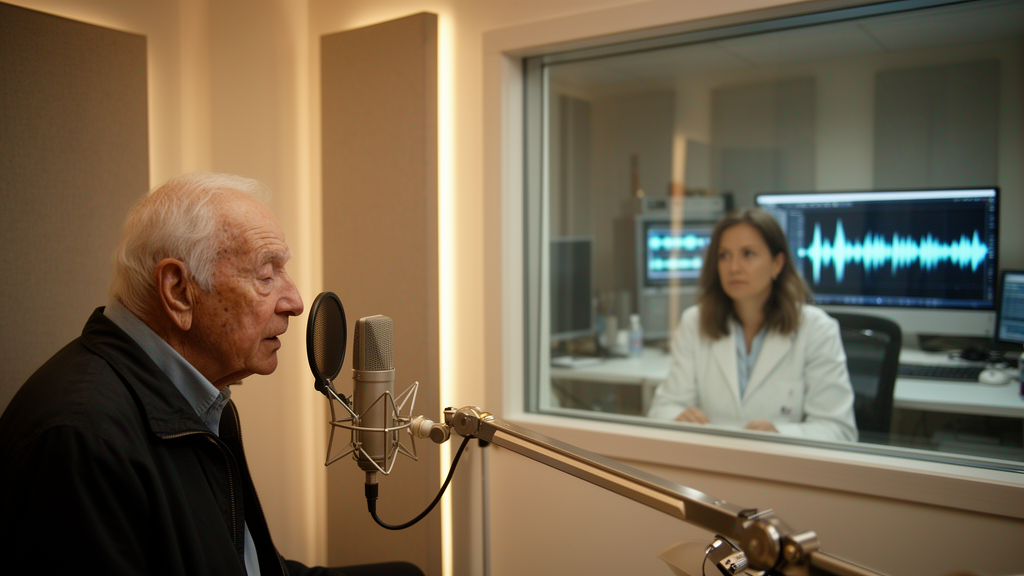
An exploratory study published in Frontiers in Neurology demonstrates that combining an image-based machine learning pipeline with explainable visualization tools can identify specific phoneme-level acoustic markers associated with Parkinson’s disease. Conducted by researchers at the University of California, Irvine, including Kotaro Tsutsumi, Peter D. Chang, Ali Ezzati, and Sanaz Attaripour Isfahani, the investigation examined whether sustained vowel phonations converted into visual audio representations could accurately differentiate individuals diagnosed with Parkinson’s disease from healthy controls. Rather than analyzing audio signals as isolated numerical features or through single phonemes alone, the research team constructed a unified composite input that integrated multiple sustained vowels into a single two-dimensional spectrogram. This novel configuration enabled the artificial intelligence model to maintain high diagnostic classification accuracy while allowing the investigators to apply gradient-weighted class activation mapping to inspect the model’s inner decision-making process and uncover which vocal sounds drove classification decisions.
Speech impairments represent one of the hallmark characteristics of Parkinson’s disease, frequently manifesting as hypokinetic dysarthria. This motor speech condition is typically distinguished by reduced vocal intensity, monotonous pitch, imprecise consonant pronunciation, and a noticeably breathy or hoarse vocal quality. Because vocal abnormalities often precede overt motor symptoms such as resting tremors, postural instability, and rigidity, non-invasive voice assessment offers significant potential for scalable, objective screening and monitoring. Traditional evaluations rely on validated examiner scales, such as the Movement Disorder Society Unified Parkinson’s Disease Rating Scale, yet these clinical assessments remain inherently vulnerable to inter-rater variability and subjective interpretation. Machine learning has emerged as a promising avenue for extracting diagnostic patterns from vocal acoustics, but prior models have largely functioned as black boxes or relied exclusively on small collections of hand-crafted dysphonia measures that obscure how specific phonemes contribute to disease detection.
To overcome these limitations, the research team aggregated data from two publicly available voice databases: the Spanish-language NeuroVoz corpus recorded at Hospital General Universitario Gregorio Marañón and the Italian Parkinson’s Voice and Speech dataset. After excluding younger healthy subjects and individuals with missing recordings to control for baseline differences, the final study cohort comprised 150 total participants, including 74 individuals clinically diagnosed with Parkinson’s disease and 76 healthy comparison controls. Within the NeuroVoz cohort of 101 participants, the Parkinson’s disease group was significantly older than the control group, whereas the Italian cohort of 49 participants showed no significant differences in age or sex between groups. Across the pooled dataset, participants averaged 67.1 years of age, and 43 percent were female. All but two Parkinson’s participants in the NeuroVoz cohort were recorded during their medication ON state, between two and five hours after dopaminergic therapy, while all Italian cohort participants were also receiving active antiparkinsonian treatment.
The methodological framework focused exclusively on sustained vocal phonations of five primary vowels: /a/, /e/, /i/, /o/, and /u/. Audio recordings were resampled to a standardized frequency of 16 kilohertz and segmented into uniform two-second windows using the Parselmouth Python interface to Praat acoustic software. The researchers extracted conventional acoustic parameters, estimating fundamental formant frequencies using the Burg algorithm alongside measures of voice quality including jitter, shimmer, harmonics-to-noise ratio, smoothed cepstral peak prominence, vowel articulation index, and vowel space area. Simultaneously, the audio segments underwent short-time Fourier transformations and were processed into log-mel spectrograms using 128 mel filter banks. This transformation allocated greater resolution to lower frequencies while applying a natural logarithmic scaling to approximate human auditory perception, converting audio waveforms into structured time-frequency images well-suited for convolutional neural networks.
The central innovation of the machine learning architecture involved stacking log-mel spectrograms of all five sustained vowels vertically along the frequency axis into a single composite image measuring 224 by 224 pixels. This unified layout allowed the model to analyze inter-vowel relationships simultaneously across a shared articulatory space. For classification, the investigators adapted a ResNet50 convolutional neural network pretrained on the ImageNet-1K dataset, modifying the terminal classification layer for binary prediction with a cross-entropy objective and an Adam optimizer. Evaluation was conducted through repeated random subsampling across five independent participant-level 80-to-20 splits, ensuring that individual speakers were strictly segregated into either training or testing partitions. To establish statistical robustness and account for split overlap, the researchers calculated bootstrapped receiver operating characteristic curves across 1,000 paired iterations per split, comparing the composite framework against both individual vowel inputs and standard machine learning baselines.
The experimental evaluations revealed that the deep learning model trained on the composite spectrogram achieved a combined average area under the receiver operating characteristic curve of 0.890, exhibiting no statistically significant difference from the average area of 0.895 achieved when training on individual vowel inputs. A composite model trained across an expanded schedule of 122 to 130 epochs similarly achieved an area under the curve of 0.900. When tested against conventional baseline models trained on 32 participant-level acoustic features, the composite neural network significantly outperformed a tuned support vector machine, which reached an area of 0.795, and a random forest classifier, which recorded an area of 0.746, while outperforming a logistic regression baseline that achieved an area of 0.803. In sensitivity analyses restricted to an age-matched cohort of 63 participant pairs, the composite architecture retained an area of 0.869, confirming that predictive performance was not driven primarily by age disparities between groups.
The integration of all five vowels within a single input image enabled the application of gradient-weighted class activation mapping, known as Grad-CAM, to quantify the neural network’s visual attention across the final convolutional layer. By segmenting the composite input into five equal horizontal frequency bands and counting pixels exceeding an activation threshold of 0.8, the investigators evaluated spatial model focus. Across healthy, Parkinsonian, and combined cohorts, the Kruskal-Wallis test indicated significant non-uniformity in attention distribution across vowel segments, with the vowel /u/ consistently eliciting the highest mean activation. This selective focus remained stable across activation thresholds of 0.5, 0.7, and 0.9. When the researchers trained and tested models using randomized vertical vowel ordering, the composite model maintained an area under the curve of 0.878 and still concentrated its highest attention on the vowel /u/, demonstrating that the phenomenon was not an artifact of spatial position at the base of the image.
Ablation experiments further established the functional importance of the vowel /u/ in guiding the classifier’s predictions. When researchers artificially replaced each vowel segment with acoustic noise one at a time, replacing the /u/ segment caused the overall classification performance to drop sharply from an area under the curve of 0.890 down to 0.838, reflecting a statistically significant decline observed across all five data splits. Replacing the vowel /i/ also resulted in a significant performance reduction to 0.856, whereas replacing vowels /a/, /e/, or /o/ produced negligible performance fluctuations, resulting in areas under the curve of 0.880, 0.894, and 0.899 respectively. Stacking vowels horizontally along the time axis yielded an area of 0.871, confirming that vertical frequency-based concatenation preserved critical articulatory relationships most effectively without compromising diagnostic accuracy.
Crucially, independent acoustic feature extractions corroborated the neural network’s focus on specific phonemes. Sex-stratified univariate comparisons showed that cepstral peak prominence for the vowel /u/ was significantly elevated in participants with Parkinson’s disease compared to healthy controls among both male and female speakers. In female participants, cepstral peak prominence was also significantly higher for the vowel /i/. After applying an analysis of covariance adjusting for age, sex, and dataset origin, both cepstral peak prominence and harmonics-to-noise ratio remained significantly higher in Parkinson’s disease for vowels /u/ and /i/, while shimmer was significantly reduced for /u/. This elevation in cepstral peak prominence and periodicity contrasts with typical dysphonia patterns in connected speech, potentially reflecting laryngeal rigidity, hyperadduction, and compensatory vocal effort during sustained maximum-effort phonation, although these metrics showed no linear correlation with motor severity scores on the Unified Parkinson’s Disease Rating Scale.
Despite these promising findings, the authors emphasize important technical and physiological limitations that necessitate cautious interpretation. The study was conducted on a modest retrospective sample of 150 speakers without prospective independent external validation, leading to relatively wide confidence intervals across experimental splits. Furthermore, when the composite model was trained on one national corpus and tested on the other, classification performance dropped precipitously to near-chance levels, achieving an area under the curve of 0.654 when trained on the Italian cohort and 0.557 when trained on the Spanish cohort. This sharp decline underscores substantial challenges in cross-corpus generalizability caused by differences in recording hardware, acoustic environments, and linguistic nuances. Because both analyzed databases represent Romance languages with five-vowel configurations, the authors conclude that future research must validate whether the diagnostic sensitivity of the vowel /u/ persists across diverse language families, connected conversational speech tasks, and larger clinical cohorts.
Subject of Research: Explainable machine learning and acoustic analysis of sustained vowels for Parkinson's disease detection
Article Title: Detection of candidate acoustic biomarkers for Parkinson's disease using an explainable machine learning composite spectrogram approach
Article References: Tsutsumi, K., Chang, P. D., Ezzati, A., & Isfahani, S. A. (2026). Detection of candidate acoustic biomarkers for Parkinson's disease using an explainable machine learning composite spectrogram approach. Frontiers in Neurology, 17, Article 1952100. https://doi.org/10.3389/fneur.2026.1952100
Image Credits: AI Generated
DOI: 10.3389/fneur.2026.1952100
Keywords: Parkinson's disease, acoustic biomarkers, machine learning, explainable artificial intelligence, Grad-CAM, spectrograms, vowel articulation, ResNet50, NeuroVoz corpus, ItalianPVS dataset, cepstral peak prominence, harmonics-to-noise ratio, hypokinetic dysarthria, digital biomarkers, voice analysis, biomarker discovery, phoneme analysis
News Source: Blake Davidson. (November 13, 2026). Explainable Machine Learning Identifies Vowel Sound As Potential Parkinson’s Disease Marker. Scienmag.