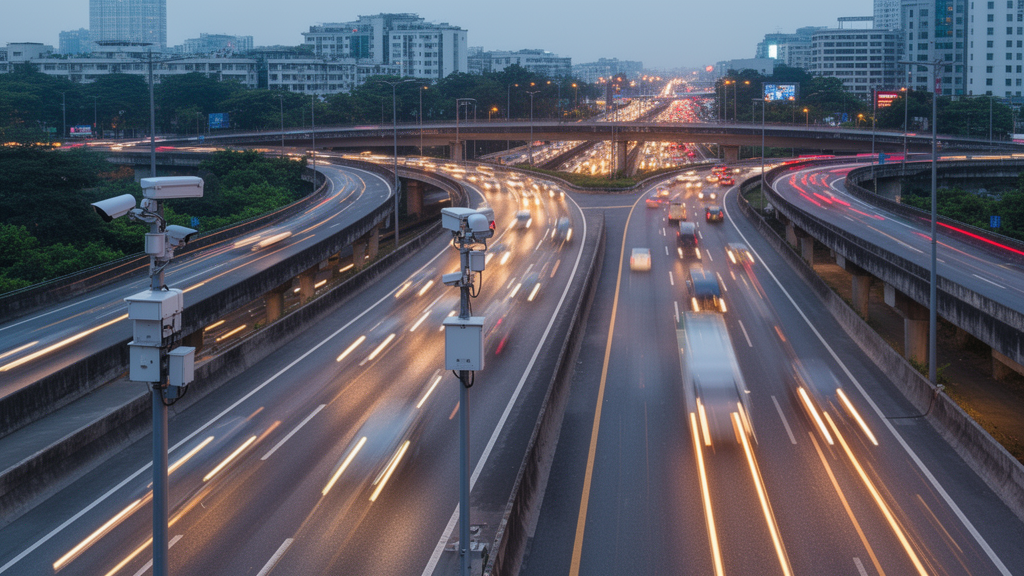
A research team led by Qun Zhang, Ziyue Wang, Chenglong Zhang, Zhanxin Gu, and Zhuofeng Zhao has introduced a stage-specific residual adaptation framework called MSIFA-PDFormer to improve multi-step traffic flow forecasting across complex road networks. Published in Discover Computing, the study demonstrates that coupling the propagation-delay-aware PDFormer backbone with two complementary, lightweight adaptation modules yields consistent reductions in predictive error across multiple benchmark datasets. Accurate multi-step traffic forecasting serves as a critical component in modern intelligent transportation systems, where timely predictions guide traffic signal optimization, automated congestion warnings, proactive route planning, and municipal mobility management. However, urban traffic patterns remain inherently difficult to forecast over extended horizons because traffic conditions exhibit severe nonlinearities, non-stationary temporal dynamics, and complex physical couplings across sensor locations. While deep spatio-temporal Transformer architectures have achieved competitive baseline performance, they frequently struggle to incorporate external environmental contexts and multi-faceted network structures without disrupting their core representations.
Standard spatio-temporal architectures for traffic prediction have evolved from basic statistical baselines and recurrent or convolutional neural networks toward advanced graph neural networks and attention-driven Transformers. Among these architectures, PDFormer established a specialized foundation by explicitly accounting for spatial propagation delays and dynamic long-range spatial dependencies through geographic and Dynamic Time Warping semantic masking. Despite these capabilities, the original PDFormer design focuses predominantly on historical traffic observations, temporal periodic embeddings, and internal spatial attention masks. It lacks a dedicated mechanism for processing exogenous variables such as local weather conditions and calendar indicators, both of which strongly alter urban travel demand and road capacity. Existing context-aware models typically merge auxiliary variables directly into input vectors or rely on complex internal attention fusion schemes. Such early-fusion approaches can dilute short-term continuity patterns captured by the delay-aware encoder, underscoring the need for an architecture-compatible adaptation scheme that respects horizon-dependent contextual influences.
To overcome these architectural limitations, the researchers engineered MSIFA-PDFormer as a modular, stage-specific framework that avoids modifying PDFormer’s internal attention blocks or parameterizing the backbone with low-rank weight updates. Instead, the model operates strictly in the representation and output spaces, segregating auxiliary information according to its functional role within the forecasting pipeline. Multi-graph structural priors are allocated entirely to a post-embedding, pre-encoder representation refinement stage, whereas external contextual indicators are routed to a late, horizon-specific residual correction stage following the base prediction head. Given a historical input sequence spanning twelve time steps across all road network sensors, an initial embedding layer maps traffic and temporal attributes into hidden node representations. These latent representations undergo structural refinement before passing into the standard PDFormer encoder blocks. The original prediction head then generates a base multi-horizon forecast, which is subsequently adjusted by the late contextual adapter to yield the final predicted flow values.
The structural refinement is handled by the Multi-Graph Structural Prior Adapter, or MGSPA, which injects topological and functional graph knowledge immediately after data embedding. MGSPA constructs three distinct structural prior matrices over the network sensors: a road topology prior, a Dynamic Time Warping temporal similarity prior, and an identity self-loop prior. The topology prior converts finite road-distance relationships into Gaussian-weighted values normalized by the standard deviation of road distances, with unit diagonals and row normalization. The Dynamic Time Warping prior selects the twenty smallest finite distances per sensor row from historical flow series, applying exponential distance weighting and row normalization to capture non-adjacent functional similarities. The identity prior preserves intrinsic node features during spatial propagation. MGSPA computes normalized source weights across these three matrices using global learnable logits passed through a softmax function, aggregating sensor features via matrix multiplication. The aggregated tensor is layer-normalized, transformed by a feature-wise multilayer perceptron, scaled by a learnable factor initialized at 0.03, and added residually to the initial embeddings.
Handling exogenous influences at the terminal end of the network, the Horizon-wise Late Context Adapter, or HLCA, maps historical environmental attributes directly to output-level residual corrections. HLCA evaluates seven external contextual variables aligned across the twelve-step historical observation window: temperature, precipitation, ten-meter wind speed, and four binary calendar indicators designating holidays, Saturdays, Sundays, and regular working days. Rather than feeding these contextual channels into the primary encoder, HLCA averages the values across all network sensors, applies layer normalization across features, and vectorizes the resulting temporal sequence. This vectorized representation passes through a two-layer Linear-GELU network to produce a hidden representation of dimension 32, which is linearly projected into scalar horizon corrections and broadcast across the sensor dimension. To prevent external context from overriding reliable short-term traffic continuity, the correction is scaled by horizon-specific coefficients that are linearly initialized from 0.005 at the earliest horizon to 0.05 at the final horizon before undergoing joint end-to-end optimization.
The experimental evaluation was conducted on an NVIDIA GeForce RTX 5090 GPU using three distinct traffic benchmarks: MTD-300, derived from enriched Madrid traffic data comprising 300 sensors across 12,432 time steps, alongside PeMS04-W and PeMS08-W, which augment California highway benchmarks with coordinate-matched Open-Meteo hourly weather records. In each dataset, the historical input length and future forecasting horizon were both set to twelve time steps, and data splits were partitioned into training, validation, and testing sets at a 6:2:2 ratio. Traffic observations were standardized using training split statistics, while contextual indicators remained in their raw scales, with hourly meteorological observations assigned across five-minute traffic intervals via zero-order hold. Model training utilized the AdamW optimizer with an initial learning rate of 0.001, weight decay of 0.05, a batch size of 16, and Huber loss with a delta parameter of 2 to mitigate outlier sensitivity, stopping early after 50 epochs without validation improvement.
Across five independent experimental runs on the primary MTD-300 benchmark, MSIFA-PDFormer achieved statistically significant improvements over the unmodified PDFormer backbone across all evaluated metrics. The base PDFormer model recorded a masked mean absolute error of 53.65 ± 0.22, a root mean squared error of 110.24 ± 0.31, and a mean absolute percentage error of 18.08% ± 0.10%. MSIFA-PDFormer reduced these values to 51.60 ± 0.21 for mean absolute error, 106.83 ± 0.28 for root mean squared error, and 17.23% ± 0.19% for mean absolute percentage error. These margins correspond to average reductions of 3.82% in mean absolute error, 3.09% in root mean squared error, and 4.70% in mean absolute percentage error. Two-sided Welch t-tests verified statistical significance, yielding p-values of 3.80 × 10⁻⁷ for mean absolute error, 9.39 × 10⁻⁸ for root mean squared error, and 1.10 × 10⁻⁴ for mean absolute percentage error. Furthermore, MSIFA-PDFormer outperformed advanced spatial patching baselines like PatchSTG, lowering error metrics by more than 15%.
Ablation experiments confirmed that the structural and contextual modules provide complementary predictive benefits when integrated into the forecasting pipeline. When evaluated independently on MTD-300, adding only HLCA lowered the mean absolute error to 52.91 ± 0.18, whereas adding only MGSPA reduced the error to 52.44 ± 0.23, with the combined architecture attaining the lowest overall error profile. Analysis of the learned structural fusion weights revealed that the Dynamic Time Warping similarity prior received the largest softmax weight at 0.811, while the road topology prior received 0.107 and the self-loop prior received 0.082. This distribution demonstrates that functional correlation between historical traffic profiles provides the primary structural guidance, supplemented by physical network connectivity. Environmental stratification further revealed that HLCA achieved its most substantial error reductions during precipitation events across all horizon intervals, confirming that external contextual corrections become especially beneficial when adverse weather disrupts baseline traffic flow patterns.
Cross-dataset testing demonstrated the broader applicability of the dual-adapter design on PeMS04-W and PeMS08-W, though with slightly more moderate percentage gains than observed on MTD-300. On PeMS04-W, MSIFA-PDFormer decreased mean absolute error by 2.78%, root mean squared error by 2.81%, and mean absolute percentage error by 4.04% compared to PDFormer. On PeMS08-W, the model achieved corresponding reductions of 2.57%, 2.52%, and 3.66%. The researchers noted that the twelve-step prediction horizon spans twelve full hours on the hourly aggregated MTD-300 dataset but only sixty minutes on the five-minute PeMS datasets. Over shorter intervals, traffic evolution remains predominantly governed by immediate temporal momentum, which naturally constrains the marginal impact of weather and calendar corrections. Stratified analysis across 736,440 test pairs categorized by flow variability showed the greatest improvement in moderate-variability sequences, which retain predictable temporal regularity while offering sufficient variation for structural and contextual signals to provide meaningful correction.
Computational profiling confirmed that the dual residual adapters introduce minimal resource overhead during training and inference, preserving the practical deployment utility of the base backbone. However, the authors highlighted several explicit limitations in the current implementation. First, averaging contextual variables across all sensor locations generates a uniform, network-wide residual correction that smooths out localized microclimate conditions, such as isolated rain showers or localized wind gusts. Second, precomputing the Dynamic Time Warping graph offline prevents the structural prior from dynamically adapting to long-term distribution shifts in sensor relationships over time. Finally, the empirical validation was restricted to highway and urban networks containing up to 307 sensors using only PDFormer as the primary backbone. Future research directions outlined by the team include developing node-specific context encoders, incorporating dynamic graph learning mechanisms, and testing adapter transferability across alternate spatio-temporal architectures and substantially larger urban sensor networks.
Subject of Research: Stage-specific residual adaptation for spatio-temporal traffic flow forecasting
Article Title: Residual adaptation with contextual information and structural priors for traffic flow forecasting
Article References: Zhang, Q., Wang, Z., Zhang, C., Gu, Z., & Zhao, Z. (2026). Residual adaptation with contextual information and structural priors for traffic flow forecasting. Discover Computing, 29(1), Article 786. https://doi.org/10.1007/s10791-026-10694-w
Image Credits: AI Generated
DOI: 10.1007/s10791-026-10694-w
Keywords: traffic flow forecasting, PDFormer, MSIFA-PDFormer, residual adaptation, spatio-temporal Transformer, multi-graph structural priors, Dynamic Time Warping, late context adapter, intelligent transportation systems, urban mobility, meteorological variables, calendar indicators, MTD-300, PeMS04-W, PeMS08-W, road network topology, Huber loss
News Source: Denise Maddox. (November 13, 2026). Dual Residual Adapters Improve PDFormer Traffic Flow Forecasting Across Sensor Networks. Scienmag.