Planting contour hedgerows of vetiver grass cut recorded surface runoff by roughly half on red-soil agricultural slopes fertilized with a mix of chemical fertilizer and fermented biogas slurry, though the accompanying effects on peanut crop yields shifted markedly from a loss to a gain across two consecutive monitoring seasons. Agricultural fields occupying sloped red-soil terrain across southern China face persistent vulnerability to overland water flow and erosive nutrient transport during intense monsoon downpours. In an effort to address nonpoint-source water pollution and evaluate livestock manure recycling, agronomists established an experimental field trial comparing conventional mineral fertilization against a partial organic substitution scheme combining digested pig slurry with living vegetative barriers. Across nineteen monitored storm and irrigation occurrences over two trial years, the presence of dense grass strips consistently diminished the overall volume of water escaping the plots, while its broader impacts on water-phase nitrogen export, phosphorus retention, and crop productivity exhibited nuanced trade-offs that defied simple assumptions of uniform environmental and agronomic improvement.
The study was established within Longtian Village in Yinhe Town, situated in Luxi County of Pingxiang within Jiangxi Province, China, positioned at an altitude of approximately 61.5 meters above sea level under a subtropical monsoon climate characterized by an average annual precipitation of 1,187.8 millimeters and a mean temperature of 17.7 degrees Celsius. The experimental ground featured an Oxisol clayey red soil oriented on a uniform five-degree slope, where baseline upper-layer soil testing prior to treatment revealed a moderately acidic pH of 5.6, an organic matter content of 16.5 grams per kilogram, total nitrogen of 1.15 grams per kilogram, total phosphorus of 1.12 grams per kilogram, and total potassium of 14.5 grams per kilogram, alongside specific mineral fractions including 0.8 milligrams per kilogram of nitrate nitrogen, 2.5 milligrams per kilogram of ammonium nitrogen, and 35 milligrams per kilogram of available potassium. Researchers planted peanut of the Changhua 18 cultivar in April of each season at a sowing rate of 150 kilograms per hectare, maintaining fifty centimeters of spacing between crop rows and fifteen centimeters between planting hills within rows, topped with a surface layer of chopped rice straw mulch spread shortly after crop emergence.
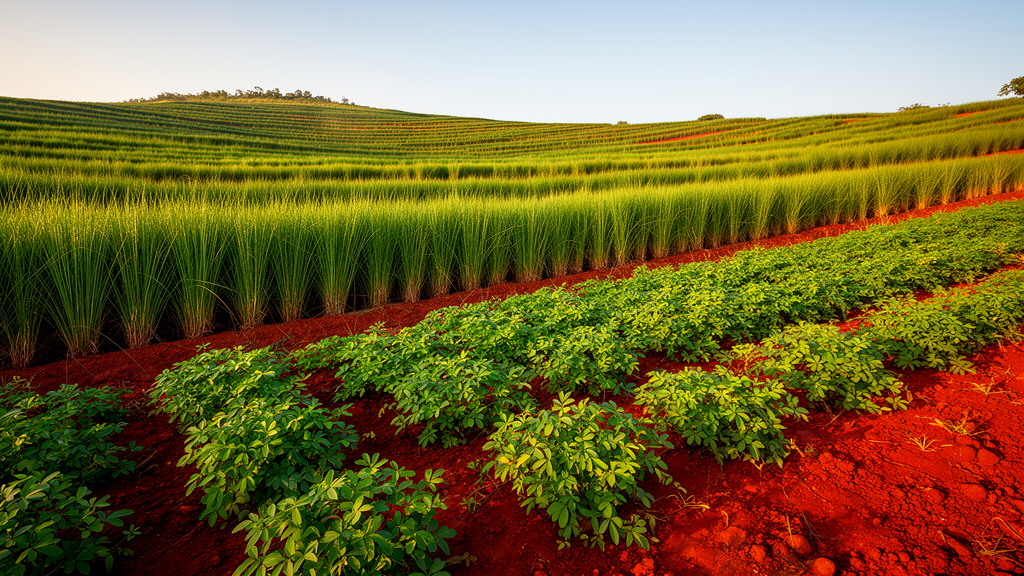
To rigorously capture surface hydrology and chemical discharge, the researchers designed nine hydrologically bounded runoff plots measuring ten meters long by four meters wide, establishing an individual experimental surface area of forty square meters per unit. At the downslope terminus of each individual plot, workers installed a concrete collection reservoir measuring two meters in length, 1.5 meters in width, and one meter deep to gather all dislodged surface water and associated soluble constituents. Three distinct management treatments were arranged across the plots, each replicated three times using identical physical plots across both 2022 and 2023. The control treatment, designated CF100, applied entirely synthetic mineral nutrients consisting of urea with 46 percent nitrogen, calcium magnesium phosphate containing 12 percent phosphate, and potassium chloride supplying 60 percent potassium oxide. The second treatment, designated CF50BS50, substituted fifty percent of the total applied nitrogen with liquid biogas slurry derived from the ninety-day anaerobic fermentation of swine manure and urine, while leaving the plots without vegetative strips. The third regime, labeled CF50BS50VG, retained the exact same half-slurry and half-chemical nitrogen fertilizer allocation as CF50BS50, but incorporated double rows of perennial vetiver grass, Chrysopogon zizanioides, planted along the slope contours at five-meter intervals.
The biogas slurry utilized across the multi-year testing period possessed an average water content of 65 percent, an organic carbon concentration of 115 milligrams per liter, a total nitrogen content of 235 milligrams per liter dominated by 146 milligrams per liter of ammonium nitrogen, alongside 51 milligrams per liter of total phosphorus, 146 milligrams per liter of total potassium, 510 milligrams per kilogram of boron, 160 milligrams per kilogram of magnesium, and an alkaline pH of 8.01. Because nitrogen equivalence was the designated operational benchmark between treatments, the slurry was analyzed prior to each seasonal application and pumped directly onto designated plots three to five days before crop sowing. For the remaining chemical inputs, sixty percent of mineral nitrogen, all mineral phosphorus, and half of mineral potassium were incorporated before seeding, while the subsequent forty percent of synthetic nitrogen and remaining potassium were topdressed ten days before peanut flowering and followed by shallow inter-row cultivation. However, because the phosphorus and potassium inherent to the swine slurry were not chemically counterbalanced across the different regimes, total cumulative inputs of phosphorus and potassium varied between the pure mineral control and the mixed organic treatments, meaning the design compared operational management systems rather than isolated single-element balances.
Hydrological tracking occurred across eight runoff-producing precipitation and irrigation events between late April and late June in 2022, totaling 82.80 millimeters of monitored incoming water, and eleven separate runoff events spanning mid-April to mid-August in 2023, encompassing 205.50 millimeters of water input. Liquid accumulation within the downslope cisterns demonstrated a substantial and consistent reduction in surface water outflow wherever contour grass barriers were maintained. In 2022, monitored event runoff reached 172,263 liters per hectare, or 17.23 millimeters depth equivalent, under pure chemical fertilizer, and 185,347 liters per hectare, or 18.53 millimeters, under the mixed slurry treatment without grass. In contrast, the plot rows flanked by vetiver hedgerows yielded only 77,200 liters per hectare, or 7.72 millimeters equivalent depth, representing a 58.3 percent reduction in water runoff relative to the unhedged slurry plots, supported by a statistically significant contrast of minus 10.81 millimeters. During the wetter monitoring period of 2023, runoff depth reached 30.18 millimeters under CF100 and 30.26 millimeters under CF50BS50, whereas the vetiver-hedged plots discharged 16.53 millimeters, reflecting a 45.4 percent reduction in total water volume, although variance between plots widened the uncertainty around this second-year estimated reduction of minus 13.73 millimeters.
The chemical quality of the escaping runoff water revealed that capturing overland water did not automatically translate into a uniform dilution of dissolved agricultural nutrients. Water samples collected from multiple vertical depths and horizontal positions within each collection tank were composited and analyzed for nitrogen and phosphorus forms. In 2022, the flow-weighted mean concentration of total phosphorus in escaping runoff from the vetiver-hedged treatment reached 0.185 milligrams per liter, accompanied by 0.173 milligrams per liter of dissolved total phosphorus. These values were noticeably higher than the corresponding phosphorus concentrations escaping the unhedged chemical control, which measured 0.109 milligrams per liter total and 0.095 milligrams per liter dissolved, as well as the unhedged slurry plots, which registered 0.074 milligrams per liter total and 0.063 milligrams per liter dissolved. Total nitrogen concentrations under the hedged regime averaged 1.975 milligrams per liter, with nitrate nitrogen contributing 1.473 milligrams per liter. In 2023, runoff ammonium nitrogen concentrations reached 0.585 milligrams per liter under chemical fertilizer and 0.550 milligrams per liter under unhedged slurry, but dropped to 0.191 milligrams per liter in the presence of vetiver, highlighting how chemical concentrations shifted dynamically across years and nutrient fractions.
When chemical concentrations were integrated with water discharge to calculate cumulative mass export per unit area, lower physical water runoff frequently counterbalanced elevated concentrations, yet statistical testing underscored substantial variability across years. In 2022, cumulative measured total nitrogen export across monitored events averaged 265.72 grams per hectare under mineral fertilizer, 202.02 grams per hectare under unhedged mixed slurry, and 151.99 grams per hectare under the vetiver hedgerow regime. Total phosphorus export during that first season averaged 18.77 grams per hectare for mineral fertilizer, 13.67 grams per hectare for unhedged slurry, and 14.49 grams per hectare where vetiver was planted. During the heavier water events of 2023, mean total nitrogen discharge rose to 501.35 grams per hectare under chemical fertilizer and 346.38 grams per hectare under mixed slurry, but remained constrained to 114.63 grams per hectare under the vetiver-hedged plots. Total phosphorus loss in 2023 averaged 20.78 grams per hectare under mineral fertilization, 24.74 grams per hectare under mixed slurry, and 9.75 grams per hectare with vetiver. Despite these numerical decreases, none of the primary linear model contrasts for total nitrogen or phosphorus export satisfied the threshold for statistical significance after multiplicity adjustments across primary endpoints, illustrating that vegetative barriers diminished mean calculated loads primarily by restricting water volume rather than guaranteeing consistent, stable decreases in chemical nutrient leaching.
The agronomic performance of the peanut crop revealed a striking divergent pattern between the two growing seasons when vetiver grass was added to the cropping area. In 2022, peanut grain yield under conventional chemical fertilization was 1,134.46 kilograms per hectare on a dry-matter basis. Substituting half of the mineral nitrogen with biogas slurry in the absence of grass increased grain yield substantially to 1,974.66 kilograms per hectare, producing a statistically significant gain of 840.21 kilograms per hectare. However, the addition of vetiver barriers to this mixed slurry regime in 2022 depressed grain yield to 1,720.32 kilograms per hectare, representing a 12.9 percent decrease of 254.35 kilograms per hectare compared to the unhedged slurry plots. In marked contrast, the 2023 growing season exhibited a complete reversal in crop response. Grain yield under chemical fertilizer reached 1,640.25 kilograms per hectare, while the unhedged slurry treatment produced 1,816.50 kilograms per hectare. The vetiver-flanked treatment achieved the highest harvest of all, reaching 2,264.50 kilograms per hectare, an increase of 448.00 kilograms per hectare or 24.7 percent over the unhedged slurry plots that remained statistically significant following multiplicity correction. Peanut straw biomass followed a matching trajectory in 2023, producing 1,999.80 kilograms per hectare under vetiver hedgerows compared to 1,358.15 kilograms per hectare under unhedged slurry and 1,052.45 kilograms per hectare under mineral fertilizer alone.
Analysis of post-harvest soil samples taken from the upper zero to twenty centimeters revealed distinct chemical shifts across treatments without demonstrating an unequivocal, uniform improvement across all soil fertility metrics. By the conclusion of the 2023 trial, soil pH measured 5.12 in plots receiving solely chemical fertilizer, 5.43 in plots receiving partial slurry without grass, and 5.58 in plots managed with both slurry and vetiver hedgerows. Available soil potassium mirrored this ascending trend, rising from 45.00 milligrams per kilogram under chemical inputs and 50.33 milligrams per kilogram under mixed slurry to 68.33 milligrams per kilogram in the vetiver-hedged soil. However, topsoil organic matter in 2023 registered lower in the vetiver treatment at 13.80 grams per kilogram than in the unhedged slurry treatment at 15.53 grams per kilogram. Total soil phosphorus was lower in both slurry-amended systems than under chemical fertilizer in both experimental years, recording 0.747 and 0.837 grams per kilogram under the slurry treatments in 2023 compared to 1.033 grams per kilogram under pure mineral fertilizer, though researchers emphasized that these post-harvest snapshots reflect localized surface balances rather than comprehensive landscape nutrient depletion.
The experimental team underscored critical constraints that define the scope and interpretation of these empirical findings. Because the trial lacked a treatment testing chemical fertilizer alongside vetiver grass in a fully crossed factorial framework, the observations evaluate the distinct addition of vegetative barriers within a fifty-percent slurry replacement practice rather than isolating a universal interaction between slurry nutrients and grass roots. Unresolved analytical discrepancies within dissolved nitrogen fractions and the absence of full seasonal rainfall budgets also mean these observations serve as a focused assessment of event-scale surface water interception rather than a total farm-scale nutrient ledger. While vetiver contour strips successfully mitigated physical surface runoff on vulnerable red slopes, their fluctuating year-to-year influence on peanut grain yields demonstrates that vegetative conservation measures must be weighed across multiple seasonal cycles before broader agronomic recommendations can be generalized.
Subject of Research: Runoff nutrient loss and peanut crop yield under biogas slurry substitution and vetiver grass barriers
Article Title: Runoff nutrient export and peanut yield under partial biogas slurry substitution with vetiver hedgerows on red soil slopes
Article References: Liu, K., Han, Y., Li, Y., & Liu, S. (2026). Runoff nutrient export and peanut yield under partial biogas slurry substitution with vetiver hedgerows on red soil slopes. Journal of Agriculture and Food Research, 32, Article 103440. https://doi.org/10.1016/j.jafr.2026.103440
Image Credits: AI Generated
DOI: 10.1016/j.jafr.2026.103440
Keywords: Chrysopogon zizanioides, vetiver hedgerows, peanut yield, biogas slurry, agricultural runoff, red soil slopes, nutrient export, nonpoint source pollution, nitrogen runoff, phosphorus export, contour vegetative barriers, Oxisol, Luxi County, organic fertilizer substitution, overland flow
News Source: Alan Morgan. (November 13, 2026). Vetiver Hedgerows Cut Sloping Red Soil Runoff While Peanut Yield Gains Vary. Scienmag.