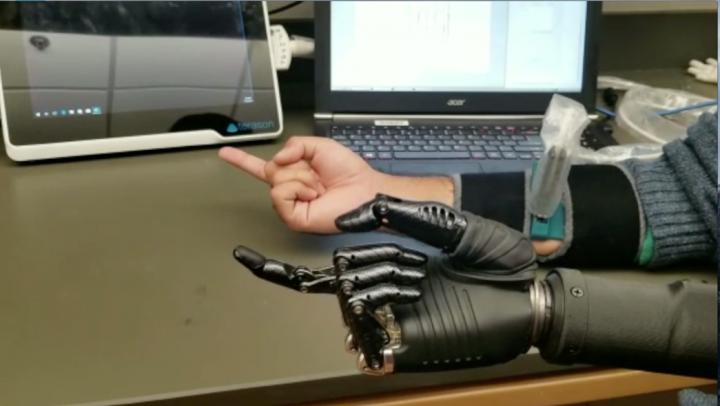
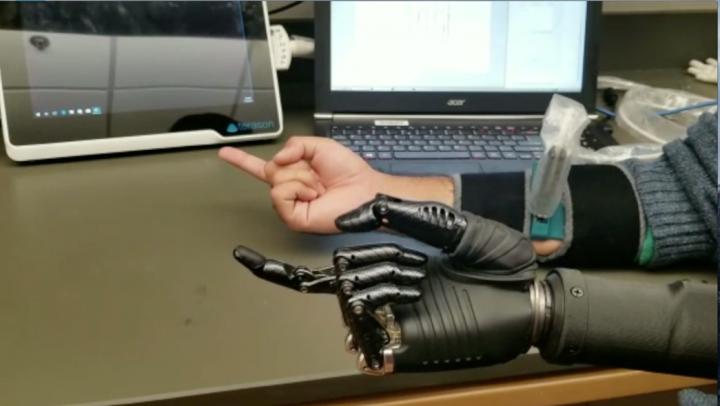
Credit: courtesy of George Mason University
There's hope for a better life for people who've lost an arm or leg, thanks to new research funded by the National Science Foundation and the Department of Defense.
George Mason University researchers are developing cutting-edge ultrasound technology to help people get greater control of prosthetics for their arms, hands, and legs.
"Our goal is to help amputees go about their daily lives with improved function," says Siddhartha Sikdar, an associate professor in the Department of Bioengineering at Mason Engineering. Sikdar has launched a pilot feasibility study with amputees who are using a new ultrasound-based system.
Currently, upper-body extremity prostheses (arm and hand) usually are controlled by an electrical method that senses muscle activity, he says. Electrodes on the skin surface pick up the electrical activity of muscles in the residual limb as the amputee attempts to perform movements.
The problem is that electrodes at the skin surface cannot readily differentiate between the signals from the many different muscles in the forearm that control the fingers and thumb.
Amputees often get discouraged by the limitations of this method, and one study showed about half don't use their expensive prostheses because the artificial limbs don't improve their quality of life, Sikdar says.
"It's really a shame because modern prosthetic hands are sophisticated systems," he says. "The biggest challenge has been to provide users with a reliable, noninvasive, and intuitive method to control these devices."
Sikdar's team has been investigating a new way of operating prostheses by using ultrasound waves to sense muscle activity. The research is funded by two $1 million grants, one from the National Science Foundation and one from the Department of Defense.
The team is designing and evaluating miniaturized ultrasound transducers, which are compact devices worn as a small band on the forearm or under the prosthetic shell.
The transducer sends sound waves into the body and senses the reflected sound waves. Then these signals are analyzed using computer algorithms to recognize muscle activity.
This method is able to sense muscle activity deep inside the tissue, and it differentiates between different muscle groups much better than electrodes on the surface of the skin.
Their laboratory research suggests that the ultrasound method allows for much dexterity in controlling upper body prosthetics, including fine-tuned motor control of the fingers and thumb, Sikdar says.
In the lab, they have shown that computer algorithms can use this ultrasound method to learn to accurately differentiate between 15 distinct hand and wrist movements. Users can robustly perform partial movements with high degree of control. "The military is funding this technology as a way to improve the lives of those who have been wounded in action," he says.
In another project, funded by the National Science Foundation, Sikdar's team is applying the ultrasound-based method for sensing muscle activity to develop new types of exoskeletons for people with spinal cord injuries.
They are also exploring several other areas of this research including developing simpler, less expensive upper-body extremity prosthetics; extending the ultrasound-based control methods to lower-limb prostheses; and training people to use the prosthetics by means of video games.
Sikdar has applied for patents on the work and is looking for ways to commercialize it if the latest research proves successful.
Eventually, these developments may help not only amputees in the United States but around the world. "Knowing that this technology can potentially help real people keeps us all highly motivated," he says.
###
About George Mason University
George Mason University is Virginia's largest public research university. Located near Washington, D.C., Mason enrolls 35,000 students from 130 countries and all 50 states. Mason has grown rapidly over the last half-century and is recognized for its innovation and entrepreneurship, remarkable diversity and commitment to accessibility. Learn more at http://www.gmu.edu.
Media Contact
Nanci Hellmich
[email protected]
703-217-4917
@GeorgeMasonNews
http://www.gmu.edu
Original Source
https://volgenau.gmu.edu/news/491531