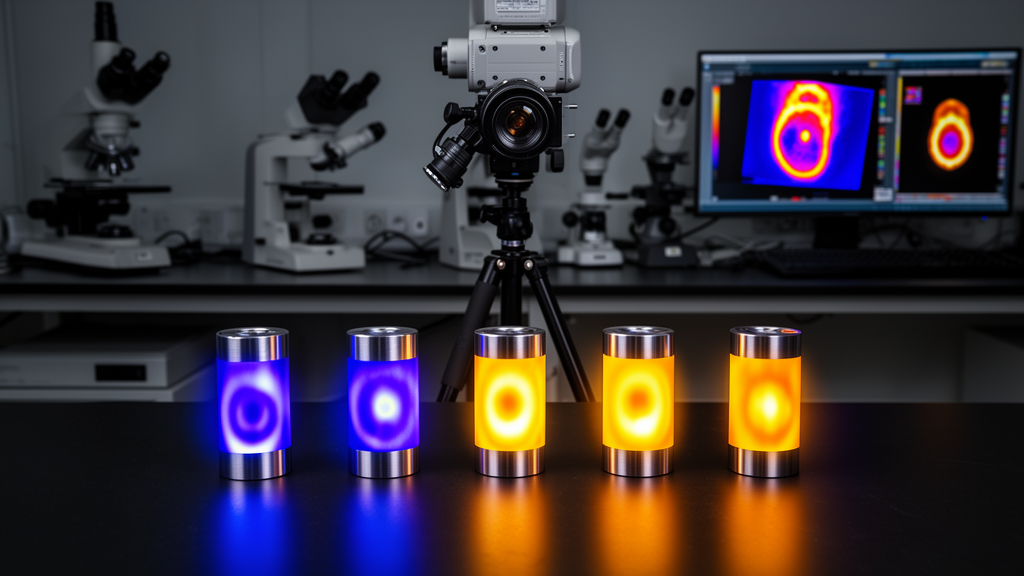
Accurate metal identification and classification serve as critical functions across industrial inspection, material sorting, and manufacturing quality control, where distinguishing between alloy types and base elements ensures operational safety and process standardization. Conventional analytical techniques frequently deployed in industrial metallurgy—such as X-ray fluorescence, magnetic induction spectroscopy, laser-induced breakdown spectroscopy, and Eddy current separation—offer established reliability but often demand substantial equipment investments, highly trained personnel, and prolonged processing times that hinder automated, high-throughput deployment. To address these operational constraints, an engineering research team based at SRM University-AP in India has developed an automated non-destructive sensing and classification framework that extracts temperature signatures from sequences of thermal images and processes the temporal patterns through hybrid deep learning architectures.
The physical principle underlying the system relies on the intrinsic thermodynamic properties governing each metal, specifically thermal conductivity and specific heat capacity. When subjected to external thermal stimulation, different metals exhibit distinct rates of heat absorption, thermal retention, and environmental heat dissipation. By observing these transient thermal responses under controlled environmental conditions, infrared sensing systems can capture discriminative temporal patterns without requiring direct physical or chemical contact with the specimens. While previous studies have paired thermal sensing with basic machine learning models or manual temperature transcription, earlier approaches faced limitations tied to handcrafted feature engineering, potential human recording errors, and the absence of structured, benchmarked time-temperature datasets designed specifically for temporal heating and cooling trajectories.
To establish a rigorous experimental foundation, the researchers collected thermal image sequences using a FLIR C5 infrared camera placed at a fixed distance of 20 centimeters from prepared metal samples. The laboratory environment was maintained at an ambient temperature of approximately 25 degrees Celsius without external ventilation to prevent erratic convective heat loss. Six distinct metallic materials—iron, aluminium, copper, brass, zinc, and lead—were machined into uniform cubes measuring 2 by 2 by 2 centimeters and polished prior to imaging to minimize surface reflectance and oxidation discrepancies. The specimens were systematically heated using a heat gun as a uniform thermal source and subsequently permitted to cool naturally. The camera captured frames at regular five-second intervals across both heating and cooling stages, documenting the progression of mean specimen temperatures.
Rather than relying on visual approximations or post-hoc color conversions from standard visual red-green-blue displays, the researchers engineered an automated extraction algorithm designed to read temperature data directly from the captured thermal image arrays. The algorithm locates the region of interest surrounding the target metal specimen within each frame, isolates the corresponding pixels, and computes the mean temperature across the selected region corresponding to that exact acquisition timestamp. This numerical extraction converts successive thermal frames into an organized tabular sequence of time-temperature data points. Sample observations recorded during the initial 25 seconds of heating illustrated distinct thermal paths: lead exhibited a rapid rise from 44.4 to 74.4 degrees Celsius, while aluminium rose more gradually from 29.4 to 33.3 degrees Celsius over the same span.
From these extracted readings, the team constructed a balanced and structured dataset comprising 6,000 total samples evenly distributed across the six metal classes, with each class contributing 1,000 instances split equally between 500 heating and 500 cooling sequences. Each sample entry recorded a starting timestamp, three successive relative time intervals, their corresponding numerical temperature values, an indicator designating whether the specimen was in a heating or cooling phase, and the verified metal category. The complete dataset was partitioned using an 80:20 train-test ratio, assigning 4,800 balanced samples to model training and setting aside an independent evaluation set of 1,200 samples—200 for each metal category—to enable a rigorous, unbiased assessment of model performance across both thermal regimes.
To classify the resulting multi-variate temporal records, the investigation designed and evaluated two distinct hybrid deep learning and ensemble learning pipelines. The primary architecture integrated PyTorch TabNet for representation learning on tabular thermal features, followed by a symmetrical Autoencoder designed to compress feature dimensions and suppress background noise, which fed into an extreme gradient boosting classifier configured with 500 estimators, a learning rate of 0.01, and a maximum tree depth of seven. The secondary framework combined a deep neural network consisting of three hidden layers with 64, 32, and 16 neurons with an ensemble Random Forest classifier containing 500 trees. Both pipelines were implemented in Python and utilized standard feature scaling to establish consistent baseline distributions across all input variables.
When assessed on the 1,200-sample test set, both proposed hybrid architectures demonstrated superior performance, achieving a classification accuracy, precision, recall, and weighted F1-score of 0.99. In comparison, traditional standalone classifiers achieved varied results on the identical dataset: Random Forest reached 0.98 accuracy, Decision Tree reached 0.96, Gradient Boosting recorded 0.93, and k-nearest neighbors achieved 0.90. Conversely, a standalone Vanilla Transformer achieved an accuracy of 0.91, while linear and probabilistic models struggled significantly with the non-linear thermal dynamics, with support vector machines reaching 0.73, logistic regression obtaining 0.46, Naive Bayes achieving 0.32, and unsupervised k-means clustering recording 0.13 accuracy.
Ablation experiments conducted on the TabNet-based pipeline isolated the specific contributions of each structural tier. Standalone extreme gradient boosting achieved an initial accuracy of 93.83 percent, which increased to 98.33 percent when integrated with TabNet feature representations. Incorporating the Autoencoder intermediate layer further elevated the complete framework to 99.02 percent accuracy, although an isolated Autoencoder combined directly with the tree classifier yielded only 82.00 percent, demonstrating that the compression layer required structured representation learning to produce effective features. In the secondary pipeline, an isolated deep neural network attained 92.58 percent accuracy, whereas pairing its learned hidden representations with the Random Forest classifier raised the classification accuracy from a baseline of 98.17 percent to 99.08 percent.
To evaluate classification stability across varying data splits, the researchers implemented a five-fold cross-validation analysis. Across the five folds, the TabNet, Autoencoder, and XGBoost pipeline demonstrated a mean accuracy of 98.55 percent with a standard deviation of 0.15 percent, with individual fold accuracies ranging between 98.4167 percent and 98.7500 percent. The deep neural network and Random Forest hybrid produced a mean cross-validation accuracy of 98.67 percent with a standard deviation of 0.29 percent, ranging between 98.2500 percent and 98.9167 percent across folds. Detailed confusion matrix analysis revealed that both hybrid models achieved perfect classification for aluminium, copper, iron, and lead samples, with the slight residual classification errors confined to minor confusion between brass and zinc specimens due to overlapping thermal dissipation behaviors.
To further examine reproducibility and assess whether the model performance had been artificially inflated by temporal correlation within the primary dataset, the team conducted two additional, completely independent heating and cooling experimental runs. When the previously trained models were evaluated on these fresh experimental datasets, both the TabNet-Autoencoder-XGBoost pipeline and the deep neural network-Random Forest model maintained consistent accuracy, precision, recall, and F1-score values of 0.99 across both independent trials. Standalone models exhibited slight fluctuations, with Random Forest and Decision Tree dropping slightly between 0.95 and 0.97 accuracy across runs, confirming that the hybrid deep architectures retained stable generalization when confronted with freshly gathered experimental time series.
The study authors noted several explicit physical and operational limitations associated with the current configuration. The methodology primarily aggregates pixel values into a single region-of-interest mean temperature over time, omitting spatial thermal distribution metrics such as local thermal gradients, pixel-level surface variations, and transient hotspot geometry. Furthermore, all experiments were conducted within a strictly controlled indoor environment using polished, identical cubic samples at a fixed camera distance of 20 centimeters. Consequently, future research will focus on assessing model performance across diverse ambient temperatures, varying detection distances, non-uniform sample geometries, and unpolished industrial surfaces, alongside benchmark comparisons against conventional spectroscopic equipment to evaluate long-term deployment viability.
Subject of Research: Automated thermal imaging and hybrid machine learning framework for metal classification
Article Title: A hybrid deep learning and ensemble framework for thermal image-based metal detection and classification system
Article References: Chiluveru, S. R., Kumari, U., Halkarni, S. S., & Rana, S. (2026). A hybrid deep learning and ensemble framework for thermal image-based metal detection and classification system. Frontiers in Computer Science, 8, Article 1953285. https://doi.org/10.3389/fcomp.2026.1953285
Image Credits: AI Generated
DOI: 10.3389/fcomp.2026.1953285
Keywords: Thermal Imaging, Metal Classification, Machine Learning, Deep Learning, Ensemble Learning, TabNet, Autoencoder, XGBoost, Random Forest, Deep Neural Networks, Non-Destructive Testing, Computer Vision, Infrared Sensing, Material Sorting, Quality Control, Thermal Conductivity
News Source: Blake Davidson. (November 13, 2026). Hybrid Machine Learning Models Identify Six Metals from Thermal Images with High Accuracy. Scienmag.