In a retrospective clinical study, researchers found that intrinsic nodule composition and vascular architecture, rather than initial size, were independently associated with treatment success following ultrasound-guided microwave ablation of benign thyroid nodules. The investigation evaluated eighty consecutive patients who completed twelve months of follow-up after undergoing thermal ablation for cytologically benign Bethesda category II lesions in Türkiye. The primary outcome, defined as achieving a volume reduction ratio of at least seventy-five percent at twelve months, was reached by thirty-five percent of the cohort, while all treated nodules achieved at least fifty percent reduction. Multivariable analysis demonstrated that predominantly cystic lesions and those exhibiting lower baseline vascularity had significantly higher odds of achieving treatment success. In contrast, baseline nodule volume showed no significant correlation with volume reduction, suggesting that pre-procedural sonographic assessment of tissue composition and blood flow provides valuable predictive guidance.
Thyroid nodules are common clinical findings in adults, with high-frequency ultrasonographic screening detecting lesions in up to sixty-eight percent of evaluated individuals. Conventional management has historically relied on surgical resection via hemithyroidectomy or total thyroidectomy. Driven by the goal of preserving functional thyroid tissue while avoiding surgical morbidity, image-guided percutaneous thermal ablation technologies have emerged as tissue-sparing alternatives. Modalities including radiofrequency ablation, laser photocoagulation, and microwave ablation offer targeted thermal destruction under direct visualization, presenting reasonable options for patients who decline surgery or are deemed poor surgical candidates.
Furthermore, microwave technology is less susceptible to tissue electrical impedance, charring, and perfusion-mediated heat-sink effects caused by adjacent blood vessels. These properties may be advantageous in large nodules and in lesions with a high fluid content. In published clinical literature, microwave ablation and radiofrequency ablation exhibit comparable safety and complication profiles. However, pooled comparative data have not demonstrated superior volume shrinkage for microwave systems, showing similar volume reduction ratios during early follow-up and slightly higher reduction with radiofrequency ablation at six and twelve months, underscoring the need to identify specific determinants of microwave response.
Despite the increasing clinical adoption of microwave ablation for benign thyroid nodules, therapeutic outcomes continue to exhibit marked variability across series. While baseline volume, vascularity, internal architecture, and delivered energy have been proposed as determinants of volume reduction and regrowth, most predictive analyses have been derived from radiofrequency ablation cohorts. Existing microwave evidence remains limited and inconsistent. Prior studies by Fu and colleagues examined procedural efficacy, Zhang and associates linked outcomes to contrast-enhanced ultrasound perfusion patterns, and Mei and coworkers identified the energy-to-volume ratio rather than Doppler vascularity as the main predictive variable. Because these studies evaluated differing variables and reached conflicting conclusions, it remained unclear whether nodule composition and vascularity independently influence microwave response. The present study addressed this question by evaluating nodule composition, Doppler vascularity, baseline volume, total applied energy, and energy-to-volume ratio together in a multivariable model.
The investigation was conducted as an institutional review board-approved retrospective observational study of consecutive patients who underwent microwave ablation for benign thyroid nodules between December 2023 and December 2024. All participants had cytologically verified Bethesda category II classifications on fine-needle aspiration biopsy, presented with compressive symptoms or cosmetic concerns, and completed twelve months of follow-up. In nodules exhibiting cystic components, biopsy was targeted to the solid portion, and chemical ethanol ablation was withheld because all predominantly cystic lesions possessed solid elements warranting thermal destruction. Patients with prior thyroid interventions, including surgery, radiofrequency ablation, or ethanol ablation, were excluded to isolate primary treatment response. Additional exclusion criteria comprised Bethesda category III or higher cytology, toxic nodules, Graves disease, pregnancy, lactation, and incomplete follow-up. Among ninety consecutive treated individuals, ten failed to complete twelve-month follow-up and were excluded, leaving eighty patients for final analysis.
Pre-procedural ultrasonographic evaluation was performed using a Siemens Acuson S2000 system equipped with a VF13-5 linear transducer, operated by an interventional radiologist with ten years of ultrasound experience who also performed the ablations. Baseline nodule volume was calculated from three orthogonal measurements using the ellipsoid formula. Nodules were classified by grayscale characteristics as predominantly cystic, solid, or mixed lesions. Predominantly cystic nodules constituted 38.8 percent of the cohort, solid nodules represented 35.0 percent, and mixed nodules accounted for 26.3 percent. Color Doppler sonography evaluated intranodular and peripheral flow, categorizing vascularity into low indicating absent or minimal flow, moderate denoting signals in less than half of the nodule, and high reflecting signals in more than half of the lesion. In the study cohort, moderate vascularity was observed in 48.8 percent, low vascularity in 27.5 percent, and high vascularity in 23.8 percent.
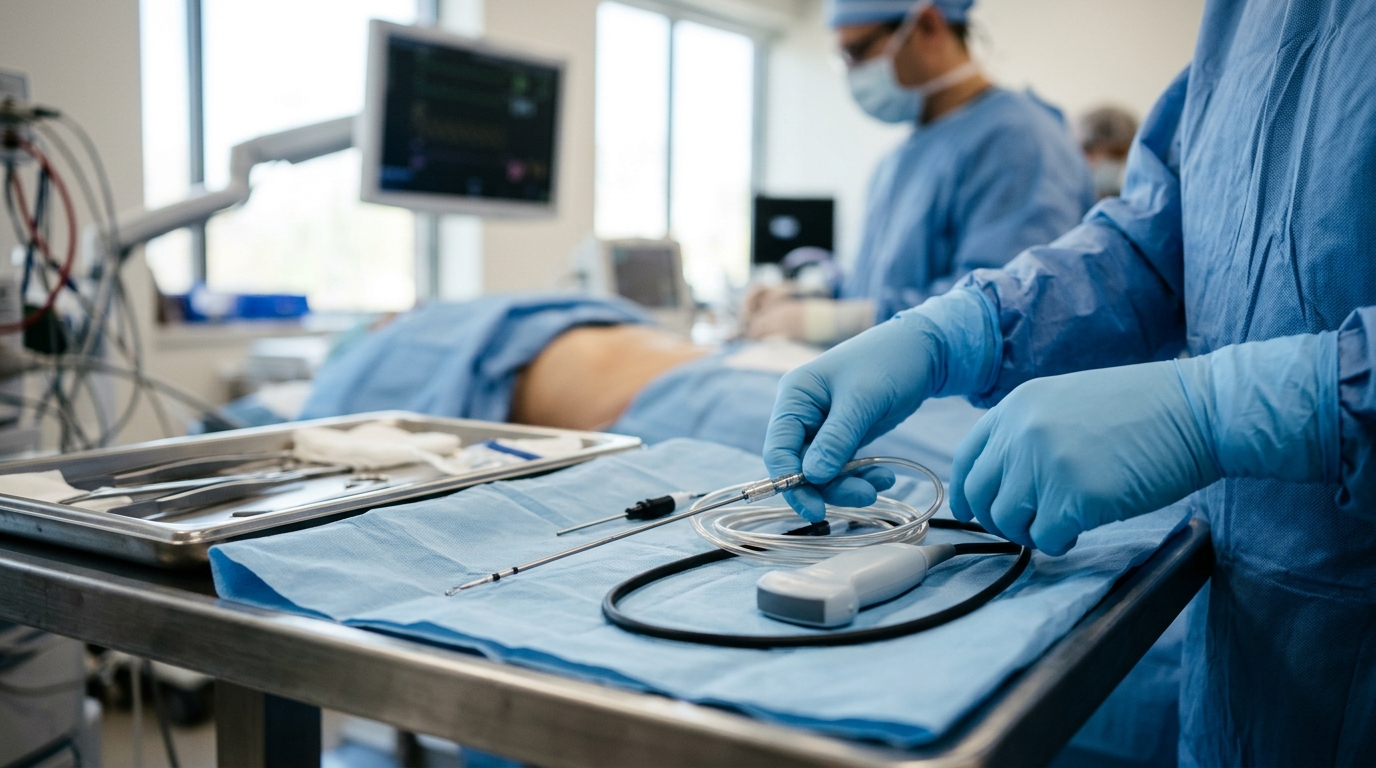
Ablations were performed under local anesthesia and ultrasound guidance using a Canyon Medical microwave system with an internally water-cooled sixteen-gauge or eighteen-gauge antenna featuring a three-millimeter active tip. Applied power ranged between twenty and forty watts based on lesion dimensions and structure. Protective hydrodissection using a starch-containing solution was administered to insulate the thyroid gland from adjacent vital neck structures. In nodules possessing cystic cavities, fluid aspiration was performed immediately before ablation, and baseline volume was measured post-aspiration so that volume reduction reflected thermal ablation rather than fluid evacuation. Total applied energy was calculated as the product of power and duration, while the energy-to-volume ratio was derived by dividing total energy by baseline volume. Patients were monitored for two hours before discharge.
Follow-up evaluations took place at one, three, six, and twelve months post-procedure, recording volume changes and calculating the volume reduction ratio. Mean volume reduction ratio increased progressively from 26.2 percent at one month to 45.6 percent at three months, 58.9 percent at six months, and 72.5 percent at twelve months. While all eighty nodules achieved a volume reduction of at least fifty percent, twenty-eight patients, or 35.0 percent, met the primary success threshold of seventy-five percent reduction. Regrowth, defined as any volume increase from the smallest recorded nadir, occurred in twenty patients (25.0 percent). Eleven patients (13.8 percent) underwent repeat ablation, whereas nine asymptomatic patients declined retreatment. Four minor complications occurred, representing a 5.0 percent complication rate comprising two cases of pain, one hematoma, and one transient hoarseness, all resolving completely without permanent nerve injury or thyroid dysfunction.
Statistical analysis demonstrated no significant Pearson correlation between baseline nodule volume and twelve-month volume reduction ratio (r = 0.102, p = 0.367), indicating that starting nodule size within the studied range of 4.05 to 19.41 milliliters was not associated with outcome. In multivariable logistic regression modeling of five pre-specified variables, nodule composition and vascularity grade were independently associated with treatment success. Predominantly cystic nodules were significantly more likely than solid nodules to achieve success, with an odds ratio of 2.785 (95 percent confidence interval 1.297 to 5.980, p = 0.009). Conversely, high vascularity was associated with a lower likelihood of success compared with low-to-moderate vascularity (odds ratio 0.350, 95 percent confidence interval 0.148 to 0.827, p = 0.017). Baseline volume (p = 0.494), total applied energy (p = 0.277), and energy-to-volume ratio (p = 0.430) showed no significant association with treatment success.
In discussing these findings, the investigators hypothesized that fluid content in predominantly cystic nodules might facilitate uniform heat distribution, whereas solid tissue may restrict thermal propagation. Additionally, highly vascular nodules may dissipate thermal energy through perfusion-mediated cooling—the heat-sink effect—thereby reducing coagulative efficacy. Although these mechanisms remain hypothetical because local tissue temperatures were not directly measured, they align with radiofrequency observations by Baek and colleagues and microwave findings by Zhang and associates. The lack of association with the energy-to-volume ratio, contrasting with observations by Mei and coworkers, may reflect linear modeling assumptions, sample size constraints, or collinearity among technical variables. The authors emphasized that because all predominantly cystic nodules contained solid components, these favorable microwave outcomes cannot be extrapolated to purely cystic lesions, for which percutaneous ethanol ablation remains the established first-line intervention.
The authors recognized several methodological limitations that temper the clinical interpretation of their results. The retrospective single-center design lacked a surgical or alternative ablation control group, precluding comparative efficacy assertions and causal determinations. All procedures were conducted by a single operator, leaving inter-operator variability and potential learning-curve influences unassessed. Follow-up was restricted to twelve months, preventing appraisal of late recurrence, while the exclusion of ten patients lost to follow-up introduced potential attrition bias. The multivariable model had an events-per-variable ratio of 5.6 across twenty-eight success events, increasing overfitting risk, and potential multicollinearity among volume and energy metrics was not formally tested. Furthermore, the model was not adjusted for confounders such as age, sex, or calcification, and vascularity grading relied on an unvalidated semi-quantitative scale without blinded evaluation. The authors concluded that prospective multicenter trials with longer follow-up are needed to confirm these findings.
Subject of Research: Microwave ablation outcomes for benign thyroid nodules
Article Title: Factors associated with treatment response to microwave ablation of benign thyroid nodules: a retrospective single-center study of nodule composition and vascularity
Article References: Demir, M., Demir, F., Altay, C. M., Onay, M., & Binboğa, A. B. (2026). Factors associated with treatment response to microwave ablation of benign thyroid nodules: a retrospective single-center study of nodule composition and vascularity. Frontiers in Endocrinology, 17, Article 1956986. https://doi.org/10.3389/fendo.2026.1956986
Image Credits: AI Generated
DOI: 10.3389/fendo.2026.1956986
Keywords: thyroid nodules, microwave ablation, interventional radiology, volume reduction ratio, ultrasound guidance, benign thyroid disease, Doppler vascularity, thermal ablation, Factors, associated, treatment, response
News Source: Ophelia Keating. (November 13, 2026). Thyroid Nodule Composition and Blood Flow Influence Microwave Ablation Success. Scienmag.