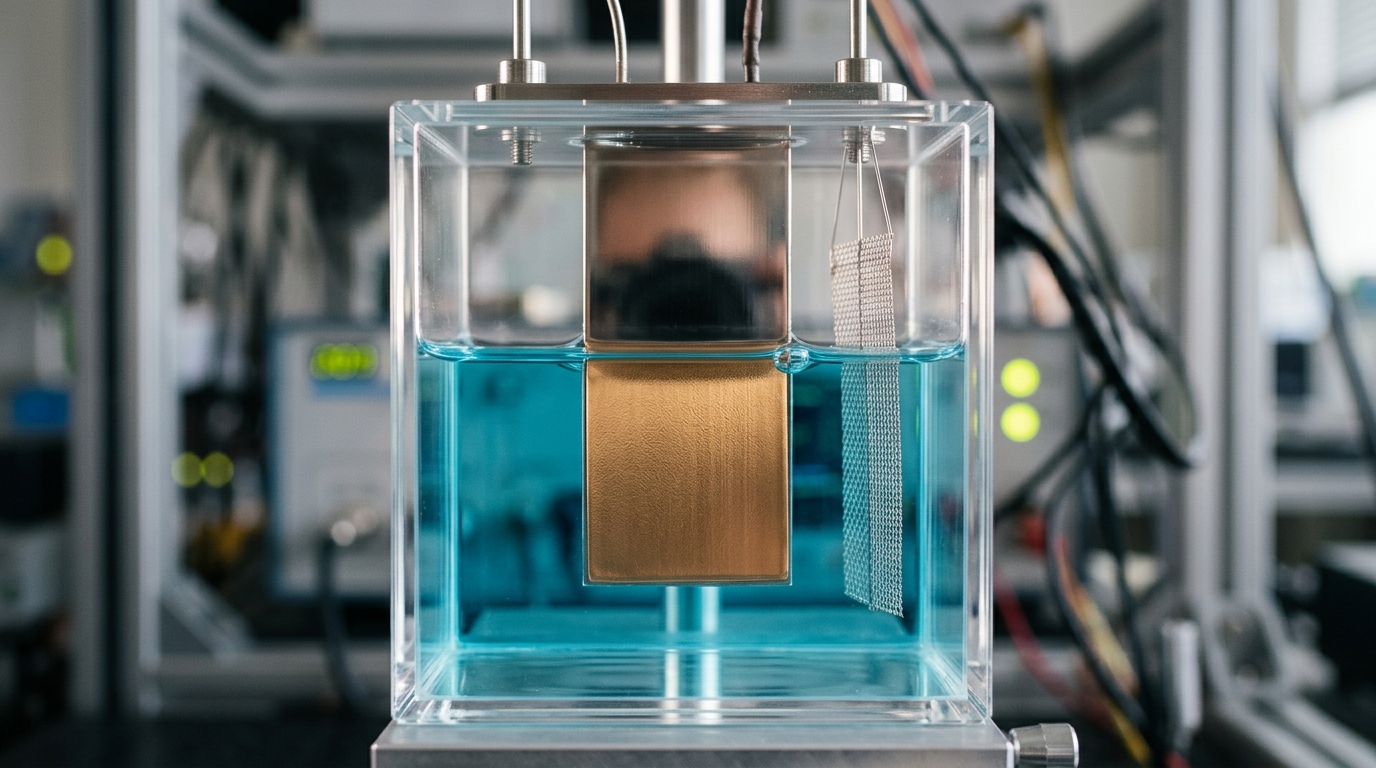
The study, published in Advanced Modeling and Simulation in Engineering Sciences, demonstrates that the common technique of averaging pulsed currents to match direct-current models can predict physically impossible negative concentrations of metal ions. This theoretical investigation provides a corrected methodology that ensures physical accuracy in simulations of electrodeposition processes.
Electroplated coatings are essential for corrosion protection, wear resistance, and decorative finishes in various industrial applications. As requirements for coating homogeneity and quality increase, the reliance on mathematical simulations to predict deposition behavior has grown significantly. While models for direct-current deposition are well-established, pulse plating, which uses periodically modulated currents to improve coating quality, has traditionally been modeled by identifying it with a direct-current model through an averaging technique.
The core of the issue lies in the diffusion boundary layer, a thin region near the cathode where the deposition process is dominated by the diffusion of free metal ions. Standard models describe this layer using Fick’s second law, a partial differential equation that governs how concentration changes over time and space. For direct-current models, the limiting current density is well-known and represents the maximum current that can be effectively used for deposition before side reactions occur. For pulse plating, researchers have often used the average current to deduce this limit from direct-current formulas.
Stephan D. Schwöbel, Thomas Mehner, and Thomas Lampke investigated whether this averaging scheme holds true in general. Their analysis revealed that for high current distributions, the identification of a physical direct-current model with an unphysical pulse-plating model leads to significant errors. Specifically, when the averaged current is set to the limiting current density for direct current, the corresponding pulse-plating model predicts that the concentration of free metal ions at the cathode becomes negative. Since negative concentrations are physically impossible, this indicates that the standard averaging technique overestimates the maximum applicable current density for pulse plating.
To address this, the authors derived a new model formulation based on obstacle problems. This mathematical framework enforces non-negativity of the concentration as a constraint within the optimization problem. By reformulating the diffusion process as a restrained optimization problem, the model guarantees that the predicted concentration distributions remain physical, even under high current densities where traditional models fail. This approach avoids the need to introduce ad-hoc corrections for side reactions to mask the unphysical predictions of the original model.
The study also developed a numerical methodology to simulate these models directly. The team used Rothe’s method for time discretization and Lagrange interpolation functions for spatial discretization, resulting in a system of stationary diffusion-reaction problems. For the obstacle problem formulation, they applied a primal-dual active set strategy to solve the resulting discrete optimization problems. This numerical scheme is designed to be easy to implement and does not rely on specific assumptions about the pulse form, making it applicable to a wide range of pulsed current regimes.
To verify their findings, the researchers applied their methodology to a specific counterexample involving rectangular pulses. They used realistic parameters for the diffusion boundary layer thickness, diffusion coefficient, and pulse timing. The simulation showed that while the direct-current model remained physical at the limiting current, the pulse-plating model using the averaging technique predicted negative concentrations. In contrast, the new obstacle problem model produced a physically plausible concentration distribution that remained non-negative throughout the process.
Furthermore, the authors derived an inverse problem to compute the maximal applicable current density for pulse plating. This optimal control problem minimizes the concentration at the cathode at the end of the pulse-on phase, subject to the physical constraints of the diffusion process. By solving this inverse problem numerically, they determined a maximal current density that is significantly lower than the value predicted by the averaging technique. For the example parameter set, the inverse problem yielded a maximal current density of approximately 7.86 A/dm², whereas the averaging technique predicted a value of about 8.58 A/dm², representing a relative error of 8.38%.
The study highlights that the deviation between the two predictions is significant and has practical implications for industrial electroplating. Using the overestimated current density from the averaging technique would lead to ineffective deposition and increased side reactions, such as hydrogen evolution, which can degrade coating quality. The new methodology provides a more accurate tool for optimizing pulse plating parameters, ensuring that the applied current is within the physically effective range.
The authors note that their model is a simplification of reality, assuming a laminar boundary layer and neglecting certain fluid dynamic effects and temperature gradients. However, the methodology serves as a crucial stepping stone for more complex models. It can be extended to include other technical aspects, such as optimizing the aspect ratio of pulse on and off times for given current densities. The existence theory for the inverse problem is still under development, but the numerical experiments indicate unique solutions for the tested cases.
This research contributes to the theoretical foundation of electrochemical modeling by providing a rigorous framework for handling non-linear constraints in diffusion processes. The developed numerical methods are versatile and can be adapted to other current regimes, not just rectangular pulses. By ensuring the physicality of the models, the study enhances the reliability of simulations used in the design and optimization of electroplating processes.
The findings underscore the importance of direct simulation over indirect identification techniques in complex electrochemical systems. As industrial applications demand higher precision in coating properties, the ability to accurately model the diffusion boundary layer under pulsed conditions becomes increasingly vital. This work offers a robust alternative to traditional averaging methods, providing engineers and scientists with a more accurate means of predicting deposition behavior and optimizing process parameters.
The diffusion boundary layer, a thin region surrounding the cathode where deposition is dominated by diffusion, is typically assumed to have a thickness between 20 and 200 micrometers. In the specific counterexample used to test the averaging technique, the authors fixed this thickness at 60 micrometers and simulated a process duration of 100 seconds. The diffusion coefficients for free metal ions in practical applications generally range from 10 to the power of negative 12 to 10 to the power of negative 8 square meters per second. The pulse parameters for the test case were set with an on-time of 0.15 seconds and an off-time of 0.25 seconds, creating a total period of 0.4 seconds. These parameters were selected to reflect realistic industrial conditions while allowing for a clear demonstration of the model’s limitations under high current densities.
The standard diffusion boundary model relies on Fick’s second law to describe the concentration distribution of free metal ions. The model assumes that the bulk concentration of these ions is constant and determined by thermodynamic equilibrium. The deposition reaction at the cathode is governed by Faraday’s law, which links the current density to the material transport across the boundary. For direct current, the limiting current density is derived from the diffusion coefficient, charge number, Faraday’s constant, bulk concentration, and boundary layer thickness. This value represents the maximum current that can be effectively used for electrodeposition before the concentration at the cathode reaches zero. When the current exceeds this limit, the model predicts negative concentrations, which are physically impossible and indicate that side reactions are being forced by transport limitations.
The averaging technique identifies the pulse plating model with a direct current model by using a constant, averaged current density. For rectangular pulses, this average is calculated by multiplying the on-current by the ratio of the on-time to the total period. The inverse relationship allows the on-current to be computed from the average. The study demonstrates that this identification fails when the average current is set to the direct current limiting value. In this scenario, the direct current model remains physical, with the concentration converging to zero from above. However, the corresponding pulse plating model predicts negative concentrations at the cathode, particularly during the on-phase. This discrepancy highlights that the averaging technique can lead to unphysical behavior and overestimates the maximum applicable current for pulse plating.
The obstacle problem formulation addresses this issue by enforcing non-negativity as a constraint within the optimization framework. This reformulation ensures that the concentration distribution remains physical even when high current densities are applied. The numerical treatment of this problem uses a primal-dual active set strategy, which is efficient for solving the resulting discrete optimization problems. The method is versatile and does not depend on specific pulse forms, making it suitable for various pulsed current regimes. The simulation results for the obstacle problem show a concentration distribution that stays non-negative throughout the process, confirming the physical plausibility of the model. This approach provides a robust alternative to ad-hoc corrections that attempt to mask unphysical predictions by introducing additional electrode reactions.
The inverse problem derived in the study computes the maximal applicable current density by minimizing the concentration at the cathode at the end of the pulse-on phase. This is subject to the physical constraints of the diffusion process and the periodicity of the pulse. The numerical solution of this inverse problem yields a maximal current density that is lower than the value predicted by the averaging technique. For the example parameter set, the inverse problem resulted in a maximal current density of approximately 7.86 A/dm², compared to 8.58 A/dm² from the averaging method. This difference of 8.38% relative error is significant and has practical implications for industrial electroplating. Using the overestimated current from the averaging technique would lead to ineffective deposition and increased side reactions, such as hydrogen evolution, which can degrade coating quality.
The authors acknowledge that the diffusion boundary layer model is a simplification of reality. It assumes a laminar boundary layer and neglects certain fluid dynamic effects, such as turbulence and temperature gradients. The thickness of the diffusion boundary layer is often unknown and must be measured separately using electrochemical methods, such as the rotating disc electrode. These methods can be influenced by side reactions, such as hydrogen development, which complicates the measurement. Despite these limitations, the methodology provides a rigorous framework for handling non-linear constraints in diffusion processes. It serves as a stepping stone for more complex models that can include additional technical aspects, such as optimizing the aspect ratio of pulse on and off times. The existence theory for the inverse problem is still under development, but the numerical experiments indicate unique solutions for the tested cases.
Subject of Research: Theoretical modeling and numerical simulation of electrochemical pulse plating in diffusion boundary layers
Article Title: Theoretical investigations and methodology for modeling and direct simulation of electrochemical pulse plating in the diffusion boundary layer
Article References: Schwöbel, S. D., Mehner, T., & Lampke, T. (2025). Theoretical investigations and methodology for modeling and direct simulation of electrochemical pulse plating in the diffusion boundary layer. Advanced Modeling and Simulation in Engineering Sciences, 12(1), Article 25. https://doi.org/10.1186/s40323-025-00309-2
Image Credits: AI Generated
DOI: 10.1186/s40323-025-00309-2
Keywords: electrochemical pulse plating, diffusion boundary layer, mathematical modeling, numerical simulation, obstacle problem, electrodeposition, limiting current density, Fick's second law, optimal control, industrial electroplating, Theoretical, investigations
News Source: Denise Maddox. (November 13, 2026). New Model Corrects Errors in Pulse Plating Current Limits. Scienmag.